Tuesday, 1 August 2017

Dragon Slayer: The Legend of Heroes - NEC TurboGrafx-CD - 1992


Dragon Slayer: The Legend of Heroes is the sixth installment in the Dragon Slayer series of RPGs.  Its initial release was in 1989 for the NEC PC-8801 before being converted to other computers and consoles.  The English translation was released on the NEC TurboGrafx-CD in 1992.

The game takes the usual JRPG format of top-down scrolling dungeons and overworld, with turn-based battles.  The overworld is not obviously grid-based like the NES Final Fantasy games I have played and allows eight way scrolling.  I also think the overworld is at least semi turn-based in that if you stand still long enough you will get a random encounter.  

Combat is turn based with the usual options of attack, magic, item, defence, run etc.  When a character and monster will take their action is mostly dependent on their Speed attribute.  With combat over you are awarded an amount of XP and gold.  If you run, the enemy remains viewable on the overworld map and can re-engage in combat. Levelling is automatic and you gain increases in Hit Points and Magic Points which are also fully replenished.  Each time you level up, your attributes also increase by 1 or 2 points.  

If in combat a member of your party should reach 0 Hit Points they fall unconscious.  If the enemies are defeated that character wakes up after the battle with 1 HP.  If the whole party is unconscious you are given the choice of restarting the battle or returning to the last town visited.  You cannot die in Dragon Slayer.

Magic spells can be collected from certain NPCs and are added to your spellbook.  Any character can use any spell and each takes a certain amount of Magic Points to cast.  There are lots of spells available with different powers but slots in the spellbook are limited.

A narrated intro sets the scene for the game.  The land of Farlayne was invaded by monsters and an epic battle ensued.  The monsters were defeated but King Corwin was killed.  Five year old Prince Logan was considered too young to rule the kingdom so Baron Drax declared he would rule as regent until Logan came of age.  Fearing for his safety, Logan was taken to the town of Exile.  That was 10 years ago....

Baron Drax announces that he is to become regent.


The game begins in Exile with the player taking the role of crown Prince Logan.  You are being prepared to take over as ruler on your upcoming sixteenth birthday.  Suddenly the town comes under attack by a horde of monsters.  You are ushered through a secret passage by your adviser and a told to make your way to the castle to request reinforcements from Baron Drax.  It turns out Baron Drax (with a name like that he was never going to be a goody was he?) sent the monsters to destroy Exile.  He intends to keep the crown for himself and to marry your mother.  He didn't expect you to escape alive so throws you in the dungeons and will use your life as a bargaining chip to force your mother to marry him.

It doesn't take long for the resistance to show up and spring you from jail.  You flee to their secret headquarters in the town of Revere.  The leader tasks you with heading to The Pits where you can free the slaves to help fight Drax and his guards.  He also makes no secret of the need to grind.... 

While grinding I discover this first section of the game is set on an island.  All the ships are conveniently guarded to stop you getting ahead of the plot.  I did find the town of Nigel where I could buy better weapons and armour.  I also discovered why I got my Level 8 arse kicked at The Pits....

After more grinding I freed the slaves and we headed to the castle to take on Drax.  We caught up with him but he escaped by ship saying he had plans to take over the whole world.  And so ends Chapter 1.  I will note my thoughts below...
  • After Chapter 1 it is not necessary to do a lot of grinding - it helps if you want the best weapons and items but is not really a requirement due to the amount of random encounters. Combat can be tough and the differing strengths of your party members can make it quite tactical in how to deal with the different enemies.
  • I like the way the scripted events use the game engine so as not to spoil immersion.  Most of these events use voice acting, the majority of which is truly awful.
  • The game is divided into several chapters, each set on a particular area and usually ending in a boss fight.  Once the chapter is completed, the next area is opened up.  Completing a chapter clears all the monsters from the land so you need to go onto the next section if you want to grind.  Previously completed areas are still accessible.
  • Coming on a CD I expected the game to have better music than it does.  It's not very varied and none of it is particularly memorable.  The tune that plays when you are in the presence of royalty is also quite short and is a little irritating when it ends then restarts.  In quality it doesn't sound much better than a chip tune to my ears.
  • Unusually for the time you can save the game absolutely anywhere.  No more traipsing to the nearest inn/palace/temple or whatever.
  • One thing I like is that you can immediately compare attack and defence values of weapons and armour just by equipping them.  It makes choosing the best items a lot easier.
  • Most towns have a Temple but they don't offer any services and seem to exist just for comedic purposes....

  • Igniting a torch to traverse dungeons sends out a circle of light that gradually reduces in size as the torch burns down.  It's a nice touch and makes a change from other games where you can freely travel underground with no light source.
The circle of torch light gradually gets smaller over time making it harder to navigate and avoid monsters.

  • Finally, an RPG without a broken economy.  As you progress through the game new weapons and armour become available.  Including selling the old gear, I can usually only afford to outfit two characters with all new equipment.  Yes, you can grind for money if you have the patience.  Even at the end game I had a couple of characters using outdated pieces of kit.
And there was me thinking I was rich.

  • For a JRPG (or any contemporary RPG for that matter) the game is very flexible in the way it can be played.....
* When a character levels up the game automatically distributes points among the attributes (Strength, Intelligence, Speed, Luck).  This can be set to manual so you can allot the points yourself.
* There are no character classes and any character is able to wield any weapon, wear any armour and learn any spell.  With the above you can mould your party members as you wish (eg. put points into strength for a combat oriented character).
* If you get fed up with the combat you can set  one or more of the characters in your party to fight automatically.
* The Warp Wing item or Warp spell allows you to instantly travel to any town, dungeon, or tower you have already visited.  This takes the pain out of backtracking between locations.
* Don't like the random encounters?  The TELE-LENS shows the groups of wandering monsters on the overworld map for a certain amount of time.  The SPY SCOPE is a one-shot item that permanently displays them.  The party moves faster than monsters so they can be avoided or confronted as you wish.
Activating the TELE-LENS or SPY SCOPE shows blue blobs representing groups of wandering monsters.

It came as no surprise that Baron Drax was not the ultimate protagonist (this being a JRPG after all).  After defeating Drax you soon discover the big bad is a dragon called Naja.  Naja can only be defeated using Sword Blaze of which there are two.  Naja can be found after a long trek through a dungeon and labyrinth filled with tough monsters.  I used up most of my potions defeating the dragon only to find it was Naja's twin.  Naja was found in the next room and kicked my arse when my potions ran out.  This was useful as when the party died I could choose to restart the battle or return to town.  Back in the town I stocked up with potions, warped back to Naja's hideout and tried again.  The fight took a long time as only Logan and Giles could do any damage with the Sword Blaze weapons.  Even with spells negated and Ethan and Sonia doling out potions every round, Naja did more damage than I could heal, but I eventually defeated him with one party member down.  The end.....


Dragon Slayer: The Legend of Heroes is one of the most enjoyable JRPGs I have played so far for my blog.  It has great graphics, varied enemies, a good story and is a decent challenge.  It also has a fair amount of humour and some memorable NPCs.  Okay, the sound is not great, but the music is bearable and the voice acting only appears at key plot points.  It also makes a change to find a PC Engine / TurboGrafx title that's not an arcade game.

Friday, 14 July 2017

Dizzy: Prince of the YolkFolk - Commodore Amiga - 1992


With a main entry in the  Dizzy series you know exactly what you are going to get - a fairly easy adventure game combining platforming, inventory based puzzles and slightly awkward controls.  Dizzy: Prince of the YolkFolk is no exception.

The game was first released in 1991 for the Sinclair Spectrum, Commodore 64 and Amstrad CPC and was highly regarded at the time.  In 1992 it was converted to the Commodore Amiga, Atari ST and DOS.  A Nintendo NES version followed in 1993.  Finally an HD remake appeared in 2011 for the iOS and Android platforms.  I'm not interested in smartphone gaming on my blog so the winner of this lot is the Commodore Amiga.  Normally a game such as this would look the same on the Atari ST but Codemasters went to the extra effort of adding more colours to the Amiga version, notably the graduated sky.  It also has the nicest music playing throughout - much better than the grating Atari ST chiptune.  The graphics on the DOS version are on a par with the ST, both looking better than the NES.  The release on the three 8-bit home computers hadn't really progressed in terms of looks since the original Dizzy from 1988 so come bottom of the pile.

The manual says that Grand Dizzy was feeling down so Dizzy and Daisy decided to bake him a cherry pie.  However, Pogie the fluffle (whatever that may be) had stolen the cherries and ran off into the enchanted forest.  Dizzy and Daisy chased after Pogie and decided to gather more cherries at the same time.  They were soon lost but came across a seemingly deserted castle.  Daisy pricked herself on a mystic spinning wheel and felt sleepy.  She found a bed where she fell asleep.  Before Dizzy could wake her he was captured by Rockwart the troll and placed in an underground prison where the game begins.  Your goal is to escape from your cell and awaken Daisy.
Ah, so that's what a fluffle is.

Dizzy starts the game with three lives and a full energy bar.  Energy is lost by touching an enemy and a life is lost once it is depleted.  A life is also lost if Dizzy ends up falling into water.  No damage is taken when falling from any height (even from heaven).
A convenient path through the clouds leads you to the pearly gates.  You can fall from here without damage.

Most of the puzzles contained in Dizzy: Prince of the Yolkfolk are fairly logical and are mainly solved by using the right item in the right place.  The items are scattered around the flick screen map along with a few red herrings.  Your starting prison cell is blocked by a locked door, but when it contains a pile of leaves, a match and a bucket of water it is pretty obvious how to escape.  Most puzzles follow this pattern so it is a comparatively easy game to complete.  The game also seems a bit shorter than previous Dizzy outings mostly down to the smaller map.

On your way to waking Daisy you must collect 20 cherries to complete the game.  Cherries also restore your energy bar if it gets sapped in any way.  Additionally there are stars and coins to collect for extra points.

To be honest Dizzy is not that much different from previous games in the series (including the awkward somersault action that can make judging some jumps a pain).  Saying that, I can't in all good conscience leave Dizzy: Prince of the Yolkfolk out of my blog when I have included some of his earlier adventures.

After waking daisy you visit Grand Dizzy and bake him the pie

Example gameplay....

Monday, 5 June 2017

Desert Strike: Return to the Gulf - Sega Mega Drive (1992) & Commodore Amiga (1993)


Desert Strike: Return to the Gulf was released in the first half of 1992, a year after Operation Desert Storm had ended and with the Middle East still fresh in mind. The plot involves a Middle Eastern despot invading a small Emirate and trying to gain weapons of mass destruction.  Some could accuse EA of shamelessly cashing in on these appalling events.  Whatever, it turned out to be the most successful game they had yet produced.

On my shortlist I had the Sega Mega Drive original and conversions for the Sega Master System, Super Nintendo and Commodore Amiga.

The Sega Mega Drive was the first version of the game and was released early in 1992 with the first conversions arriving later in the year.  It could be described as the definitive version of the game with great graphics and sound, and slick controls.  Although I had never played it before if felt familiar.  It then dawned on me it played pretty much like cross between Cyclone and Raid on Bungeling Bay.

I played the Master System version next which, it has to be said, was not very good.  It could not compete with any of the 16-bit versions here and was quite basic in all areas.
The Master System is a poor mans Desert Strike.  The helicopter doesn't even have a shadow.
I really liked the look of the SNES version at first, with its nice big helicopter sprite.  I quickly realised it was only big due to the lower resolution graphics.  The display has a zoomed-in look and therefore doesn't show as much of the play area as the Mega Drive version.  Little touches are also missing such as the wake from the ship you start the game from.  Gameplay is more or less the same as the original.
Desert Strike on the SNES.  Plays pretty much the same as the Mega Drive game but at a lower resolution.
The Commodore Amiga version appeared in 1993.  To quote the manual - 'when it came to designing the Amiga version of Desert Strike there was one question on everybody's lips - what can be done to improve the game?'.  For starters they used the Extra Half-Brite Graphics mode to display 64 simultaneous colours.  Some graphics assets such buildings, targets and especially explosions have been greatly improved.  Music is better and it features sampled sound effects and speech.  The presentation is also much slicker.  The Amiga conversion does have its drawbacks though.  Firstly, the game plays a lot slower which can be a blessing or a curse depending on the situation.  There is also disk loading which is absent on the consoles.  Lastly, the controls are compromised - where the Sega controller has a multitude of buttons, an Amiga joystick has only one (or rarely two) fire buttons.  This means cycling through weapons and accessing the map are via the keyboard.
Mega Drive [left] vs Amiga.  The jets on the Sega look a bit odd to me. 
Of the above I felt the Amiga and Genesis titles came on top.  Each had its own advantages and disadvantages so I was unable to split them.


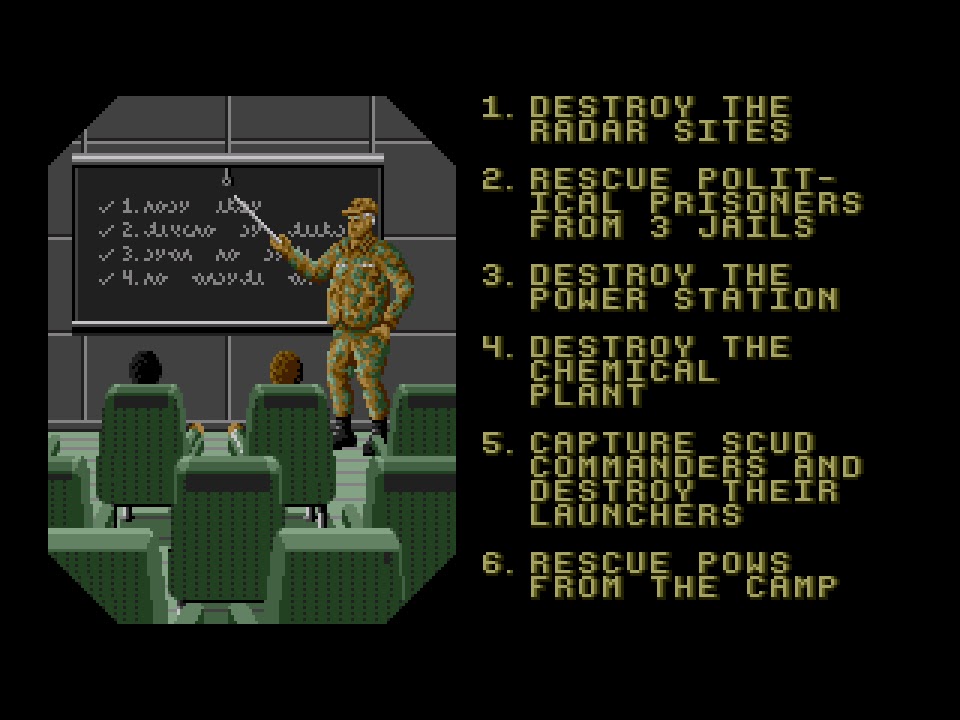
Rather than forming a coalition to send Kilbaba packing, the powers that be decided that all is needed is one man and his chopper.  Desert Strike plays over four 'campaigns' divided into several missions.  The first is called 'Air Superiority'.  Your missions here involve destroying radar sites, power station, airports, command centres, and finally picking up a secret agent.  Although the missions can be played in any order it is recommended playing in the order given as destroying the radars and power station reduces the range and accuracy of enemy anti-aircraft weapons.  The Secret Agent has copies of the Generals plans and his whereabouts is only shown after destroying the command centres and capturing the commander within.

Before you begin the game you must choose your co-pilot.  There are several to choose from, each with their own strengths and weaknesses.  One is marked MIA and can be rescued during the game - he's located next to a downed aircraft on the first level.
Choosing you co-pilot on the Mega Drive [left] and Amiga [right]
I must take issue here with the sprite of your gunship.  Although the game box, manual and in-game stills reference an AH-64 Apache, the main sprite only half resembles one -  the front half.  It looks like they have grafted on the back end of an RAH-66 Comanche with the ducted fan tail rotor and high tailplane.  The Apache has a conventional tail rotor and low tailplane.  I'm guessing this was to simplify drawing the many frames of animation.

The game proper starts with your chopper sat on the back of a frigate and you must head east towards the desert.  You navigate the area by using the map / status screen.  The map shows your objectives as well as the position of ammo crates, fuel, MIAs, missile and gun emplacements.  You can also get a reminder of completed and remaining objectives.  The screen additionally displays remaining fuel, weapons and armour, lives left and the number of MIAs you are carrying.
Status screen on Mega Drive [left] and Amiga [right].
Your gunship is armed with, from least to most powerful, a chain gun with 1,178 rounds of ammunition, 38 Hydra rockets and 8 Hellfire missiles.  The weapons can be fired in the general direction of the target with the accuracy determined by your selected co-pilot.

Ammunition supplies can be replenished by collecting ammo crates that are scattered around the play area.  The finite amount of fuel you carry can be topped up in the same manner.  Fuel and ammo pickups are displayed on the map screen, even those hidden in buildings.

The enemy territory is heavily defended with Rapier surface to air missiles and anti-aircraft guns.  Tiny enemy soldiers carry rifles (they also shoot at MIAs) and portable SAMS. There are also mobile VDAs (armoured vehicles carrying AA guns) roaming the map.  Every hit reduces the armour on your helicopter - you get a buzzer (Mega Drive) or warning speech (Amiga) when it gets too low.  Armour is also depleted if you fly into rock outcrops, high buildings, power lines and other tall structures - the chopper flies at fixed altitude so you can't fly over them.

Armour can be increased by picking up MIAs that are dispersed around the map and taking them to a dropzone. Six MIAs can be wedged into the Apache at one time.  Very rarely armour pickups can be found (usually hidden in buildings).  These pickups do not show up on the map.
Rescuing some MIAs and dropping them off at the LZ for more amour (Amiga)

Once a set of missions has been completed it is back to the frigate for the next level.  Your Apache is limited to three 'lives' which are replenished after each campaign.  You also get a password so there is no need to start from scratch.
Stormin' Norman sets out your objectives for the second campaign (Mega Drive)
And the further you get the tougher the enemies (Mega Drive)

There's a lot to like about Desert Strike whichever version you choose to play.  The handling and momentum feel just right as does the camera which always has the helicopter facing into the screenIt would be fun as just a straight shooter but the limited fuel, weapons and armour adds some strategy.  An excellent game all round.


Gameplay from the Mega Drive


I had a hard time getting Amiga gameplay to look okay on YouTube but here's my best effort (it looks better in reality)