Showing posts with label Series - Gradius. Show all posts

Tuesday, 23 January 2018

Parodius Da! - NEC PC Engine - 1992


As I've stated a few times before, the Gradius series contains some of my favourite shoot 'em ups.  These games in turn produced a couple of spin-off series - one being Salamander/Life Force, and the second being the rather strange Parodius.  As can be deduced from the title, Parodius is a parody of Gradius.

Parodius first appeared in 1988 on the MSX as Parodius: The Octopus Saves the Earth.  Like the MSX version of Gradius, it wasn't great.  In 1990 Parodius! From Myth to Laughter was released in the arcades.  It is this version on which Parodius Da! is based.

I'd heard of Parodius before but had never seen it in the arcades nor played any of the conversions.  The first time was when it appeared on my shortlist for 1991 for the Sharp X68000.  Comparing it to the original ROM on MAME, it was a pretty accurate rendition.  Even then the mighty X68000 struggled on the second level with quite a bit of slowdown when the screen got busy.  The second level was as far as I got as what really put me off was the insane difficulty level.

Come 1992, and Parodius Da! was released for the PC Engine in Japan (there was no US release on the TurboGrafx-16).  First impressions were not good after playing the X68K version.  The graphics were a lower resolution and not as detailed, and the transitions between backgrounds was not very smooth.  The music and sound effects, although good, paled against the computer.  Compared to the Sharp machine it generally looked a bit rough around the edges.  I soon got used to this, however, and found the PC Engine game more enjoyable (and needless to say, easier).  Just after completing this entry I found a there was a version of the game for the SNES.  It was not on my short-list but I decided to try it anyway. Like the other two conversions it was not released in the US but came out in Europe as Parodius: Non-Sense FantasyOf the three, it had the best sound and most options, and the graphics are almost on a par with the Sharp.  Maybe it's because I played it more extensively I still preferred the gameplay on the PC Engine.
Parodius: Non-Sense Fantasy on the SNES and Parodius Da! on the Sharp X68000
I'd always thought of Parodius as Gradius but reskinned with weird graphics.  To a certain extent I was right - it plays identically to Gradius and the graphics are a bit bizarre - but to label it as such would be unfairParodius builds on Gradius by adding a few extra elements to the game.  The strangeness starts on the ship selection screen.  Your choices include the Vic Viper from Gradius and TwinBee from another Konami franchise, which is fair enough.  Your other choices are an octopus and a penguin. I'm not going to attempt to discover if there is any sort of plot.
TwinBee is possibly the weakest character.

After the selection screen you have the choice of whether powerups are applied automatically or manually.  You also have choice of three difficulty levels.  Even the hardest level makes for an easier ride than you'll get on the X68000.

Basic gameplay will be familiar to anyone who has ever played Gradius.  You proceed through each level shooting enemies.  Certain individual enemies (usually coloured red) and waves of enemies drop capsules when destroyed.  Blue capsules act as a smart bomb and destroy all enemies on the screen when picked up.  Picking up orange capsules incrementally highlights items on your power meter which upgrade your ship (or character) when selected.  Besides 'Speedup' and the unfamiliar '!?', all upgrades are unique for each ship.  At the end of each level you are met by a 'pre boss' (such as the volcanoes in Gradius) followed by the end of level boss himself.
Defeating the second level boss.

Collecting certain capsules turns your power meter red which starts a game of 'roulette' on it.  Pressing the power up button stops it on a random power up.  I try to avoid these because if it lands on 'Speedup' it can make your ship too fast, or it can reduce the power of your main weapon (say from a laser to double shot in the case of the Vic Viper).  If it lands on '!?' then all your powerups are removed and your ship is reduced to the slowest speed.  This also happens if you are killed and can quickly lead to 'Game Over' as Parodius is pretty much a one life game.

In addition to the capsules, certain enemies drop one-time-use bell power ups.  These vary in colour which denotes their effect and you can change their colour by shooting them (though ‘choosing’ a colour is easier said than done).  The most common bell is yellow and provides bonus points.  The points value increases with each consecutive yellow bell.  The green bell increases the size of your character and any options for a short time.  In this state you are invincible but cannot use your weapons.  The white bell equips your character with a megaphone which ‘fires’ phrases in Japanese to damage enemies.  The blue bell equips your ship with a ‘smart bomb’ that clears the screen of enemies.

The green bell and white bell in action.


The sound effects and music are good with speech when power ups are selected.  The main score is based on the music from Gradius interspersed with classical jingles and music from other Konami games. 

Overall Parodius Da! is an enjoyable game.  The graphics can be strange and it’s weird playing as the different characters, but underneath it is pure Gradius so I can’t help but like it.

Example gameplay....

Thursday, 14 December 2017

Gradius II: Gofer no Yabou - NEC PC Engine Super CD-ROM - 1992


Gradius II: Gofer no Yabou is a conversion of the second title in the Gradius series of arcade games.  It was released on the CD-ROM format some four years after the arcade game.  I have already featured the NES version of Gradius II on my blog.  Where the NES conversion thematically follows the arcade original in terms of graphics, the level layout is completely different.  The PC Engine is a much more faithful conversion with the exception that it contains an exclusive bonus level.

From the options screen you can choose the Game Level from Easy, Normal, Hard and Professional.  Normal is fine for me.  Easy is possibly too easy, but is okay for training (it is the level I did my gameplay video on).  Professional has bullets flying everywhere.  There is a different ending for each difficulty level.

As before, it's just you and your Vic Viper starfighter pitted against the evil Bacterion Empire and it's leader, Gofer.  When you start a game you can choose what weapons your ship is capable of carrying.

Each selection contains Speedup and Option.  Personally I prefer the fourth choice with 2-way missiles and a Ripple laser, which gives a better spread of firepower than the normal laser.  You also have a choice of defensive upgrades.  The Shield from the original Gradius can absorb the most damage but only protects the front of the Vic Viper.  The Force Field takes less hits before it disappears but covers the whole ship.

Gameplay is the same as the first game in the series.  The screen mostly scrolls right to left although there are some areas where it wraps around in the vertical plane.  Certain enemy formations and individual enemies drop capsules (for want of a better word) when they are destroyed.  Blue capsules act a smart bomb when touched and clear any enemies and bullets on the screen.  Orange capsules add to your power meter.  When the the power meter highlights an item you wish to equip, you can select it and the meter resets.
The green bacterion is a new enemy.  It has just stolen three of my options.  Bastard.

Music and sound are excellent with the soundtrack streaming direct from the CD.  Where the CD format can't help is with the graphics.  There are flickering sprites in places and massive slowdown when the screen gets busy.  Ironically, the slowdown actually makes avoiding damage that much easier.  
This stage really slowed down with the Moai head spewing out hundreds of colour changing bullets.
The games stages are also varied with some of the enemies and certain areas looking familiar.  
It's obvious which film this part is based on.  I have just lost all my power ups so will soon die.
My only real criticism is one of the stages features a high speed run which I couldn't get past.  It will take a lot of time and and a lot of practice (or a quick look on YouTube) to work out the optimal route and even then it is all too easy to lose a life.  Which brings up another issue - Gradius II (like Gradius) is a one life game - lose a life and you lose all your power-ups after which it is very difficult to get going again.  Nevertheless, it is a great game and a welcome addition to the ever growing list of Gradius games on my blog.


Example gameplay....

Tuesday, 10 November 2015

Gradius III - Nintendo SNES - 1991


Although I am a big fan of the Gradius series, Gradius III has somehow passed me by.  The SNES port is based on the 1989 coin-up of the same name, but with several changes, including shorter stages and a toned down difficulty level.

Once again it's just you and your trusty Vic Viper spacecraft facing the might of the Bacterion Empire.  Gradius III retains all the staples of the original game in the series such as the power meter, weapons and options.  In addition, many of the enemies from previous games return in this one.
These appeared in Gradius II and as boss in Salamander where the tactics are the same - stay close and they can't get you

Like Gradius II you can choose from a number of pre-configured power meters as well as shield types at the start of the game. There is also an edit mode where you can tailor the power meter to suit.  

The game starts off in the usual way with simple formations of enemies to shoot down.  Shooting all the enemies in these early formations results in them dropping a power up capsule that adds to your power meter.  Later, you can tell which opponents will drop a capsule as they are a slightly different colour.  The capsules come in an orange or blue colour.  The orange one adds to your power meter, whereas the blue one acts as a smart bomb when it is touched.

Pressing the appropriate button activates the highlighted power up.  Added to the end of  the meter in Gradius III is the '!' symbol. By default this activates a smart bomb when selected, but this can be changed in the edit mode.

Even early on I found the game tough going and had difficulty getting to the first boss without losing a life.  I wasn't particularly enjoying the game, so had to relent and choose the easy mode.  This made the game much but better for someone with my meagre skills although it may have made it a tad too easy - on my initial attempt I didn't lose my first life until the level three boss only because I didn't know its attack pattern.  As with any Gradius game, when you lose a life you also lose your power-ups making it difficult to get up to speed again.
I lost more than a few lives on this high speed stage.
Moreso than the previous game on my blog, Gradius III is afflicted by slowdown when the screen is busy (and sometimes when it's not).  In most cases this makes the game that little bit easier rather than being an annoyance.
Lots of things on screen means lots of slowdown

The music and graphics are good, and the gameplay (slowdown apart) is typical Gradius.  It sticks to the basic Gradius recipe but adds few extras without spoiling it.  I found it a bit too hard for my tastes in the normal mode, but these was overcome by lowering the difficulty level.  Gradius III is a very good addition to the series. 


Example gameplay....

Wednesday, 21 October 2015

Gradius - NEC PC Engine - 1991


This is the third and final conversion of the 1985 coin-op classic I will include on my blog before the 'arcade perfect' iterations begin to appear in the 32-bit era.  Gradius on the PC Engine is considered by many to be the best version so how does it compare to the others on my blog so far?

It was released only in Japan in 1991 for the PC Engine - it didn't make it to the US on the TurboGrafx-16.  The only western release I have included was published for the NES way back in 1986.  Although good, the five year old game is no match for the PC Engine version.

Gradius for the Sharp X68000 came out a year after the NES release and as far as sound and graphics go, is practically indistinguishable from the arcade original.  The game runs at a faster pace than the PC Engine manages and playing it again reminded my how frustratingly difficult it is.  This version is for masochistic gamers only.


PC Engine Gradius can't display the whole screen so has to scroll vertically.  Sharp X68000 Gradius is almost pixel perfect.

So how does Gradius on the PC Engine stack up?  Well, it can't match the graphics or pace of the Sharp machine for starters.  The simpler graphics are still good so this does not detract from the game at all.  It also has the same slight vertical scroll as the PC Engine/TurboGrafx-16 version of R-Type.  Unlike R-Type, gun emplacements and such are thankfully still visible on the screen.


The reduced pace makes for a better balanced and much easier ride than the X86K version in my opinion.  I also prefer the soundtrack over the original arcade machine. Additionally, the PC Engine features an exclusive level though I'm not able to get that far without a lot more practice.

A major issue with Gradius on the PC Engine is its bouts of slowdown.  This is not noticeable on Level 1 but can become a problem when the screen gets busy from Level 2 onward.  The slowdown can be a blessing or a curse depending on your point of view.  It can make traversing a busy screen and avoiding bullets a lot easier but is somewhat disconcerting when it suddenly speeds up again.
Slowdown is an issue when the screen gets busy.


So, the PC Engine conversion, in my opinion at least, is the best version of Gradius released so far and looks to stay that way until the mid-90s.  Although it may not be as graphically accurate as the X68000 version, it's a hell of a lot less frustrating.  It also has that extra level over the coin-up.  The only fly in the ointment is the slowdown. 

Example gameplay....

Sunday, 11 August 2013

Salamander - Sharp X68000 - 1988

 
Level 4 has a lot of enemies from the first level in Gradius (including the volcanoes).

Salamander is another cracking coin-op conversion for the Sharp X68000 computer.  The arcade version of Salamander was released in 1986 as a spin off of Gradius.  Gradius is one of my favourite shoot 'em up franchises, so comes as no surprise to see this game on my list.

Once again you take control of your dependable Vic Viper in single player mode.  There is a two player co-operative mode where the second player takes control of a ship called the Lord British.   I'm not 100% certain but I believe the ultimate goal of the game is to fight your way to and destroy the eponymous Salamander which, judging by the striking artwork, is some kind of giant snake.

Salamander was also released in 1988 for the Amstrad CPC, Commodore 64 and Sinclair Spectrum all of which had levels and/or features removed (such as two-player mode).  The closest rival at the time was the NES version, renamed as Life Force in the US and Life Force Salamander in Europe.  It retained the two-player mode but differed by having a Gradius-style power-up meter. Nevertheless, it couldn't hope to match the sound or graphics of the mighty X68000.  A conversion for the PC Engine followed three years later in 1991 which I will review when (if) I get there.

Life Force on the NES (left) is better than most conversions but can't compete against Salamander on the Sharp (right).


Rather than picking up pods and selecting a power-up from a meter as in Gradius, you have to collect icons representing each power-up.   These comprise Speed Up, Missile, Laser, Ripple Laser, Force Field and Multiple.  Personally, I prefer the former method which allows for more customisation of your spacecraft.

Even the attract screen is present.

The major departure from Gradius is that Salamander has alternate vertical and horizontal scrolling levels.  The vertical scrolling sections are more frantic with increased numbers of enemies, bullets and objects to avoid.

The vertically scrolling stages tend to get busy.
One thing I am glad of is that when you lose a life you continue from where you died rather than at the beginning of the stage.  You will lose all your power-ups but with quick reflexes you can gather up any Multiples you were carrying.

I haven't played the original coin-op for many years, but if this game is anything like the X68K conversion of Gradius it will be hard to tell apart.  The sound effects and music are good - including some clear speech (remember this is 25 years old).  The controls are responsive and the graphics are well drawn and smooth with some nods to Gradius.  Salamander is an excellent conversion of an excellent arcade game.

This is similar to a level in Gradius 2.  Normally the flares come towards you giving a fraction of a second  warning.
 
A couple of the bosses.  Once you work out a weakness in their movement pattern they go down quickly.

Saturday, 25 May 2013

Gradius II - NES - 1988


After the trials and tribulations of Final Fantasy II it was good to have a bit light relief playing some scrolling shoot 'em ups from my shortlist.  Of the four or five I sampled from F-G,  Gradius II alone made it on the blog.  It was a Japan-only release and came out on the Famicom at the tail end of 1988.

Obviously a sequel to Gradius, it's once again just you and your trusty Vic Viper protecting the planet Gradius from the evil Bacterians.

One of my rare forays into level 3.  It's very reminiscent of level 1 in Gradius.

I don't recall playing the arcade version of Gradius II (titled Vulcan Venture in Europe) so I'm not able to see how it compares, but it is a good game in its own right.  Game play is much the same as Gradius so I won't go into any detail here.  The music and sound effects are great for the NES and there is even some speech when selecting a power up.  The graphics are  impressive with some big sprites, but they can flicker quite badly when the action hots up.

Big, bold graphics are the order of the day.

The main difference you'll notice when starting the game is that you now have a choice of power up meters.  The original is there along with three others featuring different weapon configurations.  All four meters contain the 'speed up', 'option' and 'force field' choices.  Additionally, when playing the game you can now have a full compliment of four 'options' rather than the two you were limited to on the NES version of Gradius.  If you select 'option' again when you have all four they start rotating around your ship.

Your choice of power up meters.  I stick with the classic one.

My main criticism of the original game was the harsh difficulty level.  Here at has been turned up several notches and for me it's a struggle just to get past the first stage.  Despite much gnashing of teeth, Gradius II has enough going for it to get onto the blog.  I just need a lot more practice....


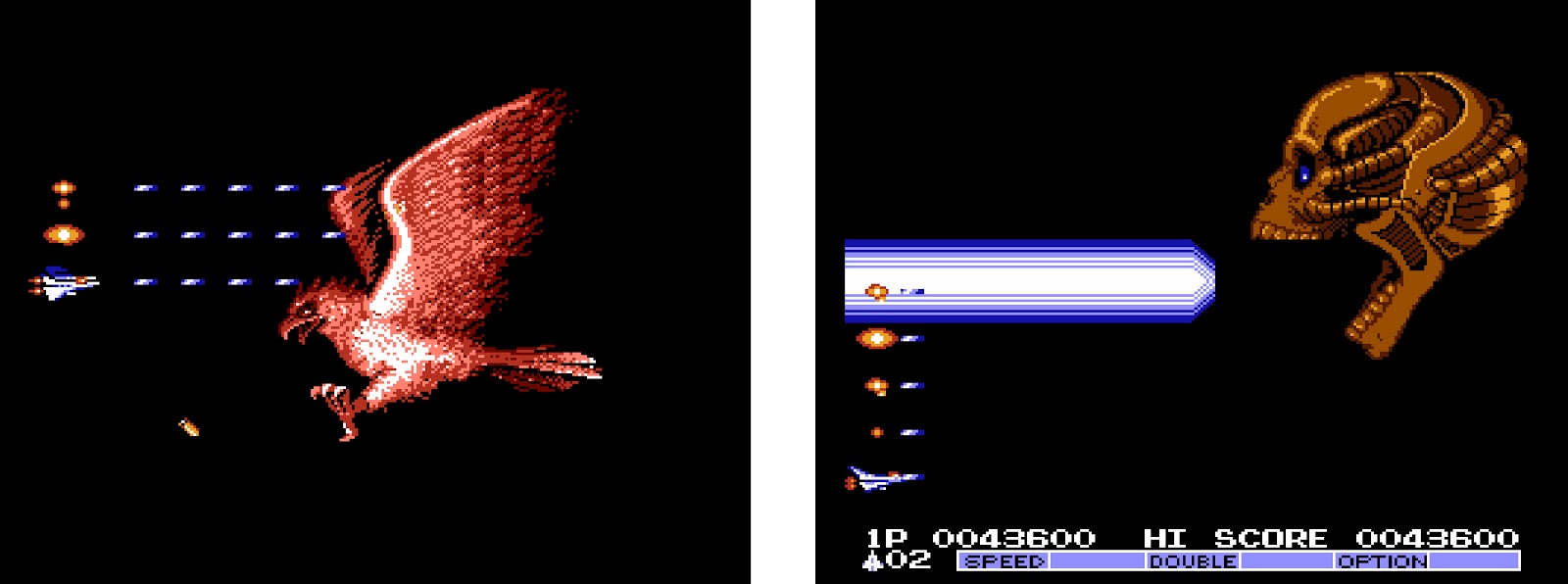
The bosses are quite impressive in this game.  I found the first level boss on the left harder to take down than the skull on the second level.


Saturday, 26 January 2013

Gradius - Sharp X68000 - 1987


Okay, I think I've mentioned on here before that I wasn't going to feature little known systems or machines not released in the UK. So, ahem, here we have the obscure Japan-only Sharp X68000 from 1987.  As it's name suggests it is a computer powered by the then ubiquitous Motorola 68000 16-bit CPU.  I remember it appeared in a magazine article back in the day and it kind of stuck in my mind because of the striking 'twin-tower' styling.  What I didn't remember were it's cracking arcade conversions.  I was reminded of it again last year when it appeared in an issue of Retro Gamer.  Up until now I was in two minds whether or not to feature it, so this game is not in my usual alphabetical order but what the hell.....

As I described Gradius on the NES in my 1986 games I won't go into the plot or gameplay again.  Suffice to say it is a excellent conversion and much closer to the original arcade machine than the NES could manage.

Firstly, the graphics are a big improvement over the NES conversion.  Due to the superior hardware, the overall look of the game is much smoother and more detailed.  The enemies are more numerous and varied in their attack patterns.  It also contains items missing in the NES version (such as the lasers on the 'floating rock' on the first stage) and gone is the limit of just two 'options'. Additionally, the end of level bosses are much smaller and not as impressive on the NES.

Comparing the first level boss for the NES (left) and X68000 (right)
  
Secondly, the audio is much better on the Sharp.  Although the laser is a bit weedy, on the whole the music and sound effects are of a much higher quality.

Does all this mean the Gradius on the X68000 is the definitive version so far? Not quite. Even though I managed to get through most of the second stage on my second attempt, the overall difficulty level is several notches higher than the NES Gradius.  My main issue also remains - you don't get any power-ups to pick up after you lose a life (the arcade original is much more forgiving in this respect).  After playing this for nearly two weeks, I still can't get past the end of the second stage - after the boss there are enemy ships seemingly appearing at random and shooting off in seemingly random directions making them impossible to avoid (for me at least).  As it stands Gradius on the NES is an excellent game in it's own right and still deserves a place on the blog but, if you can put up with the difficulty, the X68k release beats it in all areas.

As much as I tried I couldn't make it past the second level.


Friday, 14 September 2012

Gradius - NES - 1986


My first taste of Gradius was a rather dodgy conversion on the Sinclair Spectrum under the alternative name of NemesisDespite this I have since become a long time fan of the series from the arcade original to Gradius V on the PS2.  Konami have made a good fist of converting the arcade game to the NES, although there is one major issue which I will pick up on later.

Gradius is a horizontally scrolling shoot 'em up.  The game involves you controlling a ship called the Vic Viper and you have destroy the evil Bacterians who have taken over the planet Gradius.  What made the game unique at the time was the Power Meter. Power-ups are dropped when destroying certain formations or certain individual enemies. Each power-up collected highlights the next upgrade on the meter allowing the player to choose which upgrades are fitted to the ship and in what order.  Power-ups range from Speed Up to the mysterious '?' (or shield to you and me).  The power-up most associated with Gradius is the 'Option' which is an orb that follows your ship around replicating its firepower. Up to two 'Options' can be carried in this version of the game.

Gradius is played over several stages, each stage ending in a rather weak boss with a predictable firing pattern.  However, preceding each boss the scrolling stops and you are bombarded by attacks from all sides - projectiles from a couple of volcanoes on the first level and a mass of kamikaze enemies on the second.
 
The infamous volcanoes.  If there's a safe spot I haven't found it.

The sound is good, as are the graphics though they do flicker slightly in places.  My one major gripe is with the punishing difficulty level.  When you lose a life you lose all your weapon upgrades.  On the original arcade game you are guaranteed to get a few power-ups in front of you to get you started again.  On the NES you are lucky if Speed Up is highlighted on the Power Meter.  With my skill level the next two lives are normally lost in very quick succession and then it's game over.  Overall though, Gradius on the NES is still very good game in it's own right and I am enjoying the challenge.

Moai heads regularly appear throughout the series.