Showing posts with label 1984. Show all posts

Wednesday, 30 May 2012

Underwurlde - Sinclair Spectrum - 1984

First guardian, wrong weapon

Underwurlde was the second of three Sabreman games released by Ultimate Play The Game during 1984 and the only one I have not played before.  It is the follow up to Sabre Wulf and was released at the same time as Knight Lore.  After escaping the jungle, the unlucky Sabreman has been trapped in the ‘Underwurlde’ and must make his way through a castle and caverns to one of three exits (one for each of the planned sequels).  To reach the exits you have to defeat three guardians, requiring you to collect a particular weapon to pass each one.  Underwurlde boasts nearly 600 screens of side on, flip screen platforming set in the castle and the caverns beneath.

This time out Sabreman can athletically leap about the play area and cannot be killed by touching the enemy creatures.  He can however lose a life by falling too far into one of the deep caverns.  When the enemies touch Sabreman he is bounced around the screen.  Due to the abundance of enemies and the narrowness of the platforms and ledges this can make the game frustrating as it is all too easy to die. You are armed but can only shoot left or right and the enemies come at you from all around.  Aside from using platforms you can descend into the caverns by using ropes and ascend by standing on bubbles that rise from the floor.  Again, it is all too easy be touched by a creature and sent plummeting into the cavern floor.  Another annoying feature is that you jump automatically when reaching the edge of a platform; this and the touch of the enemy creatures give the game a slightly ‘out of control’ feel.

The graphics are up to the usual Ultimate standards with colourful, smooth and fast moving sprites. The sound effects are also decent enough for the Spectrum.  Underwurlde is both fun and infuriating at the same time.  I was in two minds about whether to include the game on the list due to the annoyances, but the quality of the game (just) won me over in the end.

Using a rope is the safest way to descend into the caverns.
Eagles can pick you up and try to drop you from a great height.


Saturday, 26 May 2012

Tank Commander - Commodore VIC-20 - 1984


Tank Commander from 1984 is the fifth and final game on my list for the Commodore VIC-20.  I can’t quite remember why I bought it as I had a Spectrum by this time. I think I got it because the description reminded me of a board game I had called Tank Battle.  Again, there were vastly superior games around at this point for other computers but this is one of the better VIC titles.

The board game Tank Battle - well, it has a fuel dump, command centre, tanks and mines


Tank Commander is played out over a large semi-randomly generated play area.  The scrolling terrain consists of various elements such as mountains, rivers, trees and a road. In the game you control a tank and have to travel into enemy territory to destroy an oil depot, an (I think) communications station and a command bunker before moving to the next level.  The command bunker can only be destroyed from below.

Out to stop you are enemy tanks, mines and the occasional aircraft.  Enemy tanks are either black or white.  The black tanks will hunt you down while the white tanks are static and are normally placed next to bridges.  Mines are scattered around and are easy to avoid as are the bombs dropped by the aircraft.  Once past the tanks, the enemy installations are easily destroyed.

The graphics are pretty good for the VIC and the sound consists a constantly rumbling engine noise and some simple spot effects.  As I said this is neither the best game for the time nor indeed for the VIC-20 but I have a soft spot for it so it gets on the list.


Planes are quite easy to evade.


Sunday, 20 May 2012

T.L.L. - Sinclair Spectrum - 1984


TLL or Tornado Low Level to give the full title is an arcade game for the Sinclair Spectrum released in 1984.  In the game you control a Tornado bomber and have to destroy targets laid out over a scrolling wraparound play area.  There are five targets which are shown on a map at the start of each mission.  You ‘hit’ targets be flying over them at (surprise, surprise) low level – you don’t need to press any key to hit the targets it is done automatically.

The landscape is displayed in a skewed top down view which gives a 3D effect.  As I said the play area is wraparound which makes it seem larger than it actually is.  This makes the targets easy to find on your radar, and some which appear far away on the map can actually be quite close.  As you have to fly at low level the difficulty comes with avoiding structures such as buildings, electricity pylons and bridges, though you can fly under the bridges and cables.   A neat touch is the shadow of the plane which helps gauge your altitude.

There is no doubt that TLL is a hard game.  The plane flies at two speeds – fast with the wings swept forward and faster with them swept back.  This makes hitting the small targets challenging and requiring several passes.  Later in the game the awkward position of the targets in difficult terrain doesn’t help. The time limit and finite amount of fuel just add to the pressure, although you can land to refuel.

It’s still a very good game though, with a graphical style that surprisingly was only used once again in the follow up, Cyclone.  The scrolling is fast and smooth for the time, though the sound is limited.  The game is colourful too with the dreaded Spectrum attribute clash being well contained.  Although TLL is a difficult game it is still addictive and takes a while to get frustrating.

The round object is one of your targets.

The mission map can be viewed when the aircraft is on the ground.


Tuesday, 15 May 2012

Space Taxi - Commodore 64 - 1984


Space Taxi does not exactly stretch the graphical capabilities of the C64 


Space Taxi is a very addictive arcade game for the Commodore 64.  The aim of the game is simple – ferry customers from platform to platform around the screen in the quickest time possible.  The joystick controls thrusters that fire in the four cardinal directions and the fire button lowers or raises the taxi undercarriage.  With the undercarriage lowered, the left and right thrusters are disabled. There is inertia and gravity which must be taken into account when controlling the vehicle.

When you enter a scene a customer materialises on one of the platforms and shouts “Hey Taxi!”.  You have to land on the pad to pick him up.  If you hit anything, land too hard or don’t land fully on the platform you lose a life.  If you hit the customer he disappears and you lose some money.  When a customer boards he tells you where he wants to go.  You earn a fee when dropping him off and a tip based on the time taken and the smoothness of the landing. If the customer says “Up please” you can move to the next level by flying through a gap in the top of the screen.  As you get further, levels get progressively harder with smaller gaps to get through, more things to avoid and objects such magnets and a black hole that interfere with the handling of the taxi.

Space Taxi is an excellent game.  The speech is rudimentary, the sound limited and the graphics extremely basic but the gameplay and controls are spot on.  Now I must go and try for that next level…


Things start getting tricky when moving objects appear - in this case the white ball.


Wednesday, 9 May 2012

Sabre Wulf - Sinclair Spectrum - 1984

Sabre Wulf on the Spectrum has some attribute issues but they were not very noticeable when playing.


Sabre Wulf marks the debut of our pith helmeted hero Sabreman. Sabreman starred in a series of four games and I believe the Spectrum was the only system that featured them all. The mythical Mire Mare was to be the fifth and final game in the series but was never released after a falling out between the Stamper brothers and US Gold (who purchased the Ultimate name and back catalogue). More information on the fate of Mire Mare can be found here.

As mentioned the Spectrum was the only system to feature all four Sabreman games and had the best version of Sabre Wulf.  The Commodore 64 version had drab, blocky graphics and some of the sprites were very flickery; it had good music though.  The Amstrad version, like Knight Lore, had a bizarre colour palette and was too slow.  The less said about the BBC version the better. On release Sabre Wulf was described by various reviewers as Atic Atac in the jungle but that’s no bad thing. I still have the game in its original box in pristine condition.

The less impressive Commodore 64 and horrible Amstrad CPC versions.


In this game Sabreman has somehow become stuck in a jungle and can only escape by finding the 4 pieces of the Golden Amulet of ACG.  The game is set over a 256 screen maze of jungle scenery.  Most of the screens are very similar so, like Atic Atac, a map is essential.  The jungle is inhabited by various creatures, most of which can be dispatched with your trusty sabre.  There are a few, such as the wolf (or ‘Wulf’), which are invincible and must be avoided, though some can be persuaded to run away with a deft prod of your weapon.  Scattered around the pathways are orchids which bloom in random colours.  Some colours are helpful (e.g. cyan = speed boost) while others are a hindrance (e.g. magenta = reversed joystick directions).  Treasure (for bonus points) and a generous scattering of extra lives can also be found.  As far as I can tell there is no time limit although an invincible fire appears if you linger too long on a screen.

This is another game I mapped and completed well over 25 years ago.  Playing again it seems a lot tougher than I remember or more likely my reflexes aren’t what they once were*. Being a Spectrum game you can’t expect too much from the sound effects but they are above average for the machine.  The graphics are very good – the jungle is full of vibrant colours and well animated creatures.  Another classic from Ultimate Play The Game.
 
*I’ve since rediscovered the tactic I must have used – wait by an orchid until it blooms in an appropriate colour then run like hell to the next one.

The titular 'Wulf'

That's the amulet complete. Now off to the exit.


The rather unimpressive end to the game.....

Friday, 4 May 2012

Raid on Bungeling Bay - Commodore 64 - 1984


Bland graphics, great game.


Raid on Bungeling Bay is a multi-way scrolling shoot ‘em up released on the Commodore 64 in 1984, and for the MSX and NES in 1985.  The best version is on the Commodore 64.  It was the first commercial game designed by Will Wright who would go on to design SimCity and cash cow The Sims.

The game is set on a planetoid that has been occupied by the Bungeling Empire where they are constructing a war machine with which to attack Earth.  They have built 6 different coloured factories which produce their weaponry.  The factories are supplied by ships of the same colour.  The game takes place on a large 2D wraparound playfield viewed from above.

In Raid on Bungeling Bay you take control of a helicopter and start on an aircraft carrier which acts as your base.  The helicopter is armed with an unlimited supply of missiles and 9 bombs.  Your aim is to disrupt the Bungeling infrastructure and ultimately destroy the factories whilst protecting your carrier.

Most of the enemy installations and weapons can be destroyed by missiles but the factories need to be bombed. These factories are protected by AA batteries initially but as the game progresses the enemy develops a more advanced arsenal of weaponry including tanks, fighter and bomber aircraft.  Your helicopter can take a certain amount of damage before it is destroyed although this can be repaired and your bombs replenished when you land on the carrier.  A nice touch is that the screen border changes from green to yellow to red as you take more damage so you know when to land without looking at the damage counter.  You start with five lives but if the carrier is destroyed you are only left with the helicopter you are currently flying. 

At its heart Raid on Bungeling Bay is a simple shoot 'em up but there is some strategy involved in disrupting the Bungeling supply lines and destroying the factories to slow down their technological advancement.  Your helicopter is quite nippy but can initially be difficult to control accurately due it's inertia.  Graphics and sound are best described as adequate, the graphics mostly being a drab combination of black, blue and gray.  Overall, though, it’s a fun little game.


Saturday, 28 April 2012

The Lords of Midnight - Sinclair Spectrum & Amstrad CPC (1984), Commodore 64 (1985)

Morkin takes a last look back at his companions before a lonely trek north in search of the Ice Crown.


It can’t be very often that a game crammed in to 48k of memory can be called epic but The Lords of Midnight certainly is.  It is a turn-based strategy cum wargame set across 4,000 locations. Mike Singleton used a scaling technique he call Landscaping that allowed the player to look in 8 directions from each location.  This gave a total of 32,000 unique views which was a revelation, not to mention a big selling point, back in 1984.

The aim of the game is to defeat Doomdark the witchking who controls the northern half of the land of Midnight.  He has cast a spell of cold over the land and defeating him is the only way to free it.  You start the game at the Tower of the Moon initially controlling 4 characters including Luxor the Moonprince and his son Morkin.  The game world is seen through the eyes of the character you currently have selected.

Doomdark can be defeated in two ways.  Firstly Morkin can be sent north to the Tower of Doom to destroy the Ice Crown which is the source of Doomdark’s power.  Morkin is half human, half fey and by virtue of his ancestry is immune to the Ice Fear and is the only character able to get close to the crown without detection.  The Ice Fear is a power that emanates from the Ice Crown and will sap the strength and morale of friendly armies.

The second way to defeat Doomdark is by taking his home Citadel of Ushgarak by force.  You can send out your characters to friendly citadels and keeps across the land of Midnight recruiting armies to fight for your cause.  Not all Lords can be persuaded to join, for example starting character Corleth the Fey is the only one able to persuade the forest dwelling Fey to join your quest.

The newly recruited Lord of Gard in the far south is not yet affected by the Ice Fear.
 
For Doomdark to win the game he must defeat the armies of the Free by killing Luxor or taking Xajorkith, the citadel of the Free.  He must also kill Morkin for as long as he is alive the game can still be won.

All your allies (apart from Morkin) are controlled via the Moon Ring which is worn by Luxor. The Moon Ring also radiates a warmth that lessens the effects of the Ice Fear on anyone close to it.  Unfortunately, because of this, Doomdark can sense the location of its wearer.  If Luxor should die you will lose control of the armies of the Free.  The only way to regain control is for Morkin to retrieve the ring from the location in which Luxor fell. This will mean Doomdark will know where his is, making his own quest that much more difficult.

Dotted around the landscape are features including ruins, henges, magical lakes, liths and caves which can help or hinder the player.  For example a cave may provide shelter, but it can just as easily be hiding a monster such as the dragons, wolves and ice trolls which roam the land.

Searching ruins can prove fruitful.

This game can’t be criticised for its sound because there isn’t any.  The graphics, while obviously dated, are still quite effective.  What is unchanged is the game play which is as good and as challenging as ever.  It’s not a game I have completed and not one I am likely to complete in the near future.  However my 15 year old self did map the land of Midnight using pages liberated from my maths exercise book (I still have it) so I will probably give it another go at some point.
 

At night your opponents make their moves.

Bugger.


The screenshots and review are for the Spectrum version.  The game was also converted to the Amstrad CPC (1984) and Commodore 64 (1985) and plays more or less identically on these machines.


Sunday, 22 April 2012

Kokotoni Wilf - Sinclair Spectrum - 1984

Whoever drew the graphics had no concept of scale

Now, from some of the best graphics on the Spectrum to some of the worst.  Seriously, if I gave my five year old nephew a box of crayons he could draw better dinosaurs than appear on the first stage of this game.

Kokotoni Wilf was originally released in October 1984.  I got it as part of the Soft Aid charity compilation tape in late 1985.  As can be expected on a charity tape there were a few duds, but Kokotoni Wilf stood out.

You control the unfortunately named Kokotoni Wilf and your goal is to collect (isn’t it always?) parts of the Dragon Amulet.  Apparently the amulet keeps some dragons asleep and the spell is due to wear off.  Ulrich the wizard can renew the spell, however the amulet has been broken into pieces and scattered across time.  As Ulrich’s assistant it is your task to collect the pieces. To aid you in your quest he has given you a pair of wings – the normal jump control being dropped in favour of a fly button. The fragments of amulet are represented by stars.  When all the stars on a particular stage have been collected a flashing star will appear.  This flashing star is a time gate and touching it will take you to the next time zone.  The first time zone is 1,000,000 years BC and the last is 2001.
On the original cassette inlay Wilf is depicted as a toga wearing, athletic looking fella.  In the game he is anything but.  The action moves along at rather a sluggish pace and would have benefitted from having the speed tweaked to make it a tad faster.

As I have mentioned the graphics are rather basic and sometimes completely out of scale. Animation is also simple using only two or three frames at most for each object. Sound is not great either being limited to flapping wings and some simple beeps.  Having said that collision detection is spot on, which is essential in this kind of game.

Despite my criticisms Kokotoni Wilf is a good game.  It’s annoying that I can’t put my finger on why, but there is something that draws you in.  Though it shouldn’t be, this is an addictive game and one I enjoyed playing again.

A 1984 vision of 2001


 Maps and end screen....


And they all lived happily ever after.


Tuesday, 17 April 2012

Knight Lore - Sinclair Spectrum - 1984


Knight Lore is a 3D isometric adventure game published by Ultimate Play The Game.  It was the game that spawned a new trend for this viewpoint during the mid to late 80’s.  Although Ant Attack had used isometric projection over a year before, it had failed to capture the imagination like Ultimate’s 'filmation' releases.  Knight Lore was one of three games featuring Sabre Man released during 1984, following on from Sabre Wulf and Underwurlde.  According to Tim Stamper it was supposedly completed before Sabre Wulf but was held back "because the market wasn't ready for it".

The ultimate (excuse the pun) goal of the game is to cure yourself of lycanthropy by visiting the dying wizard Melkhior in Knight Lore castle.  To do this you have to seek out the cauldron room which is situated near the centre of the castle.  In this room you’ll find Melkhior the wizard and, obviously, a cauldron.  The wizard doesn’t look like he’s knocking on heaven’s door as he perpetually circles the cauldron and kills on contact.  The cauldron itself flashes up an ingredient you need to collect in order to create a cure for your disease. Once you deposit the object a new item is shown. You have a time limit of forty days represented by a dial displayed at the bottom of the screen.  When a moon shows on the dial you change into the ‘werewulf’.

The castle contains more than 100 rooms – I’ve mapped it but haven’t counted.  Many of the rooms require platforming and lateral thinking skills (and occasionally luck) to get through.  The platforms are made up of blocks, some of which are moving and others which may sink or disintegrate when stood upon.  There are also a variety of enemies present in the castle which will normally kill on contact.  The only difference I can see between sabreman and the werewulf is that certain enemies are repelled by the former and attracted to the latter.  This can be useful to remember when navigating certain rooms.  The sparkly thing atop the cauldron also attacks you if you enter the room as a werewolf.

I first played Knight Lore around a friend’s house soon after completing Alien 8 and remember the game mechanics to be a bit clunky next to the later game.  This was especially true of the transformation between sabreman and werewolf which can happen at inopportune moments.  Also annoying is the way you can die by having spiky objects randomly drop from the ceiling in some rooms – I hate unfair deaths.  Playing again with fresh eyes it’s not nearly so frustrating. It is certainly more linear than Alien 8 and, if I remember correctly, it is easier to die – mainly on something spiky or by touching one of the fast moving ghosts. I also found the time limit a bit punishing.  I ran out of time after putting 8 objects into the cauldron so haven’t completed it…..yet.

It is another good game from Ultimate and was certainly a trendsetter but I think I will prefer the more refined Alien 8 when I get to 1985.

One of the more annoying screens with randomly falling spiky balls


I should mention here that Knight Lore was also released for the Amstrad CPC in 1985.  It generally plays slower than the Spectrum version - frustratingly so if there are more than two moving objects on the screen.  They also added an extra colour but some of the combinations are a bit jarring.  I prefer the footstep sound on the Spectrum as well - the Amstrad version plays a note each time Sabreman takes a step which can and does get annoying after a while. The Speccy version is better in my opinion.

Amstrad CPC - Painful on the eyes and painfully slow

Map though very small due to flickr limitations

Thursday, 12 April 2012

Impossible Mission - Commodore 64 - 1984

"Another visitor!  Stay a while….. Stay forever!"


Impossible Mission. Mmmmm. It’s been a game that has always been near the top of any chart of Commodore 64 games but I’ve never had any real desire to play it.  The screenshots always seemed a bit samey and plain to me but I was forced to give it a go because of this blog.

The plot involves someone called Elvin Atombender who is hacking into the world’s military computers in order to launch a missile attack. Why or against whom it doesn’t say.  It is estimated he will gain access to the launch codes in 6 (real-time) hours. Your character is a secret agent who has to infiltrate Elvin’s underground stronghold and apprehend him in his control centre before he has a chance to launch the missiles.  To gain access to the control centre you need a password, parts of which are scattered in various items of furniture over the base.

Elvin’s stronghold is set across 32 rooms connected by elevators.  The rooms are randomly located for every new game. Each room contains at least one security terminal and a series of platforms, some connected by lifts.  The platforms are populated by robots and some contain items of furniture.  To find the codes you need to search the items of furniture while evading the robots.  The time taken to search varies - wastepaper baskets take a second to search, bookcases take longer. 

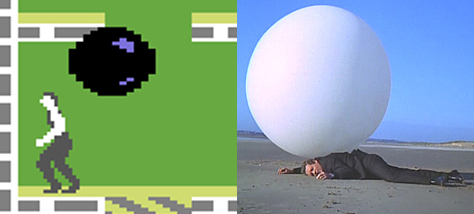
There are two types of robot in the game.  The most common are those on the platforms and they have various patterns of movement – some stay still, some move in preset patterns, some move towards you when on their level, some have different movement speeds, some fire electric bolts.  All kill on contact. The second type of robot is a floating dark sphere.  This can move between platforms, either moving in a preset pattern or homing in on you.  You can also die by falling through holes in the bottom of the screen.  I am using the words ‘kill’ and ‘die’ but what actually happens is the game deducts 10 minutes from your remaining time instead of losing a life. 6 hours doesn’t look so generous now.

Inspiration from The Prisoner maybe?

After searching an item of furniture it disappears from the screen.  If you find anything it will be one of three things.  The first is a password that can be used in one of the security terminals in the room and will reset the lifts back to their original positions. The second is another password that can be used at the security terminals to disable all the robots in the room for a few moments.  More of these lift inits and snoozes (as they are called) can be earned in the code rooms by completing a musical puzzle.  The third item will be part of the password to gain access to Elvin’s control centre. 

A fireplace is the last place I would hide a password
Once you have searched all the items of furniture it is off to one of the elevator rooms to assemble the control room password. The password is broken up into pieces of what look like computer punch cards and need to be put together like a jigsaw.  Each card is broken into four pieces and once assembled provides a letter to the password.  This part sounds easier than it is because some parts seem to fit and look okay when in fact they are wrong.  I even had one part that fitted both the right and wrong way up – at first I couldn't work out why it wasn’t being accepted.  Once the password has been completed it is off to the control room to apprehend the evil Atombender.

The Control Centre password is complete...
...and Atombender is captured.  Well, until the sequel anyway.


Okay, that’s a lengthy description of what is essentially a quite simple part platform/part puzzle game. The first thing that strikes you is the quality of the sound effects and particularly the speech at the beginning of the game. Second are the graphics and animation of the main character.  There is none of the double pixel chunkiness prevalent on many Commodore 64 games and the character runs and somersaults smoothly and realistically. As already mentioned the rooms do look plain and samey but that does not detract from the game. The difficulty is set just right as is the balance between the platforming and puzzle.  Overall Impossible Mission is an excellent game and one that actually has an ending – are you listening Bounty Bob?


Saturday, 7 April 2012

H.E.R.O. - Atari 2600, Atari 5200 & Commodore 64 - 1984

Another year, another game set in a mine

H.E.R.O. (or Helicopter Emergency Rescue Operation) was first developed for the Atari 2600 and released in early 1984.  It was subsequently released on most other console and computer platforms of the time.
 
In this game you take on the role of Roderick Hero whose task it is to rescue miners that have been trapped underground due to volcanic activity.  To aid you on your mission you can fly with the help of a backpack mounted propeller and are equipped with a laser and several sticks of dynamite.  As you descend into the mine you have to avoid (or shoot) various nasties such as bats, spiders and snakes.  If you touch a lamp the current screen becomes dark so you can’t see your way.  Additionally magma must be avoided as touching it takes a life.  Occasionally your path will be blocked by a wall.  These can be destroyed by dropping a stick of dynamite next them being careful to avoid the blast.

The controls on the 2600 and C64 are quite slick as everything is controlled from the joystick and a single fire button. Pushing forward on the joystick allows you to fly.  Pulling back drops a stick of dynamite.  Left, right and fire are self explanatory.  The Atari 5200 uses a separate fire button for dropping the explosives.

These three versions are great games which is why they are all on my list.  Gameplay and sound are on a par so the only difference between each version is the graphics.  As with River Raid, the Atari 2600 has simplified graphics with the caves being made up of solid blocks of colour.  On the Commodore 64 they have tried cramming in too much detail and the graphics end up looking messy. It’s also a little easier as the laser has a longer range.  Of the three the Atari 5200 is my favourite, but this is purely down to the graphics being less cluttered than the C64 yet more detailed than the 2600.  

The Atari 5200 boasts the best graphics of the three.


Graphics on the Atari 2600 are a bit sparse...


...while the C64 suffers from too much detail.


Tuesday, 3 April 2012

Elite - BBC Model B - 1984

I still remember being blown away by this view the first time I saw it.  Those were the days.

I remember first seeing Elite around my mate Colin’s house (him with the Videopac) when it first came out on the BBC micro. He called me up to say I must go round and see this new game.  It was one of those memorable jaw-dropping moments when the spinning Cobra came up on the screen and then when launching from the space station for the first time and looking out the rear view.  Unless you lived through the 8-bit home computer era it’s difficult to convey how seeing such groundbreaking games for the first time really felt. There were the enormous galaxies to explore, the trading, the combat, the special missions.  Back in the day this game seemed almost limitless.

You probably know all about the game already, but basically you start off with 100 credits, a Cobra Mk III spaceship armed with a front pulse laser and hundreds of planets to visit.  Initially you’ll want to make money to upgrade your ship, which can be done both on the right and wrong side of the law….

  • Trading between planets, buying low and selling high, is the staple source of income. Buying food from an agricultural planet and selling it to an industrial planet for example.  You can also deal in illegal substances such as slaves, narcotics and alien artefacts.
  • Mining asteroids by destroying them with a mining laser and picking up the pieces of ore with a fuel scoop.  Law abiding but slow and low profit.
  • Piracy – Destroying any ship you come across and scooping up the cargo (and occasional escape capsule) it drops when destroyed.  When doing this you become a fugitive and run the risk of being attacked by police Viper ships
  • Bounty hunting – As above but by killing pirates it is not breaking the law.
  • A combination for all the above.

There are plenty of upgrades to buy for your ship including more powerful lasers, fuel scoop, enlarged cargo bay, missiles and a docking computer to automatically dock your ship on the spinning space stations.

The BBC version had lots of neat details that I don’t recall featuring on the other versions I played.  For example some ships would drop their cargo as a distraction if you shot at them and occasionally you would come across a pirate waiting to ambush you by rotating to look like an asteroid.  It’s attention to detail like this that make the BBC the standout 8-bit version if not the best to play. 

It wasn’t just the game either.  It came in a large box with a ship identification chart, detailed instruction booklet and a novella – many games at the time just came in a cassette box.

Extract from instruction booklet


The game was eventually converted to nearly every home computer of the time and even the NES had a version.  I bought Elite for the Spectrum which came with an annoying anti piracy device called lenslok (you think DRM is bad!).  I played it to death but never got to Elite status.

I also bought the game when it came out for the Atari ST but this version was unplayable due to the set piece combat.  Whenever you encountered a pirate it would without fail appear with a freighter and an asteroid.  If you wanted to avoid becoming a fugitive you had to wait for ages for the freighter to move off the scope before you could continue to jump towards the planet.  The Amiga version was made by the same developer so is probably the same.  There are a few other annoyances which make the 16-bit versions inferior to the 8-bits but I won't go into them here.  Avoid.

The awful Atari ST version.

 
The best non 8-bit version of Elite, called ArcElite, is for the 32-bit Acorn Archimedes and was released a few years later.  As well as polygon graphics it features more ships and more special missions than all the other versions.  You also feel you are no longer the centre of the universe – you can come across asteroid mining vessels going about their business, police Vipers can be found attacking pirates or towing abandoned ships, you can see pirates squabbling amongst themselves, and can come across freighter fleets with their escorts.

The Archimedes didn't have many games but could boast the best version of Elite.