Showing posts with label Games S. Show all posts

Wednesday, 27 June 2018

Super Raiden - NEC PC Engine Super CD-ROM - 1992


Raiden is a scrolling shoot 'em up that appeared in the arcades in 1990 and was successful enough to spawn several sequels and a few spin-offs.  Home conversions started appearing the following year but the only ones on my shortlist are for the TurboGrafx-16 and PC Engine.  Raiden was released on the HuCard format in 1991.  It was a good rendition of the original arcade game although it loses the two player mode. In 1992 an enhanced version was released on CD-ROM as Super Raiden.  Appearing only in Japan, it was more of the same but featured a much improved soundtrack and a couple of extra stages.

As befits an arcade shoot 'em up the plot is simple.  Super Raiden is set in the year 2090 after the Earth has been invaded by aliens.  Using the alien technology the World Alliance Military have developed the Raiden Supersonic Attack Fighter with which the only hope for mankind lies.
A 1UP and a B waiting to be collected.

The game is set over ten vertically scrolling levels each ending with a boss fight.  Your Raiden ship is initially armed with the usual pea-shooter which can quickly be upgraded by collecting power-ups dropped by certain enemies.  The power-up cycles between red and blue.  A red power-up give you a Vulcan Cannon which fires a spread shot - the more it is powered up the more it spreads.  The blue power-up arms you with a an Ion Laser.  The laser fires a narrow beam but is more powerful than the spread shot.

Sub-weapons can also be added to the ship.  An H icon arms the vessel with homing missiles and the M icon equips forward firing missiles.  Picking up icons when fully armed provides extra points.

Additionally, you carry three powerful Thermonuclear Bombs with each of your three lives.  More can be added by collecting B icons.  They may not destroy all enemies on the screen but they do a lot of damage and absorb bullets.
It doesn't fill the screen but the Thermonuclear Bomb provides a brief respite.

Other pickups include P which sets your current weapons to full power and 1UP which provides an extra life.

Extra points are awarded for picking up medals, Miclus and fairies.  Miclus is a dragon mascot of the developer and I only saw an elusive fairy once on the first stage but couldn't seem to find it again.
Miclus is a recurring character in Raiden games and is playable in at least one.

Super Raiden is once again one of those 1 life games where if you lose a life you lose all your power-ups and it's hard to get going again.  When you do die your explosion throws out some shrapnel that damages enemies for a few extra points.

It has to be said that the graphics aren't great in Super Raiden though this is mostly the fault of the arcade game rather than the PC Engine.  Although detailed the graphics are pretty uninspired and many of the sprites feature throughout the whole game.  There is also some flicker when things get busy.  Likewise the sound effects are nothing out of the ordinary.  The soundtrack, however, is excellent being directly streamed from the CD.

This type of shooter is not normally my cup of tea.  While it's far from a 'bullet hell' game there are lots of enemies and bullets flying around to keep track of.  Bosses especially are fond of spewing out waves of bullets.  The speed of your ship is also fixed making it that much harder.  This all makes for a difficult and at times a very frustrating game.   It is however very addictive and hard to stop playing.  For that reason it gains a place on my blog.

A faster ship would go amiss in situations like this.

Example gameplay....


Saturday, 31 March 2018

Sonic the Hedgehog 2 - Sega Mega Drive - 1992


Sonic the Hedgehog 2 is the inevitable sequel to the first Sonic the Hedgehog game.  Once again it was well received by critics and went on to become 2nd best selling Mega Drive game of all time, beaten only by its predecessor.

The plot is pretty much the same as before.  Dr Ivo Robotnik is again trying his luck at taking over the world by creating an army of robots powered by innocent creatures.  He is using these robots to build a doomsday machine called the Death Egg.  All Robotnik needs to complete his plan are 7 Chaos Emeralds.  It is up to the blue hedgehog to find them first and foil his plans.

The core mechanics of the game are also pretty much unchanged from Sonic 1.  There are ten themed Zones to get through each divided into 'Acts'.

In Sonic 2 you can be accompanied by an anthropomorphic fox named Miles Prower aka 'Tails'.  By default Tails follows Sonic through each zone and is useful for mopping up missed rings.  He also flies by spinning his tail.  Another player can take control of Tails, in which case he just has the same moves as Sonic and cannot fly.  There is also the option to play as either Sonic or Tails alone.  Additionally, the game also features a 2-player split screen competitive mode.  I don't know what it is like on a real Mega Drive, but on the emulator the display looks rather squashed.

You start each game with three lives.  As you go through the levels you need to destroy enemy robots and pick up rings.  You destroy an enemy by spinning into them, which releases the trapped animal within.  If you are hit by an enemy you drop all the rings you are carrying.  If you are hit by an enemy and have no rings you lose a life.  Lives are lost instantly if you are crushed, fall off the screen, drown or exceed the generous time limit.  Extra lives can be picked up during the game or by collecting 100 rings.   Other items that can be picked up include Power Sneakers, Super Rings, temporary invincibility and a one-hit shield.

If you pass one of the Star Post check points while carrying at least 50 rings, you have the option of entering a special stage.  Here the view changes to an 'into the screen' mode where the goal is to collect a certain number of rings whilst avoiding bombs.  Collect the  the required number of rings (this increases with Tails in tow) and you are awarded a Chaos Emerald.

There are seven Chaos Emeralds to collect.  Once you have these you have the ability turn into Super Sonic by gathering a further 50 rings.  This mode turns Sonic yellow and he is invincible with greater acceleration, top speed and jumping abilities.  While in this mode you lose a ring per second and the mode ends once all rings are gone. 

At the end of each zone, Dr Robotnik turns up in a different machine, which you must spin into a number of times to destroy (he always manages to get away).

The music is by the same composer as the original game and is of much same quality.  Graphics, however have been greatly improved - they are of better quality and much faster.  To this end, more of the stages have been designed to take advantage of the extra speed.  A welcome addition is the Super Dash Attack which allows Sonic can reach full speed from a standing start.  I found Sonic the Hedgehog 2 to be harder that the original.  Maybe I need more practice but inertia made it difficult to land on small moving platforms.  It was all too easy for me to fall off the rafts in the Chemical Plant Zone.
****ing moving platforms.  These wouldn't be such a problem Mario game.

It was also too fast for it's own good in places, as you can find yourself bouncing around barely in control.  The Casino Night Zone is appropriate - it's set up like a pinball machine which is sometimes how Sonic 2 feels.  Overall, though, it's a great game and hasn't really dated much at all.

Saturday, 11 June 2016

Super Off Road - Nintendo SNES - 1991


Super Off Road is obviously based on the 1989 arcade game Ivan 'Ironman' Stewart's Super Off Road.  I played the Amiga version from 1990 but didn't included the subsequent console versions in the entry which, apart from dropping Ivan, are not quite straight conversions.

First task is to pick the best version from the SNES, and Sega's Master System and Mega DriveUnsurprisingly the Master System release from 1993 is first to go. The console struggles against the 16-bits in terms of graphics, sound and gameplay.  The Mega Drive version was a latecomer to the party, arriving in 1994.  The 16-bit Sega and Nintendo are pretty much on a par as far as audio and handling go, but I prefer the larger sprites on the SNES.  The graphics seem too small on the Sega and leaves empty space either side of the track.
Master System (left) and Mega Drive.  The tracks on the Mega Drive do not fill the screen like they do on other versions.  The same track is shown at the top of the page on the SNES.

Whereas the computer versions of Ivan 'Ironman' Stewarts Super Off Road are derived from a game designed to gobble coins, Super Off Road is a little easier on the consoles:-

  • You are given $100,000 to spend on car upgrades before you have even started the first race.
  • Although the game plays a lot faster than the original, handling has been made much easier.  The graphics may show your car pitching all over the place but it continues in a straight line unless you make a turn.  Only other cars can knock it off course.
  • It is no longer necessary to finish ahead of the grey car to continue (which is just as well).  Finishing on the podium will suffice.
  • Prize money has increased by 50% for first place - you now get $150,000.
The upgrade screen appears before each race.


The only real downside to Super Off Road on the SNES is that you can only have one extra player - there is no option for three players even with a multi-tap adaptor.  The grey car is also tuned to go a bit too fast in my opinion.  Unless you get a jump on him in the first race he gets impossible to beat as he spends all his prize money on nitros.  Nonetheless it is still a great game.
A rare win against the grey car.  Note the amount of nitros he has left.

 Example gameplay.....

The podium ladies are modestly dressed on the SNES.

Friday, 20 May 2016

Super Castlevania IV - Nintendo SNES - 1991


Judging by the sheer number of entries on my shortlist, the Castlevania series certainly has something going for it.  For the NES I've played the first three titles and a spoof called Akumajo Special: Boku Dracula-Kun, plus Vampire Killer for the MSX.  So far none of these has managed to float my boat.  At first glance Super Castlevania IV seemed like nothing special - just more of the same with enhanced sound and graphics.  Unless I'm certain I won't like a game, I give each one a fair crack of the whip (pun intended) and after a while Castlevania IV began to grow on me.

The manual says that every 100 years the powers of evil grow stronger and the forces of good become weak.  During these times Dracula is revived, intent on turning humanity into creatures of darkness.  Over the centuries the Belmont family has passed down the secrets of vampire slaying to their eldest son, successfully keeping Dracula in check.  

Now an evil group has performed a ritual in a ruined abbey allowing Dracula to rise once more.  Armed only with a mystical whip, it is up to Simon Belmont to face the Prince of Darkness....

The game is basically an action platformer in which you guide Simon through a generous eleven levels.  Each level ends with a boss fight.  The ultimate aim is to defeat Dracula himself. 
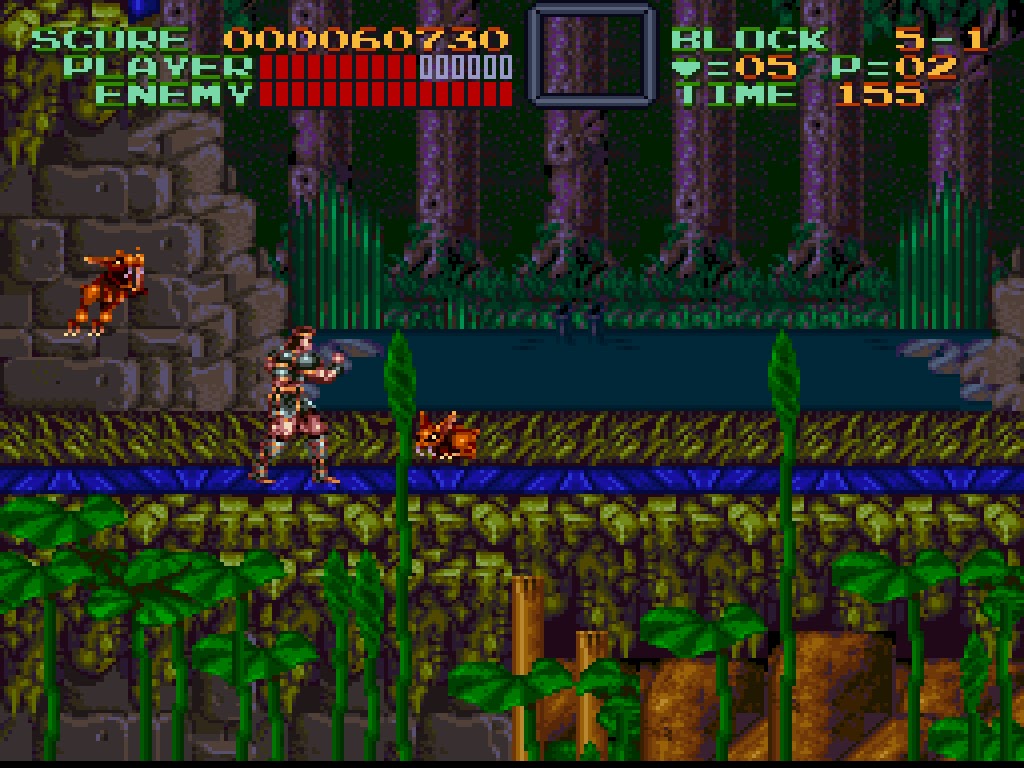
Koranot - one of the many bosses

In Super Castlevania IV, as with previous Castlevania games, the protagonists primary weapon is a whip.  It can be used to attack enemies in eight directions.  It can also be used to latch on to hoops to swing across gaps that are too large to jump.
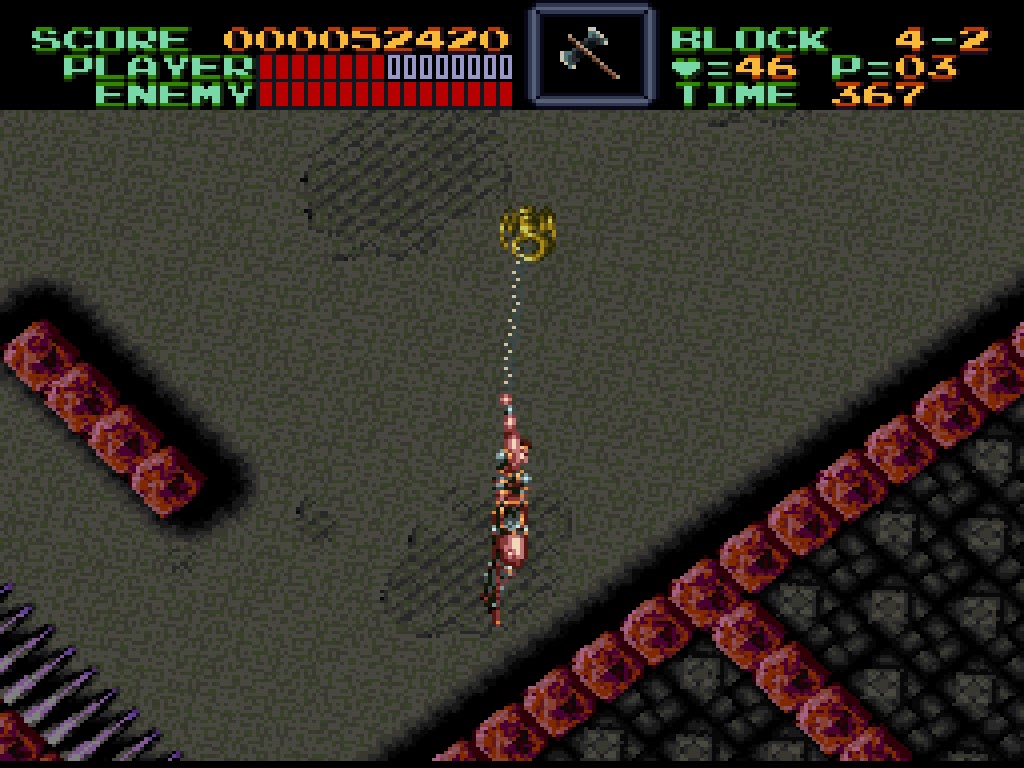
Hanging on to a conveniently placed hoop while the whole level turns through 90 degrees.

Secondary weapons and whip upgrades can be collected by destroying candles.  Only one secondary weapon may be carried at a time and include a watch (freezes enemies), an axe (powerful but difficult to accurately aim), fire bomb (which I found basically useless), a 'boomerang' (causes damage when thrown and when returning) and a dagger (easy to aim but doesn’t cause much damage).  These secondary weapons are powered by hearts which are by far the most numerous objects dropped by candles.  A small heart allows one use of a weapon and a large heart gives five uses.
Where's the Holy Hand Grenade of Antioch when you need it?

If Simon gets hit by an enemy his life bar decreases.  The life bar can be replenished to a certain degree by picking up food that occasionally drops from the candles.  If it expires he loses one of his three lives He can be instantly killed by falling off the bottom of the screen or if the time limit runs out.  Once all lives are lost you are presented with a password, allowing you to restart at the beginning of the same level without power ups or secondary weapons. 

Super Castlevania IV certainly is a great game, although some may find it repetitive.  There is a soundtrack playing throughout which, while not really memorable, is pretty good and matches the mood of the game.  Likewise the sound effects do not really stand out but are more than adequate.  The graphics, however, are excellent.  The artwork is superb and there are several layers of parallax scrolling on some levels.  Mode 7 is put to effective use at various points.  My only gripe is a small one and that is the animation of the main character himself.  If lowly 8-bit computers can manage it in Dun Darach, and Prince of Persia does it with many more frames of animation, why can't Konami make Simon Belmont walk realistically instead of looking like he is ice skating?  It doesn't detract from the action at all but is a personal annoyance I have with animation in many video games.
Mode 7 is put to good use in this rotating corridor

Example gameplay....
 

Thursday, 28 April 2016

Sonic The Hedgehog - Sega Mega Drive - 1991


In the early days of consoles, manufacturers decided it would be a good idea to have a video game character as a company mascot.  Not becoming a console owner until the Playstation 2, I had assumed Nintendo’s Mario and Sega’s Sonic the Hedgehog had always been rivals.  I later discovered this was not the case and that they both made their debut in the arcade a decade apart – Mario as the protagonist in Donkey Kong in 1981, and Sonic in the racing game Rad Mobile.  As an air freshener. 

Later in 1991 Sonic appeared in his own right as the star of Sonic the Hedgehog, ousting Alex Kidd as the Sega mascot.  By this time Mario was already established, having been the main character in several titles (including Dr Mario and three Super Mario games) and a cameo a few others (such as Punch Out!!, Tennis and Golf on the NES).  Importantly, when Sonic the Hedgehog was released on the Mega Drive, Mario had yet to star in a 16-bit game.

Fittingly, Sonic the Hedgehog is a platform game.  Compared to the amply built, moustachioed Italian, Sonic is a lot faster and exudes an impatient attitude.  Pause too long on a level and he puts his hands on his hips and taps a foot. 

The manual says that the mad scientist, Dr Ivo Robotnik, is capturing innocent creatures and turning them into evil robots for whatever reason.  It is up to you to reach Robotniks secret lab, defeat him and save the animals.

The game is set across six zones with every zone divided into three acts.  Each zone has a distinct look and feelGreen Zone is the one that everyone knows.  It contains loops, springs and several routes through.  I like to zip through the stage a fast as possible whereas my wife likes to take her time and collect all the items (this is the only game she has liked on by blog thus far).  Marble Zone slows things down.  It is a linear stage containing some simple block puzzles and requires careful jumping in parts.  Spring Yard Zone is fast level built like a pinball machine with lots of springs and bumpers.  Labyrinth Zone is a convoluted stage with underwater sections where Sonic has to jump into large bubbles to avoid drowningThe Star Light Zone has parts constructed like a roller coaster.  Scrap Brain Zone I haven't yet had chance to play properly.
 
An underwater section in the Labyrinth Zone.  Game play is the same only slower.


The aim of each act is to move from the far left of each level to reach the goal at the far right.  Inhabiting the levels are Robitnik's metallic minions.  These can be dispatched using the Super Sonic Spin Attack which involves Sonic rolling into a ball and barrelling into enemies.  It is performed by using the jump button for a high attack and the down button for a low attack.  Some of the robotic animals have spikes which must be avoided.  When an enemy is killed it releases the animal trapped within.
This creature can only be killed by jumping on it's head.  Anywhere else and you die.
 
To aid Sonic there are several types of power ups dotted around including extra lives, extra rings, shields, speed boosts and temporary invincibility.  Lamp posts act as checkpoints so you don't need restart the level should you lose a live.  There are also rings that can be collected.  Collecting 100 rings in an act rewards Sonic with an extra life.  If you should get hit by an enemy while carrying rings you lose them all.  The rings get scattered but you can normally collect a few before they disappear. If you get hit and have no rings you will lose a life.

Reaching the end of an act with a certain number of rings sends Sonic into a bonus screen, known as the Secret Zone.  This is a spinning level where the goal is to get the Chaos Emerald.  If you pick up enough rings here you can also collect another life.  The manual says you must collect six Chaos Emeralds but doesn't say what they are for.  I assume they are needed to complete the game.
The Secret Zone


At the end of each zone you face off against Dr Robotnik.  He flies a different contraption for each zone and can be defeated by hitting him a number of times with the Super Sonic Spin Attack.  Once defeated you can release all the animals from that zone.
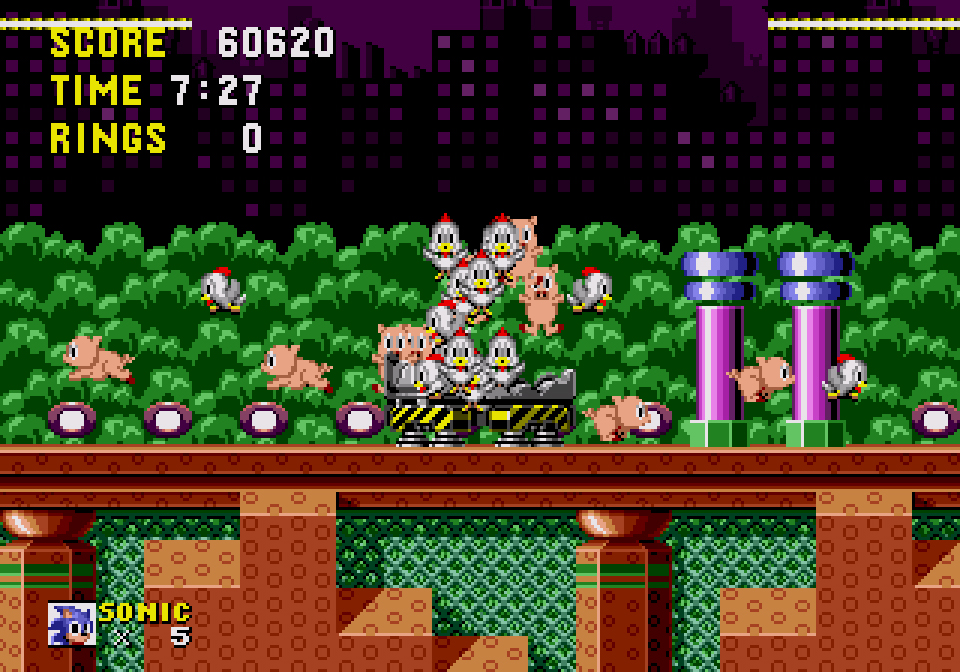
Releasing the animals at the end of Sprint Yard Zone.


In all, Sonic the Hedgehog on the Mega Drive is an excellent game.  The graphics are smooth, colourful and very fast, with slick animation.  The sound and music are top notch.  The controls are spot on and for the most part it's your fault when you die.  There are some very difficult sections and a couple of places where there are unfair deaths.   The unfair deaths can be avoided once you start to memorise the levels.  It also speaks volumes that of all the games I have played so far, this is the only one the Mrs Wingnut has wanted a go on.  She told me used to play it when she was younger, so I let her do the gameplay video.  Bless.

It's not all running.  There are some simple puzzles such as pushing this block onto the switch.


Example gameplay (courtesy of the missus)