Showing posts with label Platform - Sega Mega Drive. Show all posts

Saturday, 31 March 2018

Sonic the Hedgehog 2 - Sega Mega Drive - 1992


Sonic the Hedgehog 2 is the inevitable sequel to the first Sonic the Hedgehog game.  Once again it was well received by critics and went on to become 2nd best selling Mega Drive game of all time, beaten only by its predecessor.

The plot is pretty much the same as before.  Dr Ivo Robotnik is again trying his luck at taking over the world by creating an army of robots powered by innocent creatures.  He is using these robots to build a doomsday machine called the Death Egg.  All Robotnik needs to complete his plan are 7 Chaos Emeralds.  It is up to the blue hedgehog to find them first and foil his plans.

The core mechanics of the game are also pretty much unchanged from Sonic 1.  There are ten themed Zones to get through each divided into 'Acts'.

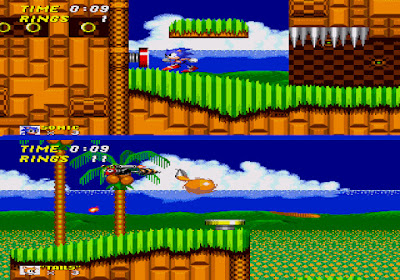
In Sonic 2 you can be accompanied by an anthropomorphic fox named Miles Prower aka 'Tails'.  By default Tails follows Sonic through each zone and is useful for mopping up missed rings.  He also flies by spinning his tail.  Another player can take control of Tails, in which case he just has the same moves as Sonic and cannot fly.  There is also the option to play as either Sonic or Tails alone.  Additionally, the game also features a 2-player split screen competitive mode.  I don't know what it is like on a real Mega Drive, but on the emulator the display looks rather squashed.
You start each game with three lives.  As you go through the levels you need to destroy enemy robots and pick up rings.  You destroy an enemy by spinning into them, which releases the trapped animal within.  If you are hit by an enemy you drop all the rings you are carrying.  If you are hit by an enemy and have no rings you lose a life.  Lives are lost instantly if you are crushed, fall off the screen, drown or exceed the generous time limit.  Extra lives can be picked up during the game or by collecting 100 rings.   Other items that can be picked up include Power Sneakers, Super Rings, temporary invincibility and a one-hit shield.

If you pass one of the Star Post check points while carrying at least 50 rings, you have the option of entering a special stage.  Here the view changes to an 'into the screen' mode where the goal is to collect a certain number of rings whilst avoiding bombs.  Collect the  the required number of rings (this increases with Tails in tow) and you are awarded a Chaos Emerald.

There are seven Chaos Emeralds to collect.  Once you have these you have the ability turn into Super Sonic by gathering a further 50 rings.  This mode turns Sonic yellow and he is invincible with greater acceleration, top speed and jumping abilities.  While in this mode you lose a ring per second and the mode ends once all rings are gone. 

At the end of each zone, Dr Robotnik turns up in a different machine, which you must spin into a number of times to destroy (he always manages to get away).

The music is by the same composer as the original game and is of much same quality.  Graphics, however have been greatly improved - they are of better quality and much faster.  To this end, more of the stages have been designed to take advantage of the extra speed.  A welcome addition is the Super Dash Attack which allows Sonic can reach full speed from a standing start.  I found Sonic the Hedgehog 2 to be harder that the original.  Maybe I need more practice but inertia made it difficult to land on small moving platforms.  It was all too easy for me to fall off the rafts in the Chemical Plant Zone.
****ing moving platforms.  These wouldn't be such a problem Mario game.

It was also too fast for it's own good in places, as you can find yourself bouncing around barely in control.  The Casino Night Zone is appropriate - it's set up like a pinball machine which is sometimes how Sonic 2 feels.  Overall, though, it's a great game and hasn't really dated much at all.

Monday, 5 June 2017

Desert Strike: Return to the Gulf - Sega Mega Drive (1992) & Commodore Amiga (1993)


Desert Strike: Return to the Gulf was released in the first half of 1992, a year after Operation Desert Storm had ended and with the Middle East still fresh in mind. The plot involves a Middle Eastern despot invading a small Emirate and trying to gain weapons of mass destruction.  Some could accuse EA of shamelessly cashing in on these appalling events.  Whatever, it turned out to be the most successful game they had yet produced.

On my shortlist I had the Sega Mega Drive original and conversions for the Sega Master System, Super Nintendo and Commodore Amiga.

The Sega Mega Drive was the first version of the game and was released early in 1992 with the first conversions arriving later in the year.  It could be described as the definitive version of the game with great graphics and sound, and slick controls.  Although I had never played it before if felt familiar.  It then dawned on me it played pretty much like cross between Cyclone and Raid on Bungeling Bay.

I played the Master System version next which, it has to be said, was not very good.  It could not compete with any of the 16-bit versions here and was quite basic in all areas.
The Master System is a poor mans Desert Strike.  The helicopter doesn't even have a shadow.
I really liked the look of the SNES version at first, with its nice big helicopter sprite.  I quickly realised it was only big due to the lower resolution graphics.  The display has a zoomed-in look and therefore doesn't show as much of the play area as the Mega Drive version.  Little touches are also missing such as the wake from the ship you start the game from.  Gameplay is more or less the same as the original.
Desert Strike on the SNES.  Plays pretty much the same as the Mega Drive game but at a lower resolution.
The Commodore Amiga version appeared in 1993.  To quote the manual - 'when it came to designing the Amiga version of Desert Strike there was one question on everybody's lips - what can be done to improve the game?'.  For starters they used the Extra Half-Brite Graphics mode to display 64 simultaneous colours.  Some graphics assets such buildings, targets and especially explosions have been greatly improved.  Music is better and it features sampled sound effects and speech.  The presentation is also much slicker.  The Amiga conversion does have its drawbacks though.  Firstly, the game plays a lot slower which can be a blessing or a curse depending on the situation.  There is also disk loading which is absent on the consoles.  Lastly, the controls are compromised - where the Sega controller has a multitude of buttons, an Amiga joystick has only one (or rarely two) fire buttons.  This means cycling through weapons and accessing the map are via the keyboard.
Mega Drive [left] vs Amiga.  The jets on the Sega look a bit odd to me. 
Of the above I felt the Amiga and Genesis titles came on top.  Each had its own advantages and disadvantages so I was unable to split them.


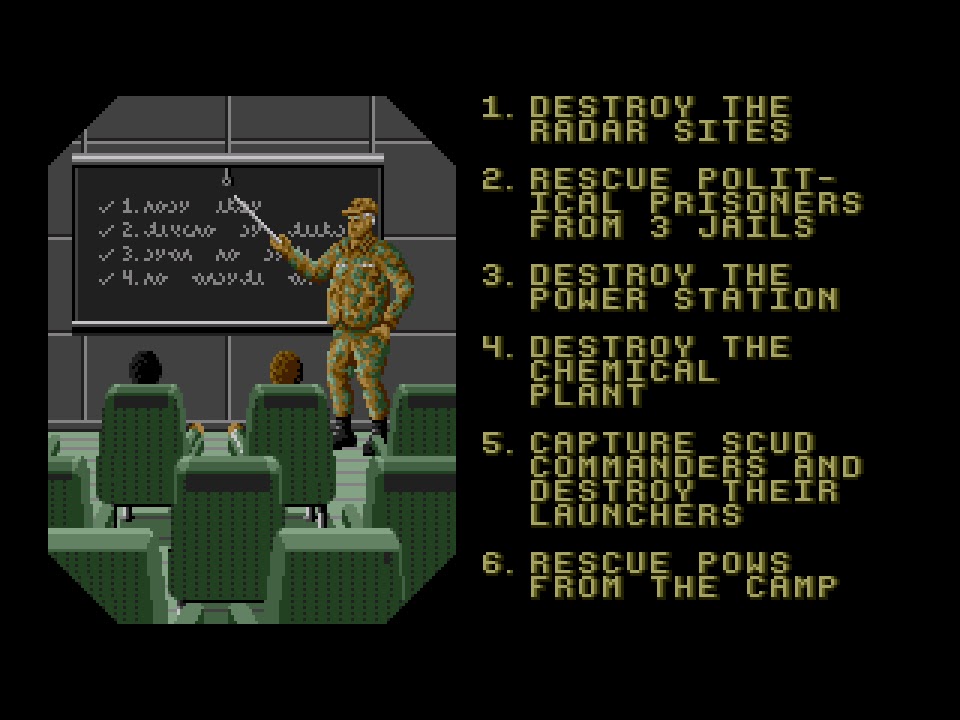
Rather than forming a coalition to send Kilbaba packing, the powers that be decided that all is needed is one man and his chopper.  Desert Strike plays over four 'campaigns' divided into several missions.  The first is called 'Air Superiority'.  Your missions here involve destroying radar sites, power station, airports, command centres, and finally picking up a secret agent.  Although the missions can be played in any order it is recommended playing in the order given as destroying the radars and power station reduces the range and accuracy of enemy anti-aircraft weapons.  The Secret Agent has copies of the Generals plans and his whereabouts is only shown after destroying the command centres and capturing the commander within.

Before you begin the game you must choose your co-pilot.  There are several to choose from, each with their own strengths and weaknesses.  One is marked MIA and can be rescued during the game - he's located next to a downed aircraft on the first level.
Choosing you co-pilot on the Mega Drive [left] and Amiga [right]
I must take issue here with the sprite of your gunship.  Although the game box, manual and in-game stills reference an AH-64 Apache, the main sprite only half resembles one -  the front half.  It looks like they have grafted on the back end of an RAH-66 Comanche with the ducted fan tail rotor and high tailplane.  The Apache has a conventional tail rotor and low tailplane.  I'm guessing this was to simplify drawing the many frames of animation.

The game proper starts with your chopper sat on the back of a frigate and you must head east towards the desert.  You navigate the area by using the map / status screen.  The map shows your objectives as well as the position of ammo crates, fuel, MIAs, missile and gun emplacements.  You can also get a reminder of completed and remaining objectives.  The screen additionally displays remaining fuel, weapons and armour, lives left and the number of MIAs you are carrying.
Status screen on Mega Drive [left] and Amiga [right].
Your gunship is armed with, from least to most powerful, a chain gun with 1,178 rounds of ammunition, 38 Hydra rockets and 8 Hellfire missiles.  The weapons can be fired in the general direction of the target with the accuracy determined by your selected co-pilot.

Ammunition supplies can be replenished by collecting ammo crates that are scattered around the play area.  The finite amount of fuel you carry can be topped up in the same manner.  Fuel and ammo pickups are displayed on the map screen, even those hidden in buildings.

The enemy territory is heavily defended with Rapier surface to air missiles and anti-aircraft guns.  Tiny enemy soldiers carry rifles (they also shoot at MIAs) and portable SAMS. There are also mobile VDAs (armoured vehicles carrying AA guns) roaming the map.  Every hit reduces the armour on your helicopter - you get a buzzer (Mega Drive) or warning speech (Amiga) when it gets too low.  Armour is also depleted if you fly into rock outcrops, high buildings, power lines and other tall structures - the chopper flies at fixed altitude so you can't fly over them.

Armour can be increased by picking up MIAs that are dispersed around the map and taking them to a dropzone. Six MIAs can be wedged into the Apache at one time.  Very rarely armour pickups can be found (usually hidden in buildings).  These pickups do not show up on the map.
Rescuing some MIAs and dropping them off at the LZ for more amour (Amiga)

Once a set of missions has been completed it is back to the frigate for the next level.  Your Apache is limited to three 'lives' which are replenished after each campaign.  You also get a password so there is no need to start from scratch.
Stormin' Norman sets out your objectives for the second campaign (Mega Drive)
And the further you get the tougher the enemies (Mega Drive)

There's a lot to like about Desert Strike whichever version you choose to play.  The handling and momentum feel just right as does the camera which always has the helicopter facing into the screenIt would be fun as just a straight shooter but the limited fuel, weapons and armour adds some strategy.  An excellent game all round.


Gameplay from the Mega Drive


I had a hard time getting Amiga gameplay to look okay on YouTube but here's my best effort (it looks better in reality)


Thursday, 28 April 2016

Sonic The Hedgehog - Sega Mega Drive - 1991


In the early days of consoles, manufacturers decided it would be a good idea to have a video game character as a company mascot.  Not becoming a console owner until the Playstation 2, I had assumed Nintendo’s Mario and Sega’s Sonic the Hedgehog had always been rivals.  I later discovered this was not the case and that they both made their debut in the arcade a decade apart – Mario as the protagonist in Donkey Kong in 1981, and Sonic in the racing game Rad Mobile.  As an air freshener. 

Later in 1991 Sonic appeared in his own right as the star of Sonic the Hedgehog, ousting Alex Kidd as the Sega mascot.  By this time Mario was already established, having been the main character in several titles (including Dr Mario and three Super Mario games) and a cameo a few others (such as Punch Out!!, Tennis and Golf on the NES).  Importantly, when Sonic the Hedgehog was released on the Mega Drive, Mario had yet to star in a 16-bit game.

Fittingly, Sonic the Hedgehog is a platform game.  Compared to the amply built, moustachioed Italian, Sonic is a lot faster and exudes an impatient attitude.  Pause too long on a level and he puts his hands on his hips and taps a foot. 

The manual says that the mad scientist, Dr Ivo Robotnik, is capturing innocent creatures and turning them into evil robots for whatever reason.  It is up to you to reach Robotniks secret lab, defeat him and save the animals.

The game is set across six zones with every zone divided into three acts.  Each zone has a distinct look and feelGreen Zone is the one that everyone knows.  It contains loops, springs and several routes through.  I like to zip through the stage a fast as possible whereas my wife likes to take her time and collect all the items (this is the only game she has liked on by blog thus far).  Marble Zone slows things down.  It is a linear stage containing some simple block puzzles and requires careful jumping in parts.  Spring Yard Zone is fast level built like a pinball machine with lots of springs and bumpers.  Labyrinth Zone is a convoluted stage with underwater sections where Sonic has to jump into large bubbles to avoid drowningThe Star Light Zone has parts constructed like a roller coaster.  Scrap Brain Zone I haven't yet had chance to play properly.
 
An underwater section in the Labyrinth Zone.  Game play is the same only slower.


The aim of each act is to move from the far left of each level to reach the goal at the far right.  Inhabiting the levels are Robitnik's metallic minions.  These can be dispatched using the Super Sonic Spin Attack which involves Sonic rolling into a ball and barrelling into enemies.  It is performed by using the jump button for a high attack and the down button for a low attack.  Some of the robotic animals have spikes which must be avoided.  When an enemy is killed it releases the animal trapped within.
This creature can only be killed by jumping on it's head.  Anywhere else and you die.
 
To aid Sonic there are several types of power ups dotted around including extra lives, extra rings, shields, speed boosts and temporary invincibility.  Lamp posts act as checkpoints so you don't need restart the level should you lose a live.  There are also rings that can be collected.  Collecting 100 rings in an act rewards Sonic with an extra life.  If you should get hit by an enemy while carrying rings you lose them all.  The rings get scattered but you can normally collect a few before they disappear. If you get hit and have no rings you will lose a life.

Reaching the end of an act with a certain number of rings sends Sonic into a bonus screen, known as the Secret Zone.  This is a spinning level where the goal is to get the Chaos Emerald.  If you pick up enough rings here you can also collect another life.  The manual says you must collect six Chaos Emeralds but doesn't say what they are for.  I assume they are needed to complete the game.
The Secret Zone


At the end of each zone you face off against Dr Robotnik.  He flies a different contraption for each zone and can be defeated by hitting him a number of times with the Super Sonic Spin Attack.  Once defeated you can release all the animals from that zone.
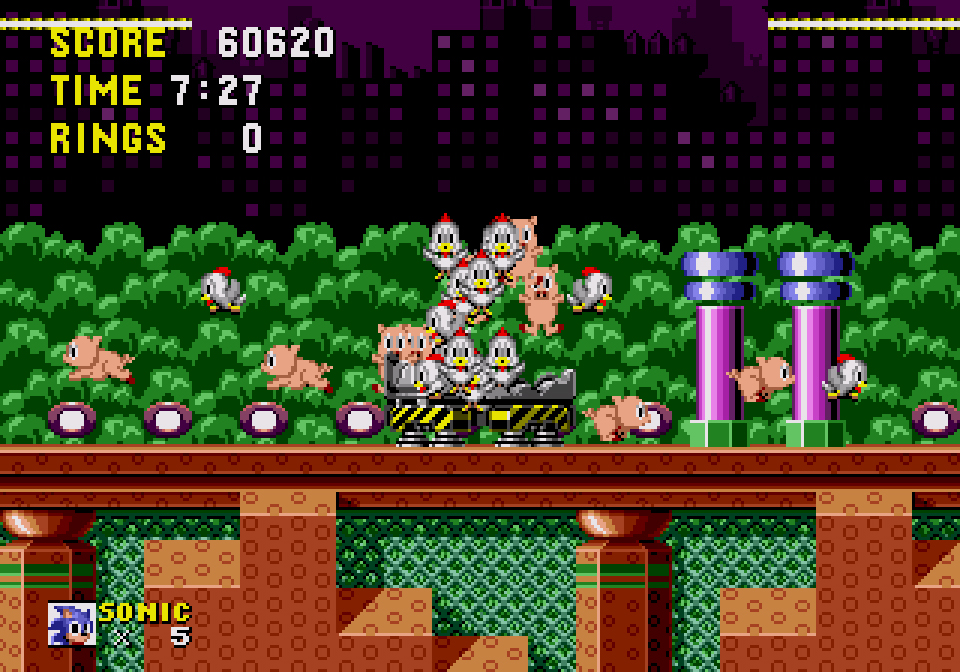
Releasing the animals at the end of Sprint Yard Zone.


In all, Sonic the Hedgehog on the Mega Drive is an excellent game.  The graphics are smooth, colourful and very fast, with slick animation.  The sound and music are top notch.  The controls are spot on and for the most part it's your fault when you die.  There are some very difficult sections and a couple of places where there are unfair deaths.   The unfair deaths can be avoided once you start to memorise the levels.  It also speaks volumes that of all the games I have played so far, this is the only one the Mrs Wingnut has wanted a go on.  She told me used to play it when she was younger, so I let her do the gameplay video.  Bless.

It's not all running.  There are some simple puzzles such as pushing this block onto the switch.


Example gameplay (courtesy of the missus)