You wait ages for a good pinball game to come along then two turn up at once. Pinball Fantasies is the follow up to Pinball Dreams and was released later in the same year.
The game contains four new tables each based around a different theme. The tables are the same width as the previous game but are a longer and slightly more complex.
Partyland has the theme of a fun fair. Speed Devils is based on motor sport.
Billion Dollar Gameshow speaks for itself.
Stones 'n Bones is set in a haunted house,
Apart from the new tables and a redesigned scoreboard there is not a lot of difference between the two games. Everything I've said about Pinball Dreams applies here.
Pinball games have been few and far between on my shortlist. There have been a few 8-bit games which were fairly primitive in both looks and physics. More recently I've played four games in the 'crush' series. While good they were designed from the outset as video pinball games and could never be physically recreated.
So, Pinball Dreams is the first such game to be included on my blog. It was developed by Digital Illusions and originally released in early 1992 for the Commodore Amiga. It has been ported quite a few times up to and including an HD version for OS X in 2011.
On loading the game the credits appear and it is reassuring to see an entry for 'Realtime Ball Calculations'.
There are four themed tables included in the game -
Ignition is the easiest table and is based around a rocket launch and space exploration.
Steel Wheel is based around the railroad and the wild west.
Beat Box is themed around the music industry.
Nightmare is apparently the hardest table and is based around a haunted graveyard.
Each table is a tad over two screens high and scroll vertically. They also have their own theme tune playing throughout. Although decent I found the music overpowered the sound effects, but thankfully they can be switched off.
The controls are responsive with several keys to choose from for the flippers (I chose left and right shift). The plunger can be controlled by the down arrow or pulling back on the mouse. The space bar acts as the 'tilt' key although I have never understood why this is always included in video pinball games.
Apart from loading times, the only real criticism I can lay against Pinball Dreams is that the tables look slightly bland and flat. This is especially so compared against the fantasy 'crush' series, and even against the Space Cadet table that came free with Windows XP. I suppose the 32 colours the Amiga can display at once doesn't help there. It is, however, the physics that can make or break a pinball game and in Pinball Dreams they are spot on.
With a main entry in the Dizzy series you know exactly what you are going to get - a fairly easy adventure game combining platforming, inventory based puzzles and slightly awkward controls. Dizzy: Prince of the YolkFolk is no exception.
The game was first released in 1991 for the Sinclair Spectrum, Commodore 64 and Amstrad CPC and was highly regarded at the time. In 1992 it was converted to the Commodore Amiga, Atari ST and DOS. A Nintendo NES version followed in 1993. Finally an HD remake appeared in 2011 for the iOS and Android platforms. I'm not interested in smartphone gaming on my blog so the winner of this lot is the Commodore Amiga. Normally a game such as this would look the same on the Atari ST but Codemasters went to the extra effort of adding more colours to the Amiga version, notably the graduated sky. It also has the nicest music playing throughout - much better than the grating Atari ST chiptune. The graphics on the DOS version are on a par with the ST, both looking better than the NES. The release on the three 8-bit home computers hadn't really progressed in terms of looks since the original Dizzy from 1988 so come bottom of the pile.
The manual says that Grand Dizzy was feeling down so Dizzy and Daisy decided to bake him a cherry pie. However, Pogie the fluffle (whatever that may be) had stolen the cherries and ran off into the enchanted forest. Dizzy and Daisy chased after Pogie and decided to gather more cherries at the same time. They were soon lost but came across a seemingly deserted castle. Daisy pricked herself on a mystic spinning wheel and felt sleepy. She found a bed where she fell asleep. Before Dizzy could wake her he was captured by Rockwart the troll and placed in an underground prison where the game begins. Your goal is to escape from your cell and awaken Daisy.
Ah, so that's what a fluffle is.
Dizzy starts the game with three lives and a full energy bar. Energy is lost by touching an enemy and a life is lost once it is depleted. A life is also lost if Dizzy ends up falling into water. No damage is taken when falling from any height (even from heaven).
A convenient path through the clouds leads you to the pearly gates. You can fall from here without damage.
Most of the puzzles contained in Dizzy: Prince of the Yolkfolk are fairly logical and are mainly solved by using the right item in the right place. The items are scattered around the flick screen map along with a few red herrings. Your starting prison cell is blocked by a locked door, but when it contains a pile of leaves, a match and a bucket of water it is pretty obvious how to escape. Most puzzles follow this pattern so it is a comparatively easy game to complete. The game also seems a bit shorter than previous Dizzy outings mostly down to the smaller map.
On your way to waking Daisy you must collect 20 cherries to complete the game. Cherries also restore your energy bar if it gets sapped in any way. Additionally there are stars and coins to collect for extra points.
To be honest Dizzy is not that much different from previous games in the series (including the awkward somersault action that can make judging some jumps a pain). Saying that, I can't in all good conscience leave Dizzy: Prince of the Yolkfolk out of my blog when I have included some of his earlier adventures.
After waking daisy you visit Grand Dizzy and bake him the pie
Desert Strike: Return to the Gulf
was
released in the first half of 1992, a year after Operation Desert Storm had
ended and with the Middle East still fresh in mind. The plot involves a Middle Eastern despot invading a small Emirate and trying to gain
weapons of mass destruction. Some could
accuse EA of shamelessly cashing in on these appalling events. Whatever, it turned out to be the most successful game they had yet produced.
On my shortlist I had the Sega Mega Drive original and conversions for the Sega Master System, Super Nintendo and Commodore Amiga.
The
Sega Mega Drive was the first version of the game and was released
early in 1992 with the first conversions arriving later in the
year. It could be described as the definitive version of the game with
great graphics and sound, and slick controls. Although I had never played it before if felt familiar. It then dawned on me it played pretty
much like cross between
Cyclone and Raid on Bungeling Bay.
I
played the Master System version next which, it has to be said, was not very good. It could
not compete with any of the 16-bit versions here and was quite
basic in all areas.
The Master System is a poor mans Desert Strike. The helicopter doesn't even have a shadow.
I
really liked the look of the SNES version at first, with its nice big
helicopter sprite. I quickly realised it was only big due to the lower resolution
graphics. The display has a zoomed-in look and therefore doesn't show
as much of the play area as the Mega Drive version. Little touches are
also missing such as the wake from the ship you start the game from.
Gameplay is more or less the same as the original.
Desert Strike on the SNES. Plays pretty much the same as the Mega Drive game but at a lower resolution.
The
Commodore Amiga version appeared in 1993. To quote the manual - 'when
it came to designing the Amiga version of Desert Strike there
was one question on everybody's lips - what can be done to improve the
game?'. For starters they used the Extra Half-Brite Graphics mode to
display 64 simultaneous colours. Some graphics assets such buildings, targets and especially
explosions have been greatly improved. Music is better and it features sampled sound effects and speech. The presentation is also
much slicker. The Amiga conversion does have its drawbacks though.
Firstly, the game plays a lot slower which can be a blessing or a curse
depending on the situation. There is also disk
loading which is absent on the consoles. Lastly, the controls are
compromised - where the Sega controller has a multitude of
buttons, an Amiga joystick has only one (or rarely two) fire buttons.
This means cycling through weapons and accessing the map
are via the keyboard.
Mega Drive [left] vs Amiga. The jets on the Sega look a bit odd to me.
Of
the above I felt the Amiga and Genesis titles came on top. Each had its own advantages and disadvantages so I was unable to split them.
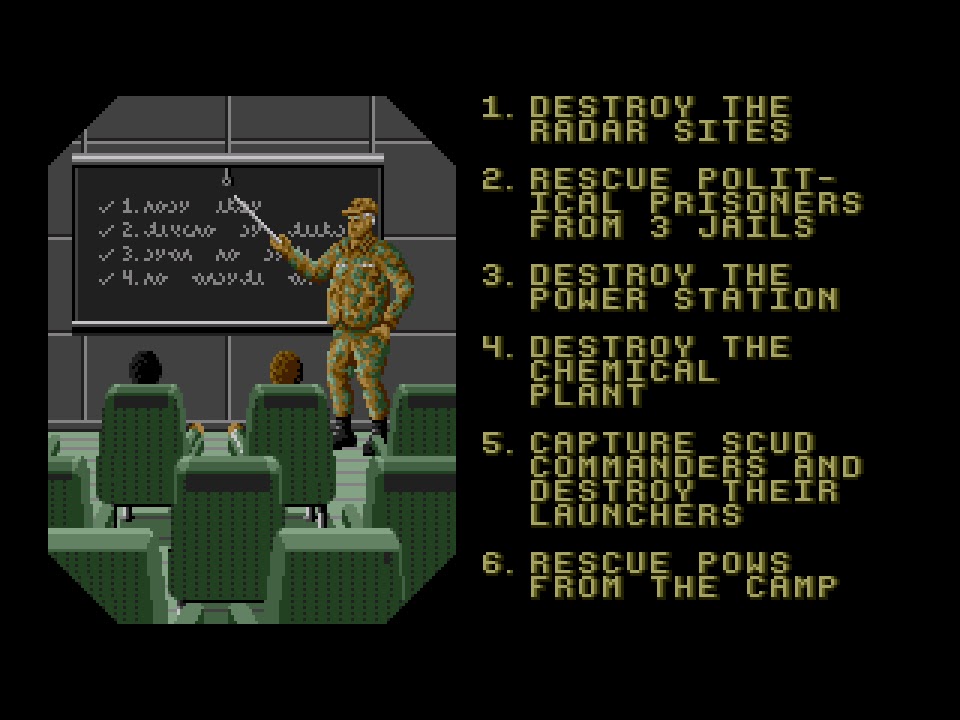
Rather than forming a coalition to send Kilbaba packing, the powers that be decided that all is needed is one man and his chopper. Desert Strike plays over four 'campaigns' divided into several
missions. The first is called 'Air Superiority'. Your missions
here involve destroying radar sites, power station, airports,
command centres, and finally picking up a secret agent. Although the
missions can be played in any order it is recommended playing in the
order given as destroying the radars and power
station reduces the range and accuracy of enemy anti-aircraft weapons.
The Secret Agent has copies of the Generals plans and his whereabouts is
only shown after destroying the command centres and capturing the
commander within.
Before
you begin the game you must choose your co-pilot. There are several to
choose from, each with their own strengths and weaknesses. One is
marked MIA and can be rescued during the game - he's located next to a downed aircraft on the first level.
Choosing you co-pilot on the Mega Drive [left] and Amiga [right]
I
must take issue here with the sprite of your gunship. Although the
game box, manual and in-game stills reference an AH-64 Apache, the
main sprite only half resembles one - the front half. It looks like
they have grafted on the back end of an RAH-66 Comanche with the ducted
fan tail rotor and high tailplane. The Apache has a conventional tail
rotor and low tailplane. I'm guessing this
was to simplify drawing the many frames of animation.
The game proper starts with your chopper sat on the back of a frigate and you must head
east towards the desert. You navigate the area by using the map / status screen. The map shows your objectives as well as the position of ammo crates, fuel, MIAs, missile and gun emplacements. You can also get a reminder of completed and remaining objectives. The screen additionally displays remaining fuel, weapons and armour, lives left and the number of MIAs you are carrying.
Status screen on Mega Drive [left] and Amiga [right].
Your gunship is armed with, from least to most powerful, a chain gun with
1,178rounds of ammunition,
38 Hydra rockets and 8 Hellfire
missiles. The weapons can be fired in the general direction of the target with the
accuracy determined by your selected co-pilot.
Ammunition
supplies can be replenished by collecting ammo crates that are scattered
around the play area. The finite amount of fuel you
carry can be topped up in the same manner. Fuel and ammo pickups are displayed on the map screen, even those hidden in buildings.
The
enemy territory is heavily defended with Rapier surface to air
missiles and anti-aircraft guns. Tiny enemy soldiers carry rifles
(they also shoot at MIAs) and portable SAMS. There are also mobile
VDAs(armoured vehicles carrying AA guns) roaming the map.
Every hit reduces the armour on your helicopter - you get a buzzer (Mega Drive) or warning speech (Amiga) when it gets too low.
Armour is also depleted if you fly into rock outcrops,
high buildings, power lines and other tall structures - the chopper
flies at fixed altitude so you can't fly over them.
Armour can be increased by picking up MIAs that are dispersed around the map and taking them to a dropzone. Six MIAs can be wedged into the Apache at one time.
Very rarely armour pickups can be found (usually hidden in buildings). These pickups do not show up on the map.
Rescuing some MIAs and dropping them off at the LZ for more amour (Amiga)
Once
a set of missions has been completed it is back to the frigate for the
next level. Your Apache is limited to three 'lives' which are
replenished after each campaign. You also get a password so there is no need to start from scratch.
Stormin' Norman sets out your objectives for the second campaign (Mega Drive)
And the further you get the tougher the enemies (Mega Drive)
There's a lot to like about Desert Strike whichever version you choose to play. Thehandling and momentum feel just right as does the camera which always has the helicopter facing into the screen. It would be fun as just a straight shooter but the limited fuel, weapons and armour adds some strategy. An excellent game all round.
Gameplay from the Mega Drive
I had a hard time getting Amiga gameplay to look okay on YouTube but here's my best effort (it looks better in reality)
If I were forced to list my top
10 favourite games of all it would be something of a struggle. One title I can confidently say would be on
there is Populous. It was the game I spent most time playing in
my Atari ST owning days and is still playable today. Needless to say, I was very excited when the
sequel was released back in 1991. It
received excellent reviews and I didn’t baulk at paying for the 512k memory
upgrade that was necessary to play the full version of the game.
As it turned out, Populous II: Trials of the Olympian Gods
was something of a disappointment to me.
Although the graphics were more detailed than the original game, the colourful
visuals were replaced with a drab palette.
The animation of the characters also seemed to take a hit by using less
frames. Finally, although there were
many more acts of divine intervention, few appeared in every game and many weren’t
particularly effective. If ever I needed
a Populous fix it would be the original
game I would load up.
If replaying retro games has taught
me anything, it is that most are rarely as good as you remember them. Replaying Populous
II turned this premise on its head as this game is better than I recall.
The core gameplay is pretty much the same as the original - you play a god who must shape the landscapeso your followers can build houses and produce more followers. More followers means more mana which is used to unleash your godly powers against your rivals followers. This time there is a story tacked onto the game. You play the offspring of one of Zeus's encounters with a mortal woman. Your goal is to defeat the olympian gods, and ultimately Zeus himself, to be allowed into the Pantheon atop Mount Olympus.
Aside from the graphics, the main difference between Populous and Populous II are the number of divine acts. There are now 29 effects split across 6 elements - People, Vegetation, Earth, Air, Fire and Water. Most of the old effects are there with a few changes. Swamp and Armageddonare much the same as they were in the original game. Earthquake is a more powerful effect than it was as it splits open the ground and leaves cracks for your enemies to fall into. The Volcano is much more devastating - it spews out lava and fire columns and leaves a large tract of uninhabitable land that takes a lot of time and effort to make usable. The Flood effect has been replace by Tidal Wave which erodes low lying land. Finally, Knights have been replaced by Heroes.
The destructive power of the volcano.
There are six heroes in all, one for each of the six elements portrayed in game. Perseus from the people element is most like the knight from the first game. He is the most intelligent of the heroes and is good at avoiding traps. Using Adonis, the hero of vegetation, can be a double-edged sword. After each combat he divides into two weaker heroes. After a while you have a bunch of weak Adosis' getting killed and giving your opponent a big chunk of mana. Heracles is double the strengh of the leader used to create him and, like all the heroes, is immune feats of the same element, such as earthquake. Odysseus is the hero of air and is the fastest of all the heroes. Achilles is the hero of fire and burns everything in his path. Lastly, Helen of Troy is the most over-powered of the heroes. She marches into enemy territory and causes any person she touchesto blindly follow her. The entranced followers cannot be controlled in any way.
Other interesting acts of god are baptismal fonts which change the alignment of a person falling into them. Thereis a contagious plague (with an annoying sound effect). Infected followers and buildings make little contribution to mana and disintegrate if Armageddon is used. You can lay down a fungus which abides by the rules of Conway's Game of Life. The Forest feat creates trees. This might not seem useful at first until you plant a bunch around the enemy buildings and start a forest fire.
Populous IIalso retains the creatures thatoccasionallywander across the level leaving an indiscriminate wave of destruction in their wake.
After each world you are awarded up to 5 lightning bolts. These act as experience and can be used to give a boost to feats in any of your six elements.
Experience is doled out after each victory.
So, with all these new additions I should find Populous II: Trials of the Olympian Gods better thanPopulous, right? Well, not in my case. The first problem is there are 1,000 worlds to conquer- twice the number of the original game. This is fair enough but it took a fair few hours and I gotinto the 200's before I suffered my first defeat. This brings us to the second issue - you can no longer see the acts of god available to your rival. Had I known the enemy god had Helen of Troy available I would have changed my tactics, but the only powers I could musterwere Raise/Lower Land and Move Papal Magnet. I couldn't attack Helen of Troy as any person she touched would become enchanted. As she was from the water elements I couldn't drown her. All I could do was watch as my followers became entranced and my towns disappear.
Don't I know it.
In spite of the above flaws, Populous II: Trials of the Olympian Gods is better that I remember and rightfully deserves a place on my blog. As much as it has gone up in my estimation, I still prefer the first game.
This screen is shown before each world. Unfortunately it does not show your opponents powers.