Showing posts with label Games F. Show all posts

Tuesday, 29 April 2014

Final Fantasy III - NES - 1990


Final Fantasy III came out in Japan in April 1990 for the Nintendo Famicom – just over two months before the original Final Fantasy was released in North America.  It was the third and final instalment to be published on the 8-bit console before the franchise moved over to the 16-bit Super Famicom/SNES.  Like Final Fantasy II the game wasn’t released in the West so I will be using a fan translation.  The only English version was a 3D remake for the Nintendo DS from 2006.  There were quite a few differences but I will use those instructions as the basis for my playthrough.  The rest I will have to work out as I go along.


I was hoping this instalment was going to be a little more original.  The plot says that your party of four orphans have been tasked with 'sweeping away the Darkness' that is threatening the world.  So far, so very Final Fantasy.  The graphics are also pretty much the same…


Hopefully the story and the ‘job system’ will make things more interesting.

The first thing to do is to name the four protagonists.  Lacking any imagination, I took the names straight from the DS manual.  You are then plopped in the bottom of a dungeon which had been created after an earthquake.  The only graphical difference between the characters is their colour.  Their default job is listed in the game as ‘onion kid’.  I can’t begin to guess why the starting class is named after a pungent vegetable.  In the dungeon there were a few simple combats followed by a boss.  Combat uses the same system as the previous two Final Fantasy games.  As well as gaining Exp and Gil (currency) after combat, you also accumulate Capacity Points.

Capacity Points form the basis of the ‘job system’ as they are needed to change your ‘job’ or character class.  The longer a character remains in the same class the more proficient they become.  This is something I will need to experiment with as I go.  I can already foresee plenty of grinding.

After defeating the dungeon boss you come across the Wind Crystal who says the balance of everything is crumbling and the characters have been chosen to restore it.  The Crystal also gives you some of its power which allows access to the initial selection of jobs.

South of the dungeon is their home town of Ur.  As before, speaking to the citizens results in a stock response.  This normally changes once a related quest has been completed.  It looks like the option to memorise key words that was introduced in Final Fantasy II has been removed.

So far I have upgraded my party to three Fighters and a Monk.  My plan is for two of the Fighters to become a White Mage and Black Mage after a little grinding.  I have covered the first overworld area (there is boulder preventing any further progress) and have discovered a second town, a castle and the entrance to another dungeon which is blocked by a lake.

As is my wont with JRPGs, I began with some pre-emptive grinding.  One improvement over the earlier games is that if a character targets an enemy that is subsequently killed he automatically targets another - the attack is no longer wasted.  I also took this opportunity to experiment with the job system.  The initial choices are Onion Kid (the default class), Fighter, Monk, White Mage, Black Mage and Red Mage.  I retained Luneth as a Fighter and Arc as a Monk. I made Refia a White Mage and Ingus a Black Mage.  Although the whole party were gaining levels, only Luneth and Arc were gaining job skills from the combat.  It was the same when I tried a Red Mage even though they are able to use most weapons.  I therefore reverted the Mages to Fighters.  After finding a SLEEP spell in the Altar Dungeon I changed Ingus back to a Black Mage.  Ingus tends to go last in combat so is still not gaining skills as fast as the melee characters.

I used Ur as my base for grinding as one of the buildings contained a couple of springs.  One spring restores all hit and magic points, and the other resurrects dead characters.

I didn't even know that was a word

After my initial bout of grinding it was only left to fully explore the first area.  I had previously visited the Altar Dungeon north of Ur which offered up some good items and the aforementioned SLEEP spell.  Kazus was literally a ghost town.  The earthquake had broken the seal that held a Jinn who in turn changed the inhabitants into ghosts.  It was mentioned the Jinn could be defeated using a Mithril ring that was made for Princess Sara of Sasoon Castle.  The ghost of Cid said he had hidden his airship in the nearby desert and I could use it to cross the lake to the Cave of the Seal where the Jinn was hanging out.

My next stop was Sasoon Castle but the Jinn had got there before me as everyone here had also been turned into ghosts.  Princess Sara, who was protected by the ring, had already made her way to Cave of the Seal.  I found a Wight Sword which a guard said would help against the undead in the cave, but only a Red Mage could wield it.  I changed Refia to the Red Mage and returned to Ur to stock up on potions and spells.

It took a couple of attempts to get to the Jinn but he wasn't too difficult to defeat due to my earlier grinding.  Princess Sara then warped us back to Sasoon Castle.  For saving his life and the lives of his daughter and his subjects, the King bestowed upon us…a…a canoe?!  A poxy canoe!  At least we can cross the lake to retrieve the airship.  A guard revealed there was a secret passage to the King’s treasury which I cleaned out before I left.  That’ll learn the tight-arsed git.

In Kazus they were more grateful.  A smith made a mithril bow for the airship with which to ram the boulder that was blocking our passage.  The collision between the rock and the hard place resulted in both the boulder and the airship being destroyed.

I am now back on foot, but with the first area open the world is now my oyster – at least until the next obstruction.  Before heading out I will grind some more against the undead in the Cave of the Seal; the CURE spell harms undead creatures (which kind of makes sense) so I can use that to improve Refia’s White Mage job skill.  I will note my thoughts below…


  • While grinding it became apparent the enemy can now jump our party from behind and get a free attack in.  It confused the hell out of me at first.

  • There are a lot of hidden items and secret passages to discover.  Some can be seen, some are revealed by NPCs and others can be found by accident. For example, Cid allowed us into his already secret storage room after we cured his ailing wife.  This contained another secret passage leading to yet more items.  Although they have nothing to do with the main quest these little extras make rewarding diversions and can offer up useful items.
I knew there was a reason why some steps when into the water.

  • Job changes can be forced upon your characters.  I had to cast the MINI spell on my party to enter a couple of dungeons.  The small characters could only cause a maximum of 2HP damage with weapons so I had to make Luneth and Arc mages so they could cast offensive spells. 

  • Locked areas in Final Fantasy III are a lot smaller than in the earlier titles and can be quickly cleared before moving on.  At least for now there doesn’t seem to be any way to return to previously visited locations so it’s hard to determine the overall size of the game world.  As yet there has been no need for mapping.

  • Soon after writing the above I acquired a ship which opened up (almost) the rest of the ‘world’.  The ‘world’ turned out to be one of those floating continents that show up from time to time in fantasy games and novels.  This continent was quite small and could be circumnavigated in a matter of minutes on a chocobo (this was a side quest).
The edge of the floating continent.  Using chocobo avoids random encounters.

  • While on the subject of chocobos – there is a fat one you can summon in certain places to store items and ease the burden on your inventory.

  • A good feature I would have liked to have seen on some other RPGs is that equipping weapons and armour alters your Attack and Defence values, so you can easily compare items.  These values, and XP and HP, were the only stats I really needed.  For me, the main stats screen was mostly superfluous.

  • On the floating continent we discovered another crystal that gave us more jobs to choose from.  I only elected to upgrade Luneth from Fighter to Knight.  After completing all the quests, Cid converted our sailing ship into an airship allowing us to reach the world below. 
  • This world appeared to be mainly open ocean and the SIGHT spell proved invaluable in allowing us to locate the few pockets of dry land.  We came across a shipwreck and were told the populace had been turned to stone and the earthquake had caused the land to sink.  Reaching the Water Crystal caused the land to rise again and gave us more jobs.  I changed Arc from Monk to Karateka.
  • I had to cheat a bit and use a map from the internet to spare me the pain of creating one myself.  Apart from the floating continent (which didn’t need mapping) there is another large overworld area and an equally large undersea area.  For the most part dungeons were pretty simple affairs that could be memorised (apart from the Cave of Darkness and later the Dark World which both contained numerous secret passages).
The world had to be explored from both above and below the water to avoid missing anything.
 
  • There is a good selection of airships available during the game including the submersible Nautilus and Invincible that can be used to traverse mountains for a short distance.  Invincible also contains a bed, vending machines for (weapons, armour, spells and magic items) and a fat chocobo.
The Invincible contained everything you could need.

  • The last section of the game took part in three interconnected dungeons - Forbidden Land Eureka, Sylx Tower and Dark World.  These are surrounded by yet another dungeon - The Ancient's Labyrinth.  I had heard this last section was very difficult as the game cannot be saved in a dungeon - only on the surface.
The final save point.

  • Attempt one did not go very well.  I can't remember exactly how far I got, but Arc and Refia were turned into frogs rendering them harmless.  Lacking any Maid Kisses I had a trying time getting back to the airship to track some down.  While I was at it I picked up some extra items to counter-act other status effects.  The next time I was better prepared.
  • On exploring Eureka I found it contained some healing springs and shops selling the most powerful spells, armour and weapons.  You could also gain the best jobs - Ninjas were able to use all weapons and armour, and Sages could cast any spell.
  • At the end of the Sylx Tower is the Dark World.  From here there is no return to the surface to save.  Companion NPCs from earlier in the game helped gain entry…


  • I discovered the final boss, Dark Cloud, very easily after moving north from the entrance.  My second attempt at this last section also went pear shaped as none of my spells or weapons had any effect on her/it.  I had to reload from outside the tower and make my way through Eureka and Sylx Tower again.
  • For my last try I explored the rest of Dark World before heading north.  I found there were four dark crystals, each guarded by a tough boss.  I had a few deaths but the LIFE 2 spell bought characters back to life with full health.  If Refia was killed a Fenix Down followed by an Elixir did the same thing.  Many CURE spells and Potions were also consumed.  As each boss was defeated the crystal released a Warrior of Darkness. 

  • My next crack at Dark Cloud went better as these Dark Warriors had weakened it.  It was a long battle including one death (followed by a LIFE 2) and a round when all the characters needed to drink an Elixir but I got there in the end.  Here is the 10 minute ending sequence.....


Since my last Final Fantasy game I have completed three Gold Box games so it was refreshing to get back to an RPG with an intuitive interface and decent sound and graphics.  I’m glad the developers did away with the flawed levelling mechanism of Final Fantasy II and went back to the more traditional system of the first game.  The job changing mechanic also adds an interesting twist to the proceedings.  Graphics and sound effects haven’t been updated much but they were good by NES standards anyway.  The music, however, seems much better and more varied.

Bad points?  As with the earlier games the random encounters started to become monotonous towards the end of the game.  I also preferred the plot, if not the execution, of the earlier titles - in your travels you had the feeling something evil was abound in the world – especially in Final Fantasy II.  In this game the populous seemed to be behaving as normal even after they had returned from being submerged under the sea.  The last criticism applies to any RPG I have played and that is the currency.  I have yet to find a balanced system and halfway through this game I was a millionaire, though to be fair I did spend it all on shurikens in Eureka.  It would have been better balanced had every single monster not dropped money.

Overall, Final Fantasy III has renewed my interest in a franchise that was beginning to wane after only two games.  I am now looking forward to see what Square can do on the SNES.


Thursday, 14 November 2013

Fantasy Zone - Sharp X68000 - 1989


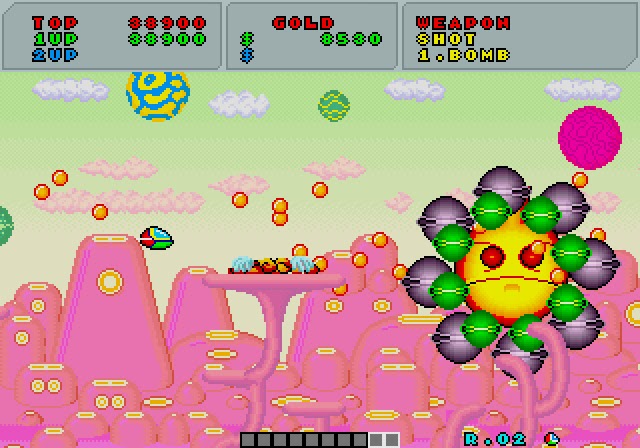
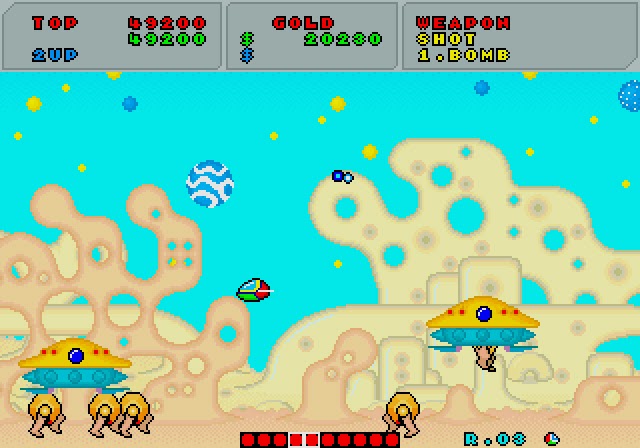
Fantasy Zone is a conversion of the Sega arcade game from 1986.  I played the Master System conversion from the same year but didn’t think it that great.  1989 saw it released on the NEC PC Engine console and Sharp X68000 computer.  From previous experience I knew the Engine would struggle against the mighty X68000 and I wasn't wrong.  Fantasy Zone on the latter looked better, sounded better, was faster and had sharper controls.  It also has parallax scrolling which is lacking on both the PC Engine and Master System versions.

PC Engine version is easily beaten by the X68000 conversion
The plot says that the planet Menon has caused the collapse of the interplanetary monetary system.  Someone is leading their forces to steal all the money from other planets to build a huge fortress in the Fantasy Zone.  Playing as Opa-Opa, you must destroy the invading enemies and put an end to their plans.

The game takes place over a horizontally scrolling play area.  The play area wraps around indefinitely and you can fly in both directions.  The primary aim of the game is to take out the enemy bases in each zone.  The relative location of each base is shown on a radar at the bottom of the screen.  Each base has an indicator on the front which changes from blue to red depending on how much energy they have left.  In addition to the usual formations of nasties that fly around, the bases release more opponents to harrass you.  A boss fight ensues once all the bases have been destroyed in each zone.


The bosses, bases and some enemies drop coins when they are killed.  These can be collected and used to buy upgrades in a shop that appears in the form of a red balloon.  Main weapon upgrades are time-limited and you get a limited quantity of upgraded bombs.  Ship upgrades stay until you lose a life.  These upgrades get progressively more expensive each time you buy them.


In spite of it's cute and colourful looks, Fantasy Zone is a very challenging shoot 'em up.  Like all good arcade games it is also addictive, having that 'just one more go' quality.  In all another impressive arcade conversion on the X68000.


Saturday, 9 November 2013

Fantasy World Dizzy - Commodore Amiga - 1989


Fantasy World Dizzy is the third in a series of graphic adventures featuring the anthropomorphic egg.  Dizzy has already featured on the blog but I omitted Treasure Island Dizzy as it only gave you a single life which I found somewhat harsh.  Fantasy World Dizzy makes amends as you start the game with three lives.

As usual I tested the game on various platforms to find the best version.  The Spectrum, Amstrad and Commodore 64 incarnations are basically unchanged from Dizzy where the graphics are predominantly black.  The 16-bit versions on the Commodore Amiga and Atari ST look much better with higher resolution graphics and a lot more colour.  Unsurprisingly for this era they look and play identically. The only difference is the music playing throughout where the Commodore machine just pips the Atari’s jaunty chip tune.

In this game Dizzy has to rescue his girlfriend, Daisy, who has been kidnapped by the Evil King's troll.  Daisy has been taken to Wizard Weird's tallest tower while Dizzy has been consigned to the King's dungeon.  

The gameplay is pretty much the same as the previous games with Dizzy somersaulting his way around the landscape.  As before, he must find a use for the various objects scattered around in order to save his beloved.  He can carry up to two items in his inventory (or four when you find a bag).  Most of the puzzles are logical and can be solved without too much thought.  In addition Dizzy must collect 30 gold coins to fully complete the game.  Some are hidden behind scenery so it is worth pressing the fire button when you find yourself hidden from view until you know where they are.


As well as Daisy, other members of the eggy clan make their debut in this game.  Speaking too these 'yolk folk' opens up a cut scene where they give up a useful object to help you progress.


The graphics in Fantasy World Dizzy do a good job of bringing the character into the 16-bit world.  There is a tune that loops continuously throughout the game.  There are no sound effects to break up the music which does get rather monotonous after a while.  The puzzles aren't too taxing on the gray matter although some do require trial and error.  The main difficulty comes from from some of the platform elements mainly due to the somersaulting action.  This can make certain sections extremely challenging when you also have to time the jumps (damn you dragon!). Overall, though, Fantasy World Dizzy is a fun little game - especially on the 16-bit computers.

Things get confusing after jumping into the bottomless well.


Example gameplay


Sunday, 19 May 2013

Final Fantasy II - NES - 1988

A rebel ship carrying a Princess about to captured by an imperial vessel captained by a Dark Knight. Hmmm...
 
Much to my surprise I really enjoyed Final Fantasy so was looking forward to playing Final Fantasy II.  This is Final Fantasy II on the NES which was released only in Japan, not the Final Fantasy II released on the SNES which in reality is Final Fantasy IV.  The original Final Fantasy II later became available in the West with subsequent remakes on newer consoles and smart phones.

Anyhow, Final Fantasy II is set in a different world to the previous game and has a new set of protagonists.  As I can't understand a word of Japanese I installed a translation patch by Neo Demiforce and am utilising the Final Fantasy Origins manual.  

You start the game by naming your party of four friends but don't get to choose their character class.  In Final Fantasy Origins they are already given names which I decided to use.  Firion was adopted as a child by Leon and Maria's parents and grew up as part of their family.  Leon is Firion's adopted brother and best friend.  Maria is Leon's sister.  Finally, Gus is not given a background but the manual says he possesses great strength is able to communicate with small hairy critters (beavers as it turned out).

These svelte individuals are a far cry from the chubby sprites.

The story so far is that the Emporer of Paramekia has summoned fiends from another dimension in bid to take over the world.  A rebel force was formed in the kingdom of Phin but in the ensuing battle the kingdom was lost.  The rebel force retreated to the town of Altea but the four protagonists were left orphaned and homeless.

The games kicks off with a similar looking battle screen to Final Fantasy where your characters are promptly defeated by a band of Dark Knights.  

Your first taste of the game is an unwinnable battle.

The party is found by Princess Hilda who takes three of them to Altea, but Leon has disappeared.  As you are too inexperienced, Princess Hilda won't let you join the rebellion but you are advised to head back towards Phin to search for Leon.

When you speak to NPCs they again give stock answers.  Occasionally key words are highlighted that can be memorised for use in conversations with other characters.  Completing quests changes the dialogue for major NPCs so it is good idea to revisit them. For the majority of quests NPCs are temporarily added to the fourth party slot.


On they way back to Phin random encounters rear their head again.  The battle system looks very similar to the first game but ranged weapons have been introduced and your party can be formed into two ranks.  Only party members in the front rank can successfully attack with melee weapons.  Characters at the rear are protected from physical attacks but can be harmed by ranged weapons and magic.  Combat is turn-based and if a party member targets a monster that is destroyed or flees then that attack is wasted.  I have all my party in the front row - I want them to get hit so they gain HP....

Character development has been completely overhauled and at this early stage I am confused as to which direction to take. Character classes have been done away with and attributes are increased depending on how each character behaves in combat. For example, if a character uses a lot of spells their Intelligence and maximum MP may increase. If they use physical attacks Power may increase.  If they keep taking a beating maximum HP may increase.  Characters can also become adept at using a particular type of weapon and they level up in weapon skills the more they use it.  Not having played this game before I'm unsure of the best way to go.  At the moment my plan is for Maria to focus on using a bow and magic, for Gus to concentrate on the axe he started with (I've since found he can dual wield so added a sword), and for Firion to become a bit of an all-rounder.  The flip side of all this is that attributes can also decrease which looks like developing a well rounded character quite difficult.  Intelligence decreases when Power increases.  Vitality decreases when Intelligence increases.  When Soul increases it depletes your Power.  Sod it, I'll make Firion a fighter too.

The stats screen from early on. Firion is not the sharpest tool in the box to begin with and can't afford to lose much intelligence.

Magic is another area that has been changed.  Each character is now given a pool of mana which depletes when casting a spell. Spells can again be bought in Magic Shops or can be found as treasure and any character is able to learn them.  As with weapon skills,  spells start at level 1 and increase in level the more you use them.  As spells reach higher levels they get more powerful, but use more mana when they are cast.

Back to the story - I found Phin was overrun with imperial forces but discovered Hilda's dying fiancé hidden in the basement of a pub.  He gave me a ring which he said will help me on my journey.  On returning to Altea with the news, I was allowed to join the rebels and then sent on my first mission to find some mithril.  I will not be writing a walk through (I can recommend Shen Nung's hugely entertaining Inconsolable blog for that)  but I will gather my thoughts and experiences below.....
                              
  • Despite the world map looking more open than the original Final Fantasy, you are still herded along the main quest path. Wander too far off the beaten track early on and you will encounter monsters than can take down a character with a single hit.
  • You can save the game as many times as you like outside of towns and dungeons, but you won't regain any mana and health without a shelter.  MP and HP can still be fully replenished by staying at an Inn.
  • In the first dungeon I found a FIRE spell and started encountering slimes that can't be hurt by normal weapons.  Further down I found an EXIT spell and immediately a powerful tortoise-like creature appeared. I lost half my party in the ensuing battle and had to use the spell to escape to the overworld.  Although I had already purchased both these spells, it's little things like this that shows the thought that has gone into the game progression.
  • I really like the story though some of it seems a bit forced in places in order to include all the plot points.  In the Snow Cave it mysteriously wouldn't let me use the EXIT spell to leave.  This was obviously scripted as when I got back to the entrance a boulder started rolling Indiana Jones style down the stairs and Josef, who was already dead, miraculously came back to life before sacrificing himself for the party.
  • Another point regarding the plot is you feel you are fighting the empire all alone.  Apart from the quest characters who temporarily join you, where are the rest of the rebel forces?
When you say 'we'.....                                                               Yeah, just as I thought!

  • Once I was getting used the the game I didn't mind the levelling system too much.  This changed when I entered Dist Cave and started encountering Gigases.  These not so jolly green giants are very resistant to both spells and weapons. I had to spend a lot of time grinding out SLEEP, SAFE and BLINK spells before I was able to defeat them on a regular basis.  Even then it took quite a few EXITs and returns to the nearest inn before I was able to fully explore the dungeon.
Bastards!

  • Another annoyance is that quest items can't be dropped or sold even though you no longer have use for them.  Items picked up early such as the ring and the ice sled have to be lugged around through the entire game taking up valuable space in your inventory.

I can see why the character progression system is divisive but I didn't mind it at first and got used to it quite quickly.  It became tiresome when I had to start prolonging random encounters and keep using the same spells over to level them up.  Thankfully levelling up weapons skills was easier.  In the end I developed Firion as a fighter and Gus as an unarmed ninja, both with useful spells to back up Maria who was the main spellcaster.  Having well developed characters was easier than I initially thought - even though certain stats can decrease, the net effect is an overall increase, although Firion ended the game as a simpleton.  I found the game much harder than Final Fantasy with more full party deaths - getting through the Empire's airship and Dist Cave during the game were particularly tough, as was Jade Passage/Pandemonium at the end.  

I must mention the bestiary here as the developers did away with most of the enemies from the previous game.  The few that have returned have different artwork. Lot's of other developers I can think of would re-use graphics and monsters when doing a sequel. The game world is a different story with a lot of the tiles carried over from the previous game, however the graphics still look good for the NES so I have no complaints there.  Most of the music in Final Fantasy II is quite pleasant and varied too - only the battle screen tune, which returned from the first game, really started to grate.  I found the plot thoroughly enjoyable, though there was a lot of back-tracking to pick up the next quest.  I have to admit that towards the end I was willing the game to be over as it was starting to get repetitive.  Nearly all the quests involve travelling to a dungeon, retrieving the quest item therein, and returning to Altea or Phin to find out where to go next. Random combats were also getting annoying and monotonous.  That said, Final Fantasy II is still a great game and was worth playing.  I'll be interested to see if Square can come up with something fresh for the third and final title on the NES.  Hopefully the quest and levelling system will be given a major overhaul or Final Fantasy III might not appear on this blog.


Other highlights (includes spoilers)....

I don't mind a game that doesn't take itself too seriously....


Getting eaten by a Leviathan was an excuse to add yet another 'dungeon'.  Obviously linear, at least you could only head toward the mouth....


After defeating the Emperor for the first time, celebrations were cut short when a messenger  announced the Dark Knight had taken his place.  As was hinted at earlier in the game, the Dark Knight was Leon.  As it turned out his reign was rather short....


The End.  The final round of combat against the Emporer and the ending scenes.  "Gwaaaahhhh!!" indeed....


Sunday, 16 December 2012

Final Fantasy - NES - 1990


Cruising the Aldi Sea.

From 1987 we are temporarily jumping ahead in time to 1990 for my next game….

Before embarking on my blog I had never played a Final Fantasy game.  Hell, I’d never even played a JRPG.  Final Fantasy on the NES was released in Japan in 1987 with the English language version not appearing until 1990.  Due to my desire to try the Japan-only Final Fantasy II and Final Fantasy III I am reviewing the first game early to keep them in chronological order.  It is the first in a long series spanning not only the JRPG backbone, but includes other genres such as MMORPGs and even a rhythm action game.

As a JRPG virgin, what did I expect?  I expected lots of random encounters and a linear story-led quest.  Because of this I half expected not to like the game.  In reality I think it’s great.


Basically you control four Light Warriors as they attempt to restore light to the orbs they carry. To accomplish this they need to defeat four elemental fiends who are ravaging the land.

Your initial task is to select up to four characters from a choice of six classes. The available classes are Fighter, Thief, Black Belt, Red Mage, White Mage and Black Mage. The Fighter is your standard warrior type and can use all types of weaponry and armour.  The manual says ‘the thief is good to have when you need to avoid an attack from the enemy’ which makes him superfluous in my book (moreso as I didn't find any traps to disarm, locks to pick or anything to steal).  The Black Belt can fight effectively without weapons.  The Red Mage is described as a fairly good fighter who can cast some Black and White magic spells.  The White Mage can cast only White (mainly defensive and healing) spells and the Black Mage can only cast Black (mainly offensive) spells.  Both the Black and White Mages are weak fighters.  You can give your characters any name you like as long as they contain no more that four letters.  Your characters are given stats but I didn't take note of whether these are preset or randomly generated.  These stats  increase during the game as you gain levels.  The manual suggests rookie players should select a Fighter, a Black Belt, a White Mage and a Black mage.  That’ll be me then.

Your party is dropped on the map just south of the castle and town of Croneria.  Despite being without arms and armour I decided to take a quick look around and it wasn't long before I came across my first random encounter.  The combat screen displays your party on the right and enemy creatures arranged on the left.  The combat is turn based and menu driven with you and the creatures fighting until one side is destroyed or flees.  Combat options are Fight, cast Magic spells, Drink a potion, use an Item and Run away.  Once you select an action for each of your characters, the combat cycles through all the participants until they have all taken their turn. Some enemies have special attacks such as paralyse or poison.  Some can turn you to stone.  With the party arranged in a line, combat is not very tactical as any character can attack any enemy and vice versa and there are no ranged weapons.  Additionally if you have a character attack an enemy creature and it dies, any subsequent attacks already aimed at that particular creature are wasted.  When enemies are killed you collect an amount of gold and experience points dependent on the creature type and how many there were.

You can't have an RPG without skeletons.


After a couple of skirmishes I headed into town to heal and tool up.  With a couple of exceptions each town has the same shops.  There is a weapon and armour shop to buy combat gear.  An inn allows you to save your game and restore magic and hit points.  The Clinic allows you to reincarnate a dead character for a small fee.  There is a white and black magic shop with each store in the town selling a particular spell level.  For example, the two magic shops in Croneria sell first level spells, while Elf Town has four magic stores selling third and fourth level spells.  Finally there is a supplies store where you can purchase various potions and various shelters.  The shelters are tents, cabins or houses which are used to restore health and save the game when you are not near a town.

I'm sure I can squeeze a few cabins and a couple more houses into my backpack.

As I mentioned, magic spells are bought in shops with the higher level spells getting progressively more expensive.  Each level has four spells while a mage is only able to memorise three of these so you need to choose wisely.  You are able to cast a set number of spells for each spell level.  The number of spells you can cast is increased as your character gains experience.

Here is my summary and thoughts of the game (for a full walkthrough check out Zenic Reverie's  RPG Consoler blog here (still WIP at the time of writing) or the irreverent Shen Nung and his Inconsolable blog here). 

  • Unlike a lot of CRPGs, Final Fantasy does not let you explore everywhere straight away.  For the first quest you can only travel in one direction as you are blocked in by mountains and the sea.  After this you can again only explore a bit more land before you get a ship.  After this you can navigate a landlocked sea until further quests opens this up.  Although you are spoon-fed the plot, the pacing is set just about right.  It is not until you get an airship that the whole world opens up.
  • Random encounters are not nearly as annoying as I thought they would be.  They are set at just the right difficulty and frequency. I only wished it could be like the Ultima series and you could see monsters coming.  Also, the enemy creatures increase in level depending on location.  As you explore new locations the stronger the enemy get.  Earlier locations will always contain the same weak enemies no matter what level you have reached.
  • There is no NPC interaction to speak of.  Talking to an NPC triggers a stock response which may or may not change if a related quest is completed.
  • The amount of money you get is set about perfectly.  You can get about every necessary item you need without much grinding, and there is always something (such as higher level spells) to spend your gold on or to save for.  It is only late in the game that gold becomes irrelevant.
  • Buying from shops is a pain in the arse.  You can only purchase one item at a time so buying, for example, fifty potions with at least three button presses for each one is needlessly time consuming.
  • Gaining experience/levelling is very well implemented and didn't have to go out of my way to grind.  For a few quests I had to make a several attempts, getting closer each time, without feeling the need to go hunting for random encounters.  Additionally, one of the early dungeons has a lot of set encounters on adjacent tiles so you can use these to gain experience points if needed. When I completed the game all my characters were on level 37.
  • In comparison to a lot of random encounters the boss fights were relatively easy, rarely lasting more than a couple of rounds.
  • One thing I really loathe is unmappable levels.  One of these appeared in the Sky Castle where you can travel on indefinitely as the level just keeps wrapping around.  This strikes me as lazy programming and it was more through luck than judgement that I made it to the next floor on my second attempt (my first thought was that the game wouldn't let me continue because I didn't have the adamant sword).
  • Considering the limitations of the NES the graphics are nigh on perfect.  Apart from some odd palette choices (green wolves?) I can’t see how they could have been improved.
  • The music and effects are okay.  There are only a handful of different tunes used on the various screens and locations yet I didn't feel the need to mute the sound which must say something.


Final Fantasy is a peach of an early RPG.  The graphics are excellent and sound is good considering the host platform.  It is also nice having the play area taking up the whole screen rather than viewing it through a window (à la Ultima/Bard's Tale etc).  The plot unfolds at a decent pace - you are forced along a linear path in the first half of the game but once you obtain the airship the whole world opens up.  There is also a nice twist at the end.  The  difficulty is set just about right - there were times when I had to limp into the nearest town with two dead characters and I only had a couple of full party deaths.  If the other games in the franchise are as enjoyable as this I am in for a treat.

You are given a Rat's Tail(!) on completing the Citadel of Trials.  Taking it to Bahamut the dragon rewards you with a class change.

Entering the dungeon to defeat the final elemental fiend.  It is only accessible by a submarine.
There is a nice twist near the end of the game.  You have to travel back 2000 years in time to defeat the final boss and complete the game.

Final boss fight and rather long-winded ending....