Showing posts with label Games K. Show all posts

Friday, 6 June 2014

The Killing Game Show - Atari ST - 1990


The title of this game piqued my interest when I noticed it on my shortlist.  It was down as a top game for the Atari ST yet I had never heard of it.  From the title I guessed it would have been a platform game taking inspiration from the show in The Running Man film.  I wouldn’t be that wide of the mark.

There is a long winded story in the manual setting the scene, but briefly you are part of a resistance movement attempting to overthrow the 21st Century Government Inc. for whatever reason.  However it turns out there is a traitor in the resistance and you are captured by the Secret Police.  To set an example you are enrolled as a contestant in The Killing Game Show.  The Killing Game Show is a televised event where the participants are criminals.  They attempt to earn their freedom by escaping the 16 ‘Pits of Death’.  Contestants are ‘prepared’ by having the lower half of their body removed. The flesh is then stripped from the top half and replaced with armour.  It seems to me the game was completed first then a plot devised to fit.  If you ‘win’ all that remains is a mess of internal organs, not a hero as the resistance leader would have you believe.
Triple lasers making short work of the enemies.  The number of magazines are on the left, bullets on the right.

The Killing Game Show was released on the Atari ST and Commodore Amiga in 1990.  Sega Mega Drive/Genesis owners received it a year later renamed as Fatal Rewind.  The Amiga version is by far the best looking and sounding of the three. It has the best music of the trio.  It has smooth parallax scrolling (missing on the ST) and pretty water reflections (absent on the Sega).  The computers also contain two more levels than the console game.  The only place Fatal Rewind comes out on top is that the Mega Drive can play music and sound effects simultaneously where on the computers you can only listen to one or the other.

The Killing Game Show is a run-and-gun platform game played over 16 levels.  It takes place across 8 cylindrical satellites, each divided into 2 wraparound sections or ‘Pits of Death’.  Flying around these levels are waves of ‘Hostile Artificial Life Forms’.  These HALFs move in intricate patterns doing their best to sap your energy.  To add urgency to the proceedings there is ‘Deadly to Organic Life Liquid’ (DOLL) that gradually rises to fill the pit.  If you touch the DOLL or your energy is depleted you lose a life.  Your goal is to travel from the bottom of each pit to the top.

Scattered around the levels are containers concealing various weapons and tools.  Weapon upgrades replace your standard single shot laser but have a limited number of shots before reverting to the default weapon.  Tools include extra energy, shaped keys, ‘water freezer’ and Oracles (these give hints when used).  You can carry only one tool and one weapon upgrade at a time.
The Water Freezer power up is essential at the beginning of this level.

When you lose a life you are sent back to the beginning of the section. An ingenious feature is that you are shown a replay of your previous attempt.  You can interrupt it at any time to take back control of your character.  This way you can get back to the point you messed up without playing the whole level again. You are able to fast forward the replay to save time.

Your character itself is very mobile.  It can jump, crouch and climb walls on the way to the top of the pit.  The challenge comes from finding, then memorising, the correct path through each level.  Some sections offer an additional challenge apart from escaping.  For example, one section on the second satellite requires you to collect diamonds.
Diamonds need to be collected on this stage.  The shaped key I'm carrying fits in the lock on the right.

So, the Amiga has the best looking graphics, the best scrolling and the best sound.  That makes it the winner, right?  Wrong. The Killing Game Show on the Commodore suffers the same frustrating difficulty as Blood Money (also by Psygnosis).  The first section is easy enough but I kept getting killed by the DOLL on the second.  To find out why I could get further on the Atari I went to the same point in both games and waited for the rising liquid.  On the ST I had to wait 1 minute 32 seconds, whereas on the Amiga I died after only 44 seconds.  The DOLL rises over twice as fast making the game far too difficult

So the Atari ST emerges as a surprising winner.  Losing the parallax layer helps the game scroll quite smoothly – not something the ST excels at.  The music, again, is fairly good for an ST and can be switched to sound effects if it becomes unbearable.  It also has the extra levels over the Mega Drive conversion.

The only issue I have (which also affects the Amiga) is that your character can get ahead of the slow scrolling.  Until I got used to it I occasionally died off-screen without seeing what had hit me.

The Oracle (eye pickup) gives hints.  Nice reflections.


Example gameplay....

Sunday, 15 July 2012

Kung Fu - NES - 1985


Kung Fu is a conversion of the Kung-Fu Master arcade game released by Irem in 1984.  The game is a simple side scrolling beat ‘em up in which you have to rescue your kidnapped girlfriend. I was in two minds on whether to include this as why have arcade conversions when the real thing is so much better?  I thought I’d give it a chance anyway and gave it a go.  Then another.  Then another.  It had me hooked so I had to add it to my list.

Not the most original plot.

The game is set over 5 levels, each ending with a boss.  The first level hosts only two types of enemies but more are added as you progress.  Your character only has a limited number of moves – he can crouch, jump, punch and kick. The punch attack scores more points than the kick but has a shorter range.  You have a limited time in which to complete each level and bonus points are added to your score depending on the remaining time and any energy left.

I’m not a massive fan of the Street Fighter style games that require 6+ buttons and memorising special moves so Kung Fu appealed to me due to its simplicity.  The graphics are obviously not as good as the arcade machine and neither is the animation; however I find the sound to be better.  Overall, Kung Fu is a great, addictive little title.  It is a bit repetitive though this is to be expected in a game such as this.

I felt bad beating on these little fellas.


Sunday, 22 April 2012

Kokotoni Wilf - Sinclair Spectrum - 1984

Whoever drew the graphics had no concept of scale

Now, from some of the best graphics on the Spectrum to some of the worst.  Seriously, if I gave my five year old nephew a box of crayons he could draw better dinosaurs than appear on the first stage of this game.

Kokotoni Wilf was originally released in October 1984.  I got it as part of the Soft Aid charity compilation tape in late 1985.  As can be expected on a charity tape there were a few duds, but Kokotoni Wilf stood out.

You control the unfortunately named Kokotoni Wilf and your goal is to collect (isn’t it always?) parts of the Dragon Amulet.  Apparently the amulet keeps some dragons asleep and the spell is due to wear off.  Ulrich the wizard can renew the spell, however the amulet has been broken into pieces and scattered across time.  As Ulrich’s assistant it is your task to collect the pieces. To aid you in your quest he has given you a pair of wings – the normal jump control being dropped in favour of a fly button. The fragments of amulet are represented by stars.  When all the stars on a particular stage have been collected a flashing star will appear.  This flashing star is a time gate and touching it will take you to the next time zone.  The first time zone is 1,000,000 years BC and the last is 2001.

On the original cassette inlay Wilf is depicted as a toga wearing, athletic looking fella.  In the game he is anything but.  The action moves along at rather a sluggish pace and would have benefitted from having the speed tweaked to make it a tad faster.

As I have mentioned the graphics are rather basic and sometimes completely out of scale. Animation is also simple using only two or three frames at most for each object. Sound is not great either being limited to flapping wings and some simple beeps.  Having said that collision detection is spot on, which is essential in this kind of game.

Despite my criticisms Kokotoni Wilf is a good game.  It’s annoying that I can’t put my finger on why, but there is something that draws you in.  Though it shouldn’t be, this is an addictive game and one I enjoyed playing again.

A 1984 vision of 2001


 Maps and end screen....


And they all lived happily ever after.


Tuesday, 17 April 2012

Knight Lore - Sinclair Spectrum - 1984


Knight Lore is a 3D isometric adventure game published by Ultimate Play The Game.  It was the game that spawned a new trend for this viewpoint during the mid to late 80’s.  Although Ant Attack had used isometric projection over a year before, it had failed to capture the imagination like Ultimate’s 'filmation' releases.  Knight Lore was one of three games featuring Sabre Man released during 1984, following on from Sabre Wulf and Underwurlde.  According to Tim Stamper it was supposedly completed before Sabre Wulf but was held back "because the market wasn't ready for it".

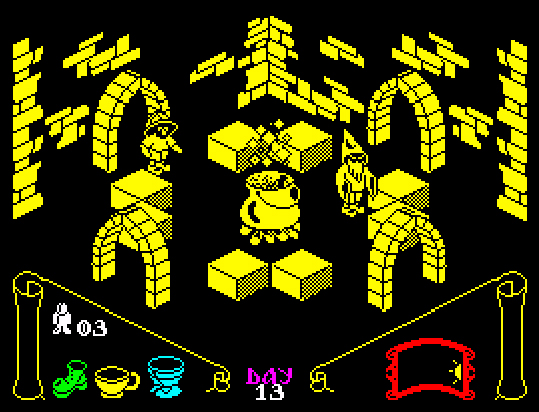
The ultimate (excuse the pun) goal of the game is to cure yourself of lycanthropy by visiting the dying wizard Melkhior in Knight Lore castle.  To do this you have to seek out the cauldron room which is situated near the centre of the castle.  In this room you’ll find Melkhior the wizard and, obviously, a cauldron.  The wizard doesn’t look like he’s knocking on heaven’s door as he perpetually circles the cauldron and kills on contact.  The cauldron itself flashes up an ingredient you need to collect in order to create a cure for your disease. Once you deposit the object a new item is shown. You have a time limit of forty days represented by a dial displayed at the bottom of the screen.  When a moon shows on the dial you change into the ‘werewulf’.

The castle contains more than 100 rooms – I’ve mapped it but haven’t counted.  Many of the rooms require platforming and lateral thinking skills (and occasionally luck) to get through.  The platforms are made up of blocks, some of which are moving and others which may sink or disintegrate when stood upon.  There are also a variety of enemies present in the castle which will normally kill on contact.  The only difference I can see between sabreman and the werewulf is that certain enemies are repelled by the former and attracted to the latter.  This can be useful to remember when navigating certain rooms.  The sparkly thing atop the cauldron also attacks you if you enter the room as a werewolf.

I first played Knight Lore around a friend’s house soon after completing Alien 8 and remember the game mechanics to be a bit clunky next to the later game.  This was especially true of the transformation between sabreman and werewolf which can happen at inopportune moments.  Also annoying is the way you can die by having spiky objects randomly drop from the ceiling in some rooms – I hate unfair deaths.  Playing again with fresh eyes it’s not nearly so frustrating. It is certainly more linear than Alien 8 and, if I remember correctly, it is easier to die – mainly on something spiky or by touching one of the fast moving ghosts. I also found the time limit a bit punishing.  I ran out of time after putting 8 objects into the cauldron so haven’t completed it…..yet.

It is another good game from Ultimate and was certainly a trendsetter but I think I will prefer the more refined Alien 8 when I get to 1985.

One of the more annoying screens with randomly falling spiky balls


I should mention here that Knight Lore was also released for the Amstrad CPC in 1985.  It generally plays slower than the Spectrum version - frustratingly so if there are more than two moving objects on the screen.  They also added an extra colour but some of the combinations are a bit jarring.  I prefer the footstep sound on the Spectrum as well - the Amstrad version plays a note each time Sabreman takes a step which can and does get annoying after a while. The Speccy version is better in my opinion.

Amstrad CPC - Painful on the eyes and painfully slow

Map though very small due to flickr limitations