Showing posts with label Platform - NEC TurboGrafx-16. Show all posts

Thursday, 30 November 2017

Dungeons & Dragons: Order of the Griffon - NEC TurboGrafx-16 - 1992

Nice box art.  Shame about the hairstyles.


Order of the Griffon is the second RPG I have played on the TurboGrafx-16 after the highly enjoyable Dragon Slayer: The Legend of Heroes.  This game was published by SSI and developed by Westwood Associates who were also responsible for the Eye of the Beholder series.  It eschews AD&D in favour of the Dungeon & Dragons Basic Edition ruleset.  It was not translated for a PC Engine release in Japan.

The first task is to assemble a party of four characters from a choice of seven classes - Fighter, Mage, Cleric, Thief, Elf, Dwarf and Halfling.  Within each class you have a choice of three pre-generated characters.  Out of the twenty-one portraits only one was obviously female with a couple androgynous characters thrown in.

Playing the game blind I would usually choose a fighter, cleric, mage and thief.  As the manual only mentions fighting and spell casting in the class description I decided to substitute the thief in favour of another fighter type.  My starting party is Keir the fighter, Tor the dwarf, Marius the cleric and Falcone the mage.  All characters start at level 1.

Each character view shows three slots for armour, two for rings, two for ready equipment and one each for boots and gloves.  Shields take one of the armour slots so a fighter, for example, can have a sword and a sling equipped whilst carrying a shield - I'm not sure yet how bows will work (it turned out bows, shields and swords could be readied simultaneously).  Spell casting characters must have either an ankh or a spellbook ready in order to use magic.  There is also a shared inventory.

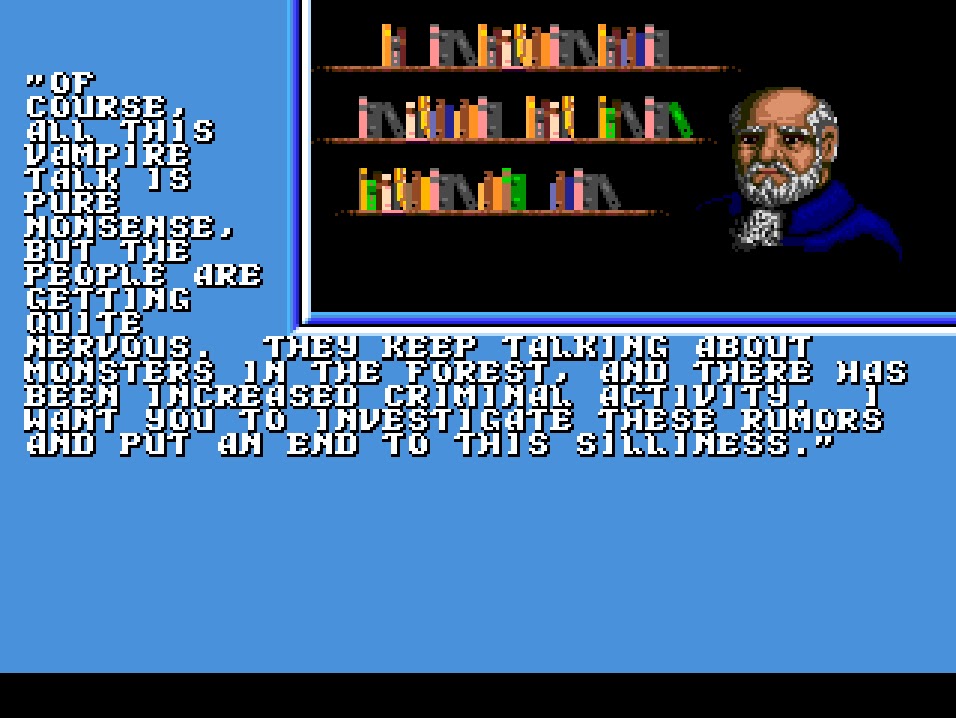
The game starts in the City of Radlebb Keep where Lord Korrigan hires the party to investigate rumours about the vampire Koriszegy.  There are also monsters appearing in the forest and an increase in crime.  He pays you 200 gold pieces upfront with the balance due on completion of the mission.

Navigation in town is done via a first person view where you move one square at a time (the view switches to top down in the wilderness).  Like the Gold Box games rooms appear empty but sometimes have a description of what they contain.  At least you don't have to look it up in a booklet.  In the town of Radlebb there are the usual establishments.  There is an Armoury that sells weapons and armour including a few magic items and potions that are out of my price range.  At the Magic Shop you can buy scrolls and have magic items identified.  There is a Temple that can cure wounds and raise the dead - this is necessary at the start of the game as a level 1 cleric can't any cast spells.  There is also a Tavern where you can rest to restore Magic Points.
Only one of these options is of any use.

In the first area you are advised to visit the Hall of the Griffon where you will receive your first quest.  The Order of the Griffon are a noble group of knights, paladins and fighters who are unable to spell Griffin.  Unless they do actually mean Griffon....
Grrrr!!
Here you are given your first quest which is to recover a magic staff from a den of Dire Wolves.  I will note my thoughts below....

  • The graphics and music throughout are very good.  Sound effects are pretty simple, limited to combat and spells.  Music composer, Frank Klepacki, also wrote the scores for a host of other Westwood games including the Command & Conquer series.
The overworld.  This town was optional but contained some good items.

  • Combat takes place on four pre-defined battlefields - one each for the overworld, towns, dungeons and inside buildings.  The party is placed in a random starting point with the enemies close by.  The combat is turn-based and is viewed top-down.  Each character has the option to move within a highlighted area and can then use weapons or cast spells.
  • If spells are cast against one of your characters it is mostly impossible to tell what there are unless they have an obvious effect.
  • It turns out I was correct in not choosing a thief as they are superfluous in this game.  There were no traps to disarm nor locked chests to pick.  Locked doors could be bashed in.
  • I don't know if Basic Dungeons & Dragons has THAC0, but you can't see your chance to hit in this game.  Additionally, equipping items such as Girdle of Giant Strength or Gauntlets of Ogre do not change your stats.  You can tell the are working only because you do more damage.
  • Missile weapons, such as darts and arrows, are limitless.  If you have, say, Dart +2 equipped, you have an unending supply.
  • In theory the combat should be just as good as the Gold Box games but this is not the case. Characters with full plate mail can only move two squares per turn so moving into position takes time.  As each character takes up two squares they have to be moved carefully to prevent them blocking one another.  Spells are limited in variety and by the number that can be memorised; at level 6 my cleric could only memorise two level 1, two level 2 and one level 3 spells.  Weapons are also limited in variety.  The best melee weapon is the long sword.  For missile weapons you have a choice of slings (not much damage) for the Cleric or darts (very limited range) for the Mage.  The best missile weapons for the fighters are bows which can be readied alongside a sword and shield.
  • As I've just mentioned the full set of D&D spells have not been included.  For example, there are only two level 2 mage spells and just one level 3 cleric spell to choose from.
Some of the spells that are included have nice graphical effects and fireball is ever useful.

  • Most magic items can be found after combat, but shops also sell a good selection. 
  • The Magic Shop has a couple of useless options.  "Look around" does nothing.  There is an Identify option but all magic items are already identified.

  • As far as I can tell there are only random encounters on the overworld.  Towns and dungeons only seem to have fixed combats.  The exception to this is when you are sometimes interrupted while resting in dungeons or in the wilderness.
  • As always the economy becomes a problem towards the end of the game.  Once you have all the best spells and gear, there is nothing to spend your gold pieces on.  Thankfully it doesn't cause encumbrance as you have no choice whether to pick up gold and there is no way to drop it.
  • All the characters are capped at level 8.  Without grinding, Marius peaked relatively early and Falcone maxed out in the final dungeon.
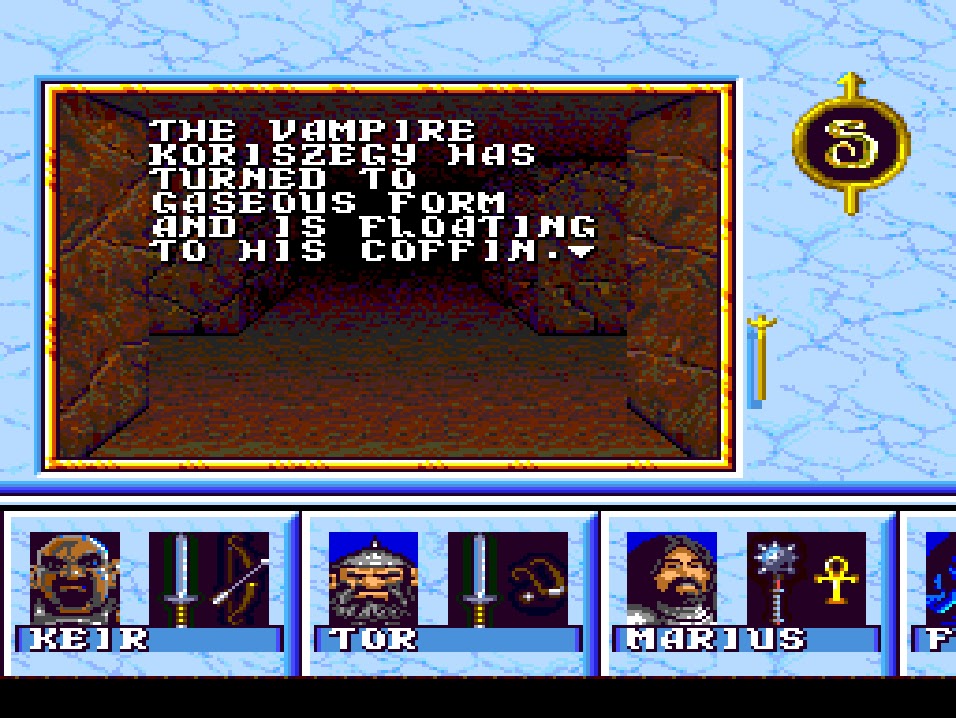
  • As the game progresses it is revealed a vampire called Koriszegy is planning to take over the realm.  A group called the Iron Ring are kidnapping folk so Koriszegy can create an undead army under his control.  Your party is tasked to stop him, first by obtaining the gems he is using to create the undead army, and secondly by defeating Koriszegy himself.  On the way you have to defeat Nosferatu (who the Order of the Griffon originally thought was Koriszegy) and rescue a Princess from the clutches of the Iron Ring.  Finally, you need to retrieve three items with which to defeat the vampire.

Although I've picked a lot of holes in Order of the Griffon, these are mainly due to the implementation of the D&D rules.  I'm also probably unfairly judging it against the Gold Box games.  As it stands it is an enjoyable adventure.  The game world is not stupidly big and doesn't throw hundreds of random encounters at you like a lot of console RPGs.  The graphics are pretty good and the music that plays thoughout the game did not have me reaching for the mute button.  It's by no means the greatest RPG in the world, but it kept me interested until completion.


The End

After gathering all the items required to defeat Koriszegy I was sent off to find him in his keep.  During mapping and pulling a couple of levers I found the vampire but couldn't reach him due to an impenetrable field.  I soon encountered another vampire who said I needed to find three levers to switch off the field.  He also explained specifically how to defeat Koriszegy before disappearing in a puff of smoke.
Ah, okay...

After finding the third lever I returned to Koriszegy.

It took two goes to defeat him.  On the first attempt his 'army' was spread out and behind walls so area effect spells were not effective.  His allies were able to pick off my characters one by one.  The second attempt took place in another portion of the battlefield where they were more conveniently arranged.


After the battle you win a good haul of useless treasure.


Tuesday, 1 August 2017

Dragon Slayer: The Legend of Heroes - NEC TurboGrafx-CD - 1992


Dragon Slayer: The Legend of Heroes is the sixth installment in the Dragon Slayer series of RPGs.  Its initial release was in 1989 for the NEC PC-8801 before being converted to other computers and consoles.  The English translation was released on the NEC TurboGrafx-CD in 1992.

The game takes the usual JRPG format of top-down scrolling dungeons and overworld, with turn-based battles.  The overworld is not obviously grid-based like the NES Final Fantasy games I have played and allows eight way scrolling.  I also think the overworld is at least semi turn-based in that if you stand still long enough you will get a random encounter.  

Combat is turn based with the usual options of attack, magic, item, defence, run etc.  When a character and monster will take their action is mostly dependent on their Speed attribute.  With combat over you are awarded an amount of XP and gold.  If you run, the enemy remains viewable on the overworld map and can re-engage in combat. Levelling is automatic and you gain increases in Hit Points and Magic Points which are also fully replenished.  Each time you level up, your attributes also increase by 1 or 2 points.  

If in combat a member of your party should reach 0 Hit Points they fall unconscious.  If the enemies are defeated that character wakes up after the battle with 1 HP.  If the whole party is unconscious you are given the choice of restarting the battle or returning to the last town visited.  You cannot die in Dragon Slayer.

Magic spells can be collected from certain NPCs and are added to your spellbook.  Any character can use any spell and each takes a certain amount of Magic Points to cast.  There are lots of spells available with different powers but slots in the spellbook are limited.

A narrated intro sets the scene for the game.  The land of Farlayne was invaded by monsters and an epic battle ensued.  The monsters were defeated but King Corwin was killed.  Five year old Prince Logan was considered too young to rule the kingdom so Baron Drax declared he would rule as regent until Logan came of age.  Fearing for his safety, Logan was taken to the town of Exile.  That was 10 years ago....

Baron Drax announces that he is to become regent.


The game begins in Exile with the player taking the role of crown Prince Logan.  You are being prepared to take over as ruler on your upcoming sixteenth birthday.  Suddenly the town comes under attack by a horde of monsters.  You are ushered through a secret passage by your adviser and a told to make your way to the castle to request reinforcements from Baron Drax.  It turns out Baron Drax (with a name like that he was never going to be a goody was he?) sent the monsters to destroy Exile.  He intends to keep the crown for himself and to marry your mother.  He didn't expect you to escape alive so throws you in the dungeons and will use your life as a bargaining chip to force your mother to marry him.

It doesn't take long for the resistance to show up and spring you from jail.  You flee to their secret headquarters in the town of Revere.  The leader tasks you with heading to The Pits where you can free the slaves to help fight Drax and his guards.  He also makes no secret of the need to grind.... 

While grinding I discover this first section of the game is set on an island.  All the ships are conveniently guarded to stop you getting ahead of the plot.  I did find the town of Nigel where I could buy better weapons and armour.  I also discovered why I got my Level 8 arse kicked at The Pits....

After more grinding I freed the slaves and we headed to the castle to take on Drax.  We caught up with him but he escaped by ship saying he had plans to take over the whole world.  And so ends Chapter 1.  I will note my thoughts below...
  • After Chapter 1 it is not necessary to do a lot of grinding - it helps if you want the best weapons and items but is not really a requirement due to the amount of random encounters. Combat can be tough and the differing strengths of your party members can make it quite tactical in how to deal with the different enemies.
  • I like the way the scripted events use the game engine so as not to spoil immersion.  Most of these events use voice acting, the majority of which is truly awful.
  • The game is divided into several chapters, each set on a particular area and usually ending in a boss fight.  Once the chapter is completed, the next area is opened up.  Completing a chapter clears all the monsters from the land so you need to go onto the next section if you want to grind.  Previously completed areas are still accessible.
  • Coming on a CD I expected the game to have better music than it does.  It's not very varied and none of it is particularly memorable.  The tune that plays when you are in the presence of royalty is also quite short and is a little irritating when it ends then restarts.  In quality it doesn't sound much better than a chip tune to my ears.
  • Unusually for the time you can save the game absolutely anywhere.  No more traipsing to the nearest inn/palace/temple or whatever.
  • One thing I like is that you can immediately compare attack and defence values of weapons and armour just by equipping them.  It makes choosing the best items a lot easier.
  • Most towns have a Temple but they don't offer any services and seem to exist just for comedic purposes....

  • Igniting a torch to traverse dungeons sends out a circle of light that gradually reduces in size as the torch burns down.  It's a nice touch and makes a change from other games where you can freely travel underground with no light source.
The circle of torch light gradually gets smaller over time making it harder to navigate and avoid monsters.

  • Finally, an RPG without a broken economy.  As you progress through the game new weapons and armour become available.  Including selling the old gear, I can usually only afford to outfit two characters with all new equipment.  Yes, you can grind for money if you have the patience.  Even at the end game I had a couple of characters using outdated pieces of kit.
And there was me thinking I was rich.

  • For a JRPG (or any contemporary RPG for that matter) the game is very flexible in the way it can be played.....
* When a character levels up the game automatically distributes points among the attributes (Strength, Intelligence, Speed, Luck).  This can be set to manual so you can allot the points yourself.
* There are no character classes and any character is able to wield any weapon, wear any armour and learn any spell.  With the above you can mould your party members as you wish (eg. put points into strength for a combat oriented character).
* If you get fed up with the combat you can set  one or more of the characters in your party to fight automatically.
* The Warp Wing item or Warp spell allows you to instantly travel to any town, dungeon, or tower you have already visited.  This takes the pain out of backtracking between locations.
* Don't like the random encounters?  The TELE-LENS shows the groups of wandering monsters on the overworld map for a certain amount of time.  The SPY SCOPE is a one-shot item that permanently displays them.  The party moves faster than monsters so they can be avoided or confronted as you wish.
Activating the TELE-LENS or SPY SCOPE shows blue blobs representing groups of wandering monsters.

It came as no surprise that Baron Drax was not the ultimate protagonist (this being a JRPG after all).  After defeating Drax you soon discover the big bad is a dragon called Naja.  Naja can only be defeated using Sword Blaze of which there are two.  Naja can be found after a long trek through a dungeon and labyrinth filled with tough monsters.  I used up most of my potions defeating the dragon only to find it was Naja's twin.  Naja was found in the next room and kicked my arse when my potions ran out.  This was useful as when the party died I could choose to restart the battle or return to town.  Back in the town I stocked up with potions, warped back to Naja's hideout and tried again.  The fight took a long time as only Logan and Giles could do any damage with the Sword Blaze weapons.  Even with spells negated and Ethan and Sonia doling out potions every round, Naja did more damage than I could heal, but I eventually defeated him with one party member down.  The end.....


Dragon Slayer: The Legend of Heroes is one of the most enjoyable JRPGs I have played so far for my blog.  It has great graphics, varied enemies, a good story and is a decent challenge.  It also has a fair amount of humour and some memorable NPCs.  Okay, the sound is not great, but the music is bearable and the voice acting only appears at key plot points.  It also makes a change to find a PC Engine / TurboGrafx title that's not an arcade game.

Sunday, 5 January 2014

R-Type - PC Engine / TurboGrafx-16 - 1989

Dobkeratops - The archetypal R-Type boss.

Along with Gradius, R-Type is one of my favourite shoot ‘em up franchises.  I have enjoyed every game I have played in the series, from the 1987 arcade classic to the excellent R-Type Final on the Playstation 2. 

In 1988 I had already dismissed the Sega Master System and 8-bit computer conversions of the original game.  Now in 1989 it’s the turn of the big guns – the Sharp X68000, the Commodore Amiga and the NEC PC Engine/TurboGrafx-16.  Each has major flaws compared to the arcade original so do any deserve a place on my blog?

I had great expectations for the Sharp X68000 conversion and knew it could handle a pretty accurate rendition of the arcade game.  Arcade quality graphics? Check.  Arcade quality sound? Check.  Fast moving, flicker free sprites? Check.  Accurate gameplay?  Erm…  Now, I like challenging games and R-Type is already a tough game so why make it even harder?  In this version you spend more time dodging bullets than you do shooting enemies which is not much fun.  There are also two difficulty levels – normal and hard.  The only difference I can see with normal mode is that the hit box of your ship is made smaller so bullets can pass through parts of it without registering.  Why mess up the collision detection when a reduction in the number of bullets would suffice?  Disappointing to say the least.

R-Type on the X68000 looked and sounded the part.  It was let down by the hike in difficulty level.

Contrary to the X68K conversion I didn’t have high hopes for the Commodore Amiga.  I used to own the subpar Atari ST conversion of R-Type and was expecting another lazy port.  To my surprise it turned out to be much smoother and faster than on the ST.  Having a limited palette, the graphics can’t hope to compete with the Sharp and NEC machines, and some backgrounds are missing altogether.  Additionally, with only one fire button you have to take your hand off the joystick and use the spacebar to control the ‘Force’ pod - not ideal in this shooter.  Having said that, the Amiga version of R-Type is a pretty good game in its own right.

A good shooter for the Amiga but out-classed in this company.

Finally we have the legendary conversion of R-Type for the PC Engine/Turbografx-16.  The Engine wasn’t released in the UK but screenshots of the game appeared in several magazines of the time and practically kick-started a grey import market on their own. R-Type on the PC Engine was released in Japan as R-Type I and R-Type II with the eight levels split equally across two Hu-Cards. Lucky Turbografx-16 owners got the game in its entirety.  The issue with this version is that instead of reducing the size of the graphics, the developers decided to have the levels scroll slightly in the vertical plane.  This is easy to become accustomed to but does mean you can’t see, for example, gun emplacements at the top of the screen if you are in the lower half.  Nevertheless, the game gets through since this blog is about my favourite video games, not how accurately they were converted.

The NEC console makes a good stab at the graphics.  Only a few shades are missing.


In the game you control an R-9a “Arrowhead” starfighter and must take on the mysterious Bydo – an amalgam of biological and mechanical components.  The R-9a is initially armed with a quick fire laser.  This weapon can also fire a powerful laser pulse by holding down the fire button for a few seconds to charge it.  The Arrowhead can also be upgraded by collecting power-ups.  Upgrades include ‘bits’ (help protect the top and bottom of your ship and fires weak lasers), speed ups, homing missiles and three different lasers (by picking up coloured crystals).  The most famous power-up has to be the ‘Force’ pod.  The ‘Force’ is an indestructible pod that follows the up/down movement of your ship and fires small laser bolts.  It can also be attached to the front or rear of the R-9a where it provides protection and allows the upgraded laser types to work. As it is indestructible it can soak up bullets and harms any enemy it comes into contact with.  Astute use of the 'Force' is needed to successfully navigate the eight levels of the game.

Each of the stages I completed ended in a boss.  The only exception was the third where the boss is a giant ship that takes up almost the entire stage.  Each has one or more weak points that need to be hit several times to take them down.
This boss splits into 3 parts.  The first one has just exploded

If your ship gets hit or you touch the scenery you will lose a life.  You restart a game at the last checkpoint passed but any upgrades you were carrying will be lost.  Depending where this happens restarts can often be frustrating.  And short-lived.


So, although it’s not perfect, R-Type on the PC Engine/Turbografx-16 is the best version I have found so far.  The graphics are pretty close to the arcade original losing out due to fewer colours and lower complexity in places.  There is the occasional slow down, flickering sprites, and that annoying vertical scrolling but it still deserves a place on my blog.  I guess I’ll have to wait for R-Types on the Playstation for the definitive conversion.

Level 3 is basically one huge boss.
Example gameplay....


Thursday, 26 September 2013

Blazing Lazers - TurboGrafx-16 / PC Engine - 1989


Blazing Lazers (or Gunhed as it was called in Japan) was one of the first games to appear on the new TurboGrafx-16.  It was released by Hudson Soft, one of the co-developers of the console, so remained exclusive to that machine.  As a highly regarded vertically scrolling shoot 'em up it should be right up my alley...

The plot says that Earth is under threat from the evil Dark Squadron with only you and your Gunhed fighter standing in their way.  Your aim is to make your way through nine stages, taking down various bosses as you go, in order to destroy the Dark Emperor.

The main weapon on your Gunhed ship is a rapid fire laser.  There are four numbered pickups that can change the weapon between a Photon Blaster, Field Thunder, Power Wave and Ring Blaster.  The firepower of these weapons can be upgraded by up to six levels by collecting purple power ups called 'gels' which are dropped by the enemy.

They also drop secondary power ups consisting of [H]oming missiles, [S]hields, [M]ulti-body (a drone that follows your movements) and [F]ull fire (strengthens the power of your weapons).

Finally there is the cluster bomb of which you carry a limited number.  These wipe most of the enemies on the screen and are useful for getting out of a tight spot.

Firing the ever handy cluster bomb.

Blazing Lazers eases you in gently with the first couple of levels being fairly simple affairs with plenty of power ups being dropped.  Different areas in each of the long levels favour certain upgrades so you often have to avoid power ups, as well as the enemy, in order to retain your weapon of choice.
  
 
The guns at this point fire missiles that come in from the side, making the shield the best upgrade.
 

Maybe it's just me, but I found the difficulty really ramped up in third level with lots of invincible enemies (and cluster bomb usage).  It then eased off again for the fourth level.  At the end of each stage a boss appears.  For the most part these are quite underwhelming - they have obvious weak points and simple movement patterns.

Boss no. 4 - Tarax the (not so) Great.

The actual game itself is an absolute blast.  The gameplay can get very frenetic in places, but it is in no way a 'bullet hell' shooter.  Although you lose your power ups when you die, so many are dropped it's quite easy to get up to speed again.  There are also a number of checkpoints in each level so you don't have to restart from the beginning.

The graphics are very good with a varied and smooth scrolling background.  The sprites are colourful, detailed and varied in size and shape and there is not the slightest hint of slowdown when the screen gets busy.  The sound effects are also pretty good including snippets of speech when you collect a power up.  There is music playing throughout, although I found some of it sounded a bit out of place in a fast shoot 'em up.  Overall, an excellent game.


Sample gameplay.  The ship disappearing in places is down to the recording software and not the game.