Showing posts with label Games T. Show all posts

Tuesday, 10 July 2018

Treasures of the Savage Frontier - PC (MS-DOS) - 1992


Treasures of the Savage Frontier marks the end of the road for SSI's Gold Box engine.  It has given good service over the nine AD&D (and two Buck Rogers) games starting with Pool of Radiance in 1988.  There have been a couple of hiccups along the way, but for the most part the series has been very good.

This game is the follow up to Gateway to the Savage Frontier released the previous year.  The main things I remember about Gateway was the step backwards the Gold Box engine took and the contrived ending.  This time I am playing the DOS version as the VGA graphics are a big improvement over the 16 colours displayed on the Amiga.  Things got off to an inauspicious start when I had to create my party using the awkward character designer.  Picking the icons was so much easier in The Dark Queen of Krynn.
I can't say I'm sorry to see the back of this.

Indeed, it seems like Treasures of the Savage Frontier used a Gold Box engine several versions older than the last couple of games:-
  1. You have to press (M)ove to enter a move mode and then (E)xit before you can perform any other actions.  In most of the games you can simply use the cursor keys or the mouse to move.
  2. You have to quit the game and restart in order to load a saved game.
  3. It's not so easy to move around with the mouse - the cursor no longer changes to show your intended direction in the 3D window.
  4. The graphics aren't as good as The Dark Queen of Krynn which was also released in 1992.
  5. This last point affects all Gold Box games - what is described is not what you see in the first person view.
Description vs reality.

The manual says that Amanitas has magically transported your party, the Heroes of Ascore, to the city of Llorkh.  Zhentarim survivors from the last game are battling the resident dwarves for control of the city.  You have been summoned to aid the dwarves in defeating the Zhentarim and are then to visit Amanitas in Secomber.

Amanitus was the mage in Gateway to the Savage Frontier  who told us where to go next.  He does this again but this time we can communicate with him via a magic crown so we don't need to travel to Secomber each time we complete a task.
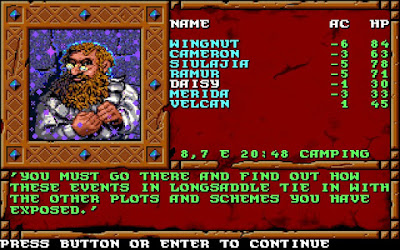
As the game goes on it is revealed that the Zhentarim, Hosttower Mages and the Kraken society have joined forces with the goal of taking over the region.  The Lord's Alliance is made up of a dozen cities who have grouped together to combat common threats in the area.  The evil union is intent on breaking up the Alliance using kidnapping, deception and subterfuge to set the cities against one another.  They have also framed the Heroes of Ascore as traitors.

Miscellaneous notes...
  • Combat has been tweaked by occasionally adding fresh opponents or friendly NPCs to a battle already in progress.  This can make the fights a little more interesting.
  • Some higher level items of magic equipment have been given names such as Sword of Stalking +4, Squid Shield +2 and Redflame Armour +2.  I'm not sure if they are imbued with extra abilities.
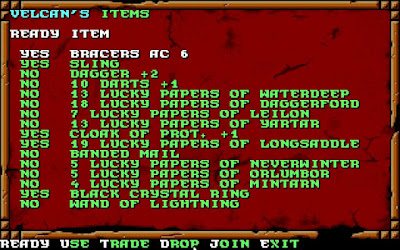
  • I kept picking up loads of Lucky Papers during the game.  Without knowing what they were for I didn't want to throw them away...

  • It turned out you can read them with three coloured crystals, one each from a Zhentil Lord, a Hosttower Sorceress and a Kraken Master.  If you meet them in battle and kill one of the enemies you can pick up their crystal. The remaining opponents smash theirs.  To collect them all you have to ensure you kill a different type of opponent first.  Lucky papers show the enemy objectives in each town.  I guess you can use these if you want to complete any city quest out of order.  I didn't.

  • There is a cheesy romance between the main character and a recruited NPC.  It doesn't detract from the plot but doesn't really add anything either.
*barf*
  • There were at least a couple magic stores that sold the whole gamut of +1 weapons and armour.  I don't recall seeing one in any of the other gold box games apart from the occasional store that sold wands, potions and scrolls.


After completing quests in all the cities it was off to Mirabar to meet with the Councilors of the Lord's Alliance and to prove our innocence.  This brought up the usual end game screens with pages of reading...


What came next seemed disconnected from the main quest and felt like it was tacked on afterwards.  We were tasked with retrieving a magical gem from the hoard of a long dead (yeah, right) dragon.  This was to be found in Ice Peak in the far north of the overworld map.

The dragon's lair was located in a maze-like area on the far side of a one way door - once in you can't get out.


Alas, I was unable to finish the game due to an impossible penultimate battle.  You are attacked by three groups made up of blackrobed mages, spies and masters.  The blackrobed mages and blackrobed spies always get the jump on you and have a propensity for casting hold monster and hold person spells.  The blackrobed masters finish off held characters and disrupt my mages spells.  I'm lucky if I can get through the first round with half my party able to move.  Having a hasted party, invisible characters, and even turning the level down to Novice makes no difference to the outcome.  After many failed attempts I watched a couple of 'Let's Plays' on YouTube to see how it was done.  The videos showed the players being attacked by two groups of four and one group of five.  I had this...
Thirteen opponents would have been doable, twenty-five were not.  If anyone has any ideas please let me know*.

Although I couldn't complete the game I did like it.  Contemporary reviews weren't very kind calling it more of the same.  This is fine by me as I like the series.  Also, I found Treasures of the Savage Frontier was refreshing as it took us back to where Hold Person and Stinking Cloud spells still worked and my starting characters couldn't yet cast Fireballs. 
It was not quite the fitting end to the series I had hoped for but I still enjoyed it.  Here's hoping SSI's Dark Sun engine games are just as good.


*Addendum

After finishing writing this entry I did go on to complete the game.  I needed to load up my final save just to confirm the names of the enemies in the 'unwinnable' battle so I didn't bother buffing.  I decided to have a go anyway and was lucky enough to get off two fireballs before the enemy started to cast, so disrupting most of their spellcasters.  Their first volley of 'holds' only affected a couple of my party.  Some friendly dwarves and extra enemies turned up and I eventually won with only three dead characters.  The end game....


Having no chance to rest or heal we were thrown into a battle against Freezefire.  This was an ancient dragon that once terrorised the realm.  After the last battle it was disappointingly easy.  Although it had a -8 AC, it only had 56 hit points and was not immune to magic.  It went down within two rounds managing to hit only one accompanying dwarf with some kind of cold attack.

"You do realise this game doesn't have a sequel don't you?"


The End


Monday, 29 October 2012

Thrust - BBC Model B - 1986


Another blast from the past I used to play on my mates Beeb.  Thrust was originally released for the BBC micro in 1986 and despite being converted to a host of other computers it is this version that remains the best.    It beats it's rivals in all the main areas - Atari ST (gameplay), Commodore 64 (sound), Amstrad CPC (speed) and Sinclair Spectrum (everything).  It plays similarly to the Atari arcade game Gravitar and is rock hard.

The blurb says the resistance is going to launch an offensive against the evil Intergalactic Empire but they lack the Klystron pods needed to power their battlegrade starships.  You are tasked with pilfering the Klystron Pods from the Empires storage planets.

For each planet you start just above the surface.  Ship controls are rotate left/right, thrust, fire, and shield/tractor beam.  Nearby you will always find a reactor which powers the limpet guns that protect the base.  Pump a few bullets into this and it will disable the defences for a short while. Shooting the reactor too much causes it to go critical giving you 10 seconds to escape before the planet explodes. 


Blasting the reactor disables the defences for a short time.

The first Klystron pod is located on the surface of the planet but subsequent ones need to be collected from underground.  Navigating the underground tunnels is made tricky by the gravity, your ships inertia and the limpet guns taking pot shots at you.  You can activate shields to protect you from the shots, but the shield quickly uses up fuel.  Extra fuel can be picked up from the silos dotted around - just hover near them and activate the tractor beam.  

Once located, the Klystron pod also has to be picked up with the tractor beam.  When collected it is attached to your ship and has to be taken from the planet.  As the pod has it's own weight and inertia navigating the caverns is easier said than done.  The game cycles through six planet layouts, with the later levels featuring reverse gravity and invisible walls (which can only be seen with the shield activated).

Thrust is one game I'm absolutely crap at (as can be seen from the video clip) though it is a fun, if frustrating, game to play.  The graphics and sound can best be described as 'functional' but as it was a budget game this is forgiveable.  The only real gripe I have with the game, and this applies to nearly all versions, is the keyboard layout which is not the easiest to get to grips with.  The awkward positioning of the buttons makes it difficult to get comfortable and you can't redefine the keys.

Shooting the orb opens the door.


Wednesday, 24 October 2012

Tau Ceti - Amstrad CPC - 1986


Tau Ceti is a game I spent a lot of time playing in my youth when it was published in 1985 for the Sinclair Spectrum.  It was later converted to the Amstrad CPC, Commodore 64 and Atari ST for release in 1986.  I knew this game would appear on the blog so played them to pick the one to feature. As with Elite, the ST had a weak conversion and has gameplay issues that ruled it out of the running.  I had heard the Commodore 64 version was the pick of the 8-bits so tried that next.  After clearing the the threats from the first city, I warped to the next one only to be annihilated by three suicidal flying saucers without killing a single one.  I tried again with the same result – I didn’t remember the game being this hard!  On the third attempt I took down one saucer with a missile at point blank range just before I died.  So, while it had the best graphics and sound the C64 is way too hard to be enjoyable.  Next up was the Spectrum version which played much as I remembered.  It didn't have the puny laser of the Commodore 64 so you could actually destroy things.  Lastly I loaded up the game for the Amstrad CPC.  This turned out to be the definitive version – it played pretty much the same as on the Spectrum but had colour (instead of monochrome shaded) graphics in the viewing window.

The game is set on the planet of Tau Ceti III which was colonised in 2050.  In 2150 a plague swept through the colony which was then abandoned and left to the devices of the robot maintenance systems.  After a couple of years a cure for the disease was found.  About the same time radio contact was lost with the automatic systems when the planet was hit by a massive meteor.  In 2164 it was decided to recolonise Tau Ceti III but minutes after landing a mayday message was received followed by silence.  It was decided that the robots had run amok after the meteor impact and the only way to stop them without destroying the buildings is to shut down the fusion reactor in the capital city.   This is where you come in….

Your mission is to explore the planet in a Gal-Corp Skimmer, searching the reactor substations in each city for a total of 40 pieces of reactor cooling rods.  These need to be assembled into 20 complete rods and inserted into the main reactor in the capital city of Centralis.  This will shut down the reactor and disable the planet defences allowing the colonists to return.

37 more rod pieces to find

You start the game aboard a skimmer that is docked in a lander.  The skimmer is armed with lasers, 8 heat seeking and 8 anti-missile missiles. It additionally comes equipped with a defensive shield, flares and infra-red night sights.  The display is largely made up of a viewing window, a communications screen and a radar map.  You are also provided with displays showing the skimmers status and navigational aids (direction finders and compass).

Once launched the viewing window displays the view from your ship (it can be changed to view from the rear or either side).  The buildings and hostile ships are viewed in solid 3D and, ground-breaking for the time, are shaded in accordance to the position of the sun.  As the day progresses Tau Ceti moves across the sky and the shadows deepen.  When the sun sets it is completely dark which is when your flares and nights sights come into play.  One day/night cycle on Tau Ceti III lasts approximately one hour.

Using Infra-Red is essential at night but things get a bit blurry.

The quickest way to navigate between cities is to utilise jump pads.  Jump pads can be located in the North, South, East and/or West of a city and each one has a particular destination.  One ADF will point to the nearest pad.  When landed you can call up a map which displays the jump network.


Just like Google Maps.


The cities have several types of defences including fortress buildings, robot hunter-killers (the flying saucers), guardian crawlers and proximity mines.  Your main armament is a fairly powerful laser (or a useless one in the case of the Commodore 64).  It does overheat if used constantly so you need to keep an eye on the temperature gauge.  To back this up you are armed with eight fire and forget missiles.  Defensive armament comprises a shield and eight anti-missile missiles (your communications display shows when an enemy launches a missile).  If you are still being hit when your shields are low then your systems start to fail.

The city of Hame contained a lot of hostiles.  It was 'Game Over' soon after this  screenshot.

As well as the reactor substations you can also dock at supply centres and with your landerThe civilian supply centres allow you to repair the skimmer.  Docking with the lander or at military supply centres allow you to re-arm as well as carrying out repairs.  Typing EQUIP in the communications window displays the available facilities.

Re-arming the skimmer can only be achieved at your lander or a military supply centre.


In its day, the graphics in Tau Ceti were unique and way ahead of its time.  Nowadays they look a bit dated and the sound isn't up to much, however the playability is still there.  There is also a lot of strategy involved - do you go in with all guns blazing or try to pick off enemies one at a time?  Do you use your missiles now or save them in case there is nowhere to rearm?  It doesn't take long to get immersed in the game and I enjoyed revisiting it.  

There was a sequel to Tau Ceti called Academy which on paper looked like it should have been better, but I didn't get on with the mission based structure.

 Docking at a sub-station where cooling rod pieces are found.


Saturday, 26 May 2012

Tank Commander - Commodore VIC-20 - 1984


Tank Commander from 1984 is the fifth and final game on my list for the Commodore VIC-20.  I can’t quite remember why I bought it as I had a Spectrum by this time. I think I got it because the description reminded me of a board game I had called Tank Battle.  Again, there were vastly superior games around at this point for other computers but this is one of the better VIC titles.

The board game Tank Battle - well, it has a fuel dump, command centre, tanks and mines


Tank Commander is played out over a large semi-randomly generated play area.  The scrolling terrain consists of various elements such as mountains, rivers, trees and a road. In the game you control a tank and have to travel into enemy territory to destroy an oil depot, an (I think) communications station and a command bunker before moving to the next level.  The command bunker can only be destroyed from below.

Out to stop you are enemy tanks, mines and the occasional aircraft.  Enemy tanks are either black or white.  The black tanks will hunt you down while the white tanks are static and are normally placed next to bridges.  Mines are scattered around and are easy to avoid as are the bombs dropped by the aircraft.  Once past the tanks, the enemy installations are easily destroyed.

The graphics are pretty good for the VIC and the sound consists a constantly rumbling engine noise and some simple spot effects.  As I said this is neither the best game for the time nor indeed for the VIC-20 but I have a soft spot for it so it gets on the list.


Planes are quite easy to evade.


Sunday, 20 May 2012

T.L.L. - Sinclair Spectrum - 1984


TLL or Tornado Low Level to give the full title is an arcade game for the Sinclair Spectrum released in 1984.  In the game you control a Tornado bomber and have to destroy targets laid out over a scrolling wraparound play area.  There are five targets which are shown on a map at the start of each mission.  You ‘hit’ targets be flying over them at (surprise, surprise) low level – you don’t need to press any key to hit the targets it is done automatically.

The landscape is displayed in a skewed top down view which gives a 3D effect.  As I said the play area is wraparound which makes it seem larger than it actually is.  This makes the targets easy to find on your radar, and some which appear far away on the map can actually be quite close.  As you have to fly at low level the difficulty comes with avoiding structures such as buildings, electricity pylons and bridges, though you can fly under the bridges and cables.   A neat touch is the shadow of the plane which helps gauge your altitude.

There is no doubt that TLL is a hard game.  The plane flies at two speeds – fast with the wings swept forward and faster with them swept back.  This makes hitting the small targets challenging and requiring several passes.  Later in the game the awkward position of the targets in difficult terrain doesn’t help. The time limit and finite amount of fuel just add to the pressure, although you can land to refuel.

It’s still a very good game though, with a graphical style that surprisingly was only used once again in the follow up, Cyclone.  The scrolling is fast and smooth for the time, though the sound is limited.  The game is colourful too with the dreaded Spectrum attribute clash being well contained.  Although TLL is a difficult game it is still addictive and takes a while to get frustrating.

The round object is one of your targets.

The mission map can be viewed when the aircraft is on the ground.