Thursday, 12 April 2012

Impossible Mission - Commodore 64 - 1984

"Another visitor!  Stay a while….. Stay forever!"


Impossible Mission. Mmmmm. It’s been a game that has always been near the top of any chart of Commodore 64 games but I’ve never had any real desire to play it.  The screenshots always seemed a bit samey and plain to me but I was forced to give it a go because of this blog.

The plot involves someone called Elvin Atombender who is hacking into the world’s military computers in order to launch a missile attack. Why or against whom it doesn’t say.  It is estimated he will gain access to the launch codes in 6 (real-time) hours. Your character is a secret agent who has to infiltrate Elvin’s underground stronghold and apprehend him in his control centre before he has a chance to launch the missiles.  To gain access to the control centre you need a password, parts of which are scattered in various items of furniture over the base.

Elvin’s stronghold is set across 32 rooms connected by elevators.  The rooms are randomly located for every new game. Each room contains at least one security terminal and a series of platforms, some connected by lifts.  The platforms are populated by robots and some contain items of furniture.  To find the codes you need to search the items of furniture while evading the robots.  The time taken to search varies - wastepaper baskets take a second to search, bookcases take longer. 

There are two types of robot in the game.  The most common are those on the platforms and they have various patterns of movement – some stay still, some move in preset patterns, some move towards you when on their level, some have different movement speeds, some fire electric bolts.  All kill on contact. The second type of robot is a floating dark sphere.  This can move between platforms, either moving in a preset pattern or homing in on you.  You can also die by falling through holes in the bottom of the screen.  I am using the words ‘kill’ and ‘die’ but what actually happens is the game deducts 10 minutes from your remaining time instead of losing a life. 6 hours doesn’t look so generous now.
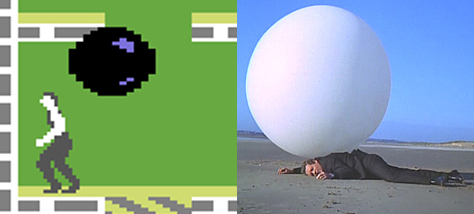
Inspiration from The Prisoner maybe?

After searching an item of furniture it disappears from the screen.  If you find anything it will be one of three things.  The first is a password that can be used in one of the security terminals in the room and will reset the lifts back to their original positions. The second is another password that can be used at the security terminals to disable all the robots in the room for a few moments.  More of these lift inits and snoozes (as they are called) can be earned in the code rooms by completing a musical puzzle.  The third item will be part of the password to gain access to Elvin’s control centre. 

A fireplace is the last place I would hide a password
Once you have searched all the items of furniture it is off to one of the elevator rooms to assemble the control room password. The password is broken up into pieces of what look like computer punch cards and need to be put together like a jigsaw.  Each card is broken into four pieces and once assembled provides a letter to the password.  This part sounds easier than it is because some parts seem to fit and look okay when in fact they are wrong.  I even had one part that fitted both the right and wrong way up – at first I couldn't work out why it wasn’t being accepted.  Once the password has been completed it is off to the control room to apprehend the evil Atombender.

The Control Centre password is complete...
...and Atombender is captured.  Well, until the sequel anyway.


Okay, that’s a lengthy description of what is essentially a quite simple part platform/part puzzle game. The first thing that strikes you is the quality of the sound effects and particularly the speech at the beginning of the game. Second are the graphics and animation of the main character.  There is none of the double pixel chunkiness prevalent on many Commodore 64 games and the character runs and somersaults smoothly and realistically. As already mentioned the rooms do look plain and samey but that does not detract from the game. The difficulty is set just right as is the balance between the platforming and puzzle.  Overall Impossible Mission is an excellent game and one that actually has an ending – are you listening Bounty Bob?


Saturday, 7 April 2012

H.E.R.O. - Atari 2600, Atari 5200 & Commodore 64 - 1984

Another year, another game set in a mine

H.E.R.O. (or Helicopter Emergency Rescue Operation) was first developed for the Atari 2600 and released in early 1984.  It was subsequently released on most other console and computer platforms of the time.
 
In this game you take on the role of Roderick Hero whose task it is to rescue miners that have been trapped underground due to volcanic activity.  To aid you on your mission you can fly with the help of a backpack mounted propeller and are equipped with a laser and several sticks of dynamite.  As you descend into the mine you have to avoid (or shoot) various nasties such as bats, spiders and snakes.  If you touch a lamp the current screen becomes dark so you can’t see your way.  Additionally magma must be avoided as touching it takes a life.  Occasionally your path will be blocked by a wall.  These can be destroyed by dropping a stick of dynamite next them being careful to avoid the blast.

The controls on the 2600 and C64 are quite slick as everything is controlled from the joystick and a single fire button. Pushing forward on the joystick allows you to fly.  Pulling back drops a stick of dynamite.  Left, right and fire are self explanatory.  The Atari 5200 uses a separate fire button for dropping the explosives.

These three versions are great games which is why they are all on my list.  Gameplay and sound are on a par so the only difference between each version is the graphics.  As with River Raid, the Atari 2600 has simplified graphics with the caves being made up of solid blocks of colour.  On the Commodore 64 they have tried cramming in too much detail and the graphics end up looking messy. It’s also a little easier as the laser has a longer range.  Of the three the Atari 5200 is my favourite, but this is purely down to the graphics being less cluttered than the C64 yet more detailed than the 2600.  

The Atari 5200 boasts the best graphics of the three.


Graphics on the Atari 2600 are a bit sparse...


...while the C64 suffers from too much detail.


Tuesday, 3 April 2012

Elite - BBC Model B - 1984

I still remember being blown away by this view the first time I saw it.  Those were the days.

I remember first seeing Elite around my mate Colin’s house (him with the Videopac) when it first came out on the BBC micro. He called me up to say I must go round and see this new game.  It was one of those memorable jaw-dropping moments when the spinning Cobra came up on the screen and then when launching from the space station for the first time and looking out the rear view.  Unless you lived through the 8-bit home computer era it’s difficult to convey how seeing such groundbreaking games for the first time really felt. There were the enormous galaxies to explore, the trading, the combat, the special missions.  Back in the day this game seemed almost limitless.

You probably know all about the game already, but basically you start off with 100 credits, a Cobra Mk III spaceship armed with a front pulse laser and hundreds of planets to visit.  Initially you’ll want to make money to upgrade your ship, which can be done both on the right and wrong side of the law….

  • Trading between planets, buying low and selling high, is the staple source of income. Buying food from an agricultural planet and selling it to an industrial planet for example.  You can also deal in illegal substances such as slaves, narcotics and alien artefacts.
  • Mining asteroids by destroying them with a mining laser and picking up the pieces of ore with a fuel scoop.  Law abiding but slow and low profit.
  • Piracy – Destroying any ship you come across and scooping up the cargo (and occasional escape capsule) it drops when destroyed.  When doing this you become a fugitive and run the risk of being attacked by police Viper ships
  • Bounty hunting – As above but by killing pirates it is not breaking the law.
  • A combination for all the above.

There are plenty of upgrades to buy for your ship including more powerful lasers, fuel scoop, enlarged cargo bay, missiles and a docking computer to automatically dock your ship on the spinning space stations.

The BBC version had lots of neat details that I don’t recall featuring on the other versions I played.  For example some ships would drop their cargo as a distraction if you shot at them and occasionally you would come across a pirate waiting to ambush you by rotating to look like an asteroid.  It’s attention to detail like this that make the BBC the standout 8-bit version if not the best to play. 

It wasn’t just the game either.  It came in a large box with a ship identification chart, detailed instruction booklet and a novella – many games at the time just came in a cassette box.

Extract from instruction booklet


The game was eventually converted to nearly every home computer of the time and even the NES had a version.  I bought Elite for the Spectrum which came with an annoying anti piracy device called lenslok (you think DRM is bad!).  I played it to death but never got to Elite status.

I also bought the game when it came out for the Atari ST but this version was unplayable due to the set piece combat.  Whenever you encountered a pirate it would without fail appear with a freighter and an asteroid.  If you wanted to avoid becoming a fugitive you had to wait for ages for the freighter to move off the scope before you could continue to jump towards the planet.  The Amiga version was made by the same developer so is probably the same.  There are a few other annoyances which make the 16-bit versions inferior to the 8-bits but I won't go into them here.  Avoid.

The awful Atari ST version.

 
The best non 8-bit version of Elite, called ArcElite, is for the 32-bit Acorn Archimedes and was released a few years later.  As well as polygon graphics it features more ships and more special missions than all the other versions.  You also feel you are no longer the centre of the universe – you can come across asteroid mining vessels going about their business, police Vipers can be found attacking pirates or towing abandoned ships, you can see pirates squabbling amongst themselves, and can come across freighter fleets with their escorts.

The Archimedes didn't have many games but could boast the best version of Elite.