Saturday, 23 December 2017

Grandad and the Quest for the Holey Vest - Atari ST - 1992


Grandad and the Quest for the Holey Vest is a graphical adventure game release exclusively for the Atari ST in 1992.  I thought this quite unusual as by this time the Commodore Amiga was the more popular home computer, but as it's shareware instead of a commercial release I guess it's not so strange.  I just don't have the mindset for adventure games and unless they are relatively easy I quickly lose interest.  Most of the puzzles in Grandad are pretty straightforward so it's just my cup of tea.

As you can tell from the title Grandad is a game that doesn't take itself too seriously....

The controls are simple - Grandad can be moved around in his electric wheelchair with a joystick or the cursor keys.  Fire button or the space bar brings up the command menu.  There are few commands but enough to solve the puzzles.  LOOK describes nearby objects or the room if no objects are close by.  GET puts objects in your inventory and INVENTORY lists them.  USE allows you to use any object you are carrying.  You can also SAVE and LOAD the game.

For the most part the puzzles are logical and not particularly difficult which is fine by me.  Unwinnable 'dead man walking' situations can mostly be avoided.  At the beginning of the game it is possible to give away an item that is needed to solve a puzzle.  If you take the option to keep the item you are rewarded with a 'ping' and some points.  If you give the item away points are deducted so you know where you went wrong.  The only place you can really get stuck is if your wheelchair runs out of power.  There is a spare battery that can be found.
I remember seeing this one on some film.
Grandad contains the obligatory maze.  All rooms look similar but it is mappable if rather large.  This was where I used the SAVE and LOAD commands most so the wheelchair didn't run out of juice.
The Basement

What really appeals to me is the mundane setting and the humour.  There can't be many adventures set in a fairly ordinary house with a grumpy old codger as the 'hero'.  The game really is laugh out loud funny in places although some of the humour can be near the knuckle.
Now, tell me who wouldn't have chosen that option first?

The graphics are good considering the 16-colour display of the Atari ST.  Sound is limited to a few pings and bleeps. The only real annoyance is the pause of a couple of seconds between screens - but that is very minor.

Grandad and the Quest for the Holey Vest may not appeal to die-hard fans of Sierra games, but for someone like me who doesn't like obscure puzzles, it's a pleasant way to while away a few hours.  I did have to look at hints twice which is good for my non-adventure gaming mind (if I have to look up clues more than four or five times I junk a game).
Thank you Google
As I said, the game is a shareware title and Ian Scott would send the code to access the whole game to those who registered.  I'm pretty sure he would have moved on from the address on the title screen but if he is still around I would gladly send him a fiver.


The End

Thursday, 14 December 2017

Gradius II: Gofer no Yabou - NEC PC Engine Super CD-ROM - 1992


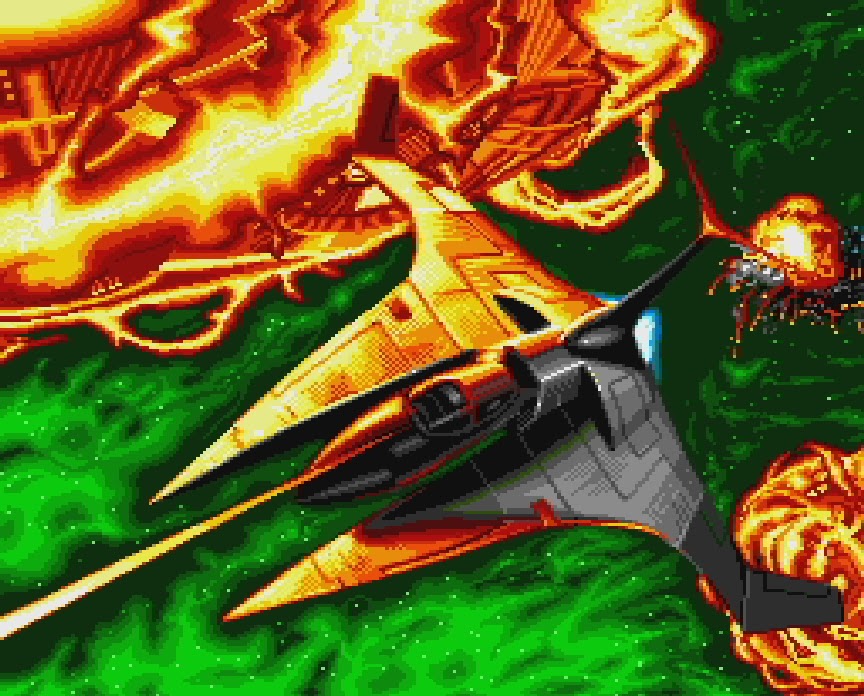
Gradius II: Gofer no Yabou is a conversion of the second title in the Gradius series of arcade games.  It was released on the CD-ROM format some four years after the arcade game.  I have already featured the NES version of Gradius II on my blog.  Where the NES conversion thematically follows the arcade original in terms of graphics, the level layout is completely different.  The PC Engine is a much more faithful conversion with the exception that it contains an exclusive bonus level.

From the options screen you can choose the Game Level from Easy, Normal, Hard and Professional.  Normal is fine for me.  Easy is possibly too easy, but is okay for training (it is the level I did my gameplay video on).  Professional has bullets flying everywhere.  There is a different ending for each difficulty level.

As before, it's just you and your Vic Viper starfighter pitted against the evil Bacterion Empire and it's leader, Gofer.  When you start a game you can choose what weapons your ship is capable of carrying.

Each selection contains Speedup and Option.  Personally I prefer the fourth choice with 2-way missiles and a Ripple laser, which gives a better spread of firepower than the normal laser.  You also have a choice of defensive upgrades.  The Shield from the original Gradius can absorb the most damage but only protects the front of the Vic Viper.  The Force Field takes less hits before it disappears but covers the whole ship.

Gameplay is the same as the first game in the series.  The screen mostly scrolls right to left although there are some areas where it wraps around in the vertical plane.  Certain enemy formations and individual enemies drop capsules (for want of a better word) when they are destroyed.  Blue capsules act a smart bomb when touched and clear any enemies and bullets on the screen.  Orange capsules add to your power meter.  When the the power meter highlights an item you wish to equip, you can select it and the meter resets.
The green bacterion is a new enemy.  It has just stolen three of my options.  Bastard.

Music and sound are excellent with the soundtrack streaming direct from the CD.  Where the CD format can't help is with the graphics.  There are flickering sprites in places and massive slowdown when the screen gets busy.  Ironically, the slowdown actually makes avoiding damage that much easier.  
This stage really slowed down with the Moai head spewing out hundreds of colour changing bullets.
The games stages are also varied with some of the enemies and certain areas looking familiar.  
It's obvious which film this part is based on.  I have just lost all my power ups so will soon die.
My only real criticism is one of the stages features a high speed run which I couldn't get past.  It will take a lot of time and and a lot of practice (or a quick look on YouTube) to work out the optimal route and even then it is all too easy to lose a life.  Which brings up another issue - Gradius II (like Gradius) is a one life game - lose a life and you lose all your power-ups after which it is very difficult to get going again.  Nevertheless, it is a great game and a welcome addition to the ever growing list of Gradius games on my blog.


Example gameplay....

Thursday, 30 November 2017

Dungeons & Dragons: Order of the Griffon - NEC TurboGrafx-16 - 1992

Nice box art.  Shame about the hairstyles.


Order of the Griffon is the second RPG I have played on the TurboGrafx-16 after the highly enjoyable Dragon Slayer: The Legend of Heroes.  This game was published by SSI and developed by Westwood Associates who were also responsible for the Eye of the Beholder series.  It eschews AD&D in favour of the Dungeon & Dragons Basic Edition ruleset.  It was not translated for a PC Engine release in Japan.

The first task is to assemble a party of four characters from a choice of seven classes - Fighter, Mage, Cleric, Thief, Elf, Dwarf and Halfling.  Within each class you have a choice of three pre-generated characters.  Out of the twenty-one portraits only one was obviously female with a couple androgynous characters thrown in.

Playing the game blind I would usually choose a fighter, cleric, mage and thief.  As the manual only mentions fighting and spell casting in the class description I decided to substitute the thief in favour of another fighter type.  My starting party is Keir the fighter, Tor the dwarf, Marius the cleric and Falcone the mage.  All characters start at level 1.

Each character view shows three slots for armour, two for rings, two for ready equipment and one each for boots and gloves.  Shields take one of the armour slots so a fighter, for example, can have a sword and a sling equipped whilst carrying a shield - I'm not sure yet how bows will work (it turned out bows, shields and swords could be readied simultaneously).  Spell casting characters must have either an ankh or a spellbook ready in order to use magic.  There is also a shared inventory.

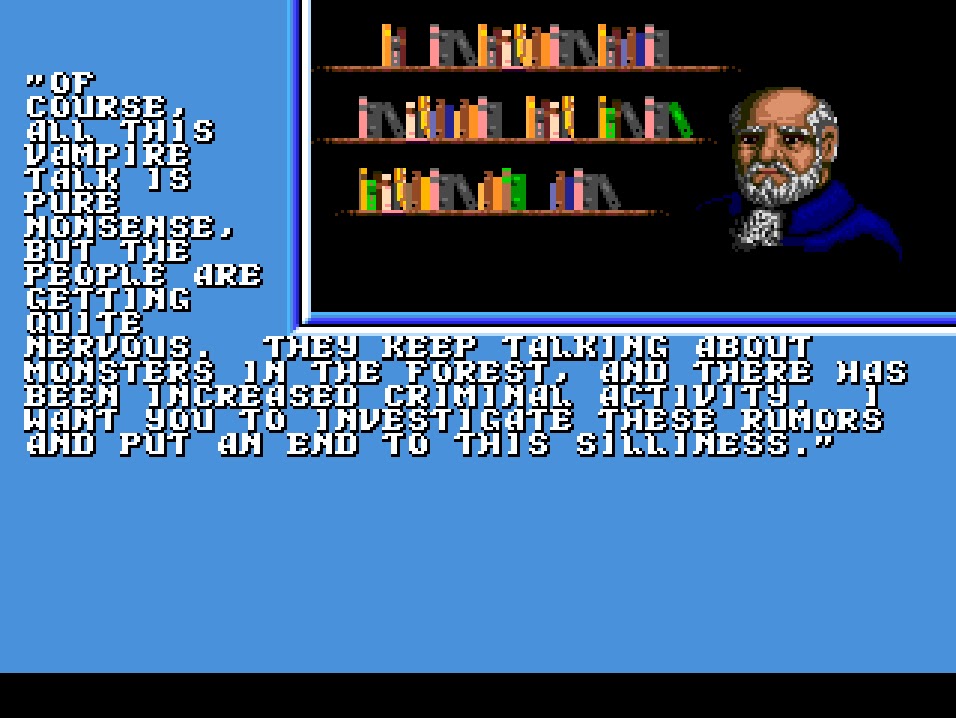
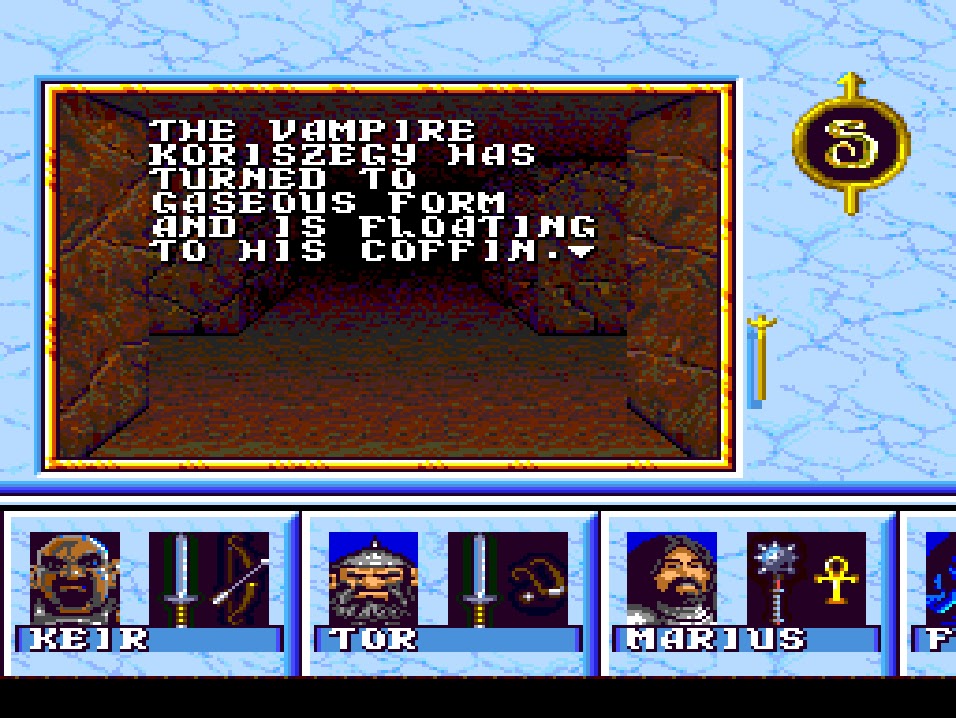
The game starts in the City of Radlebb Keep where Lord Korrigan hires the party to investigate rumours about the vampire Koriszegy.  There are also monsters appearing in the forest and an increase in crime.  He pays you 200 gold pieces upfront with the balance due on completion of the mission.

Navigation in town is done via a first person view where you move one square at a time (the view switches to top down in the wilderness).  Like the Gold Box games rooms appear empty but sometimes have a description of what they contain.  At least you don't have to look it up in a booklet.  In the town of Radlebb there are the usual establishments.  There is an Armoury that sells weapons and armour including a few magic items and potions that are out of my price range.  At the Magic Shop you can buy scrolls and have magic items identified.  There is a Temple that can cure wounds and raise the dead - this is necessary at the start of the game as a level 1 cleric can't any cast spells.  There is also a Tavern where you can rest to restore Magic Points.
Only one of these options is of any use.

In the first area you are advised to visit the Hall of the Griffon where you will receive your first quest.  The Order of the Griffon are a noble group of knights, paladins and fighters who are unable to spell Griffin.  Unless they do actually mean Griffon....
Grrrr!!
Here you are given your first quest which is to recover a magic staff from a den of Dire Wolves.  I will note my thoughts below....

  • The graphics and music throughout are very good.  Sound effects are pretty simple, limited to combat and spells.  Music composer, Frank Klepacki, also wrote the scores for a host of other Westwood games including the Command & Conquer series.
The overworld.  This town was optional but contained some good items.

  • Combat takes place on four pre-defined battlefields - one each for the overworld, towns, dungeons and inside buildings.  The party is placed in a random starting point with the enemies close by.  The combat is turn-based and is viewed top-down.  Each character has the option to move within a highlighted area and can then use weapons or cast spells.
  • If spells are cast against one of your characters it is mostly impossible to tell what there are unless they have an obvious effect.
  • It turns out I was correct in not choosing a thief as they are superfluous in this game.  There were no traps to disarm nor locked chests to pick.  Locked doors could be bashed in.
  • I don't know if Basic Dungeons & Dragons has THAC0, but you can't see your chance to hit in this game.  Additionally, equipping items such as Girdle of Giant Strength or Gauntlets of Ogre do not change your stats.  You can tell the are working only because you do more damage.
  • Missile weapons, such as darts and arrows, are limitless.  If you have, say, Dart +2 equipped, you have an unending supply.
  • In theory the combat should be just as good as the Gold Box games but this is not the case. Characters with full plate mail can only move two squares per turn so moving into position takes time.  As each character takes up two squares they have to be moved carefully to prevent them blocking one another.  Spells are limited in variety and by the number that can be memorised; at level 6 my cleric could only memorise two level 1, two level 2 and one level 3 spells.  Weapons are also limited in variety.  The best melee weapon is the long sword.  For missile weapons you have a choice of slings (not much damage) for the Cleric or darts (very limited range) for the Mage.  The best missile weapons for the fighters are bows which can be readied alongside a sword and shield.
  • As I've just mentioned the full set of D&D spells have not been included.  For example, there are only two level 2 mage spells and just one level 3 cleric spell to choose from.
Some of the spells that are included have nice graphical effects and fireball is ever useful.

  • Most magic items can be found after combat, but shops also sell a good selection. 
  • The Magic Shop has a couple of useless options.  "Look around" does nothing.  There is an Identify option but all magic items are already identified.

  • As far as I can tell there are only random encounters on the overworld.  Towns and dungeons only seem to have fixed combats.  The exception to this is when you are sometimes interrupted while resting in dungeons or in the wilderness.
  • As always the economy becomes a problem towards the end of the game.  Once you have all the best spells and gear, there is nothing to spend your gold pieces on.  Thankfully it doesn't cause encumbrance as you have no choice whether to pick up gold and there is no way to drop it.
  • All the characters are capped at level 8.  Without grinding, Marius peaked relatively early and Falcone maxed out in the final dungeon.
  • As the game progresses it is revealed a vampire called Koriszegy is planning to take over the realm.  A group called the Iron Ring are kidnapping folk so Koriszegy can create an undead army under his control.  Your party is tasked to stop him, first by obtaining the gems he is using to create the undead army, and secondly by defeating Koriszegy himself.  On the way you have to defeat Nosferatu (who the Order of the Griffon originally thought was Koriszegy) and rescue a Princess from the clutches of the Iron Ring.  Finally, you need to retrieve three items with which to defeat the vampire.

Although I've picked a lot of holes in Order of the Griffon, these are mainly due to the implementation of the D&D rules.  I'm also probably unfairly judging it against the Gold Box games.  As it stands it is an enjoyable adventure.  The game world is not stupidly big and doesn't throw hundreds of random encounters at you like a lot of console RPGs.  The graphics are pretty good and the music that plays thoughout the game did not have me reaching for the mute button.  It's by no means the greatest RPG in the world, but it kept me interested until completion.


The End

After gathering all the items required to defeat Koriszegy I was sent off to find him in his keep.  During mapping and pulling a couple of levers I found the vampire but couldn't reach him due to an impenetrable field.  I soon encountered another vampire who said I needed to find three levers to switch off the field.  He also explained specifically how to defeat Koriszegy before disappearing in a puff of smoke.
Ah, okay...

After finding the third lever I returned to Koriszegy.

It took two goes to defeat him.  On the first attempt his 'army' was spread out and behind walls so area effect spells were not effective.  His allies were able to pick off my characters one by one.  The second attempt took place in another portion of the battlefield where they were more conveniently arranged.


After the battle you win a good haul of useless treasure.