Friday, 14 July 2017

Dizzy: Prince of the YolkFolk - Commodore Amiga - 1992


With a main entry in the  Dizzy series you know exactly what you are going to get - a fairly easy adventure game combining platforming, inventory based puzzles and slightly awkward controls.  Dizzy: Prince of the YolkFolk is no exception.

The game was first released in 1991 for the Sinclair Spectrum, Commodore 64 and Amstrad CPC and was highly regarded at the time.  In 1992 it was converted to the Commodore Amiga, Atari ST and DOS.  A Nintendo NES version followed in 1993.  Finally an HD remake appeared in 2011 for the iOS and Android platforms.  I'm not interested in smartphone gaming on my blog so the winner of this lot is the Commodore Amiga.  Normally a game such as this would look the same on the Atari ST but Codemasters went to the extra effort of adding more colours to the Amiga version, notably the graduated sky.  It also has the nicest music playing throughout - much better than the grating Atari ST chiptune.  The graphics on the DOS version are on a par with the ST, both looking better than the NES.  The release on the three 8-bit home computers hadn't really progressed in terms of looks since the original Dizzy from 1988 so come bottom of the pile.

The manual says that Grand Dizzy was feeling down so Dizzy and Daisy decided to bake him a cherry pie.  However, Pogie the fluffle (whatever that may be) had stolen the cherries and ran off into the enchanted forest.  Dizzy and Daisy chased after Pogie and decided to gather more cherries at the same time.  They were soon lost but came across a seemingly deserted castle.  Daisy pricked herself on a mystic spinning wheel and felt sleepy.  She found a bed where she fell asleep.  Before Dizzy could wake her he was captured by Rockwart the troll and placed in an underground prison where the game begins.  Your goal is to escape from your cell and awaken Daisy.
Ah, so that's what a fluffle is.

Dizzy starts the game with three lives and a full energy bar.  Energy is lost by touching an enemy and a life is lost once it is depleted.  A life is also lost if Dizzy ends up falling into water.  No damage is taken when falling from any height (even from heaven).
A convenient path through the clouds leads you to the pearly gates.  You can fall from here without damage.

Most of the puzzles contained in Dizzy: Prince of the Yolkfolk are fairly logical and are mainly solved by using the right item in the right place.  The items are scattered around the flick screen map along with a few red herrings.  Your starting prison cell is blocked by a locked door, but when it contains a pile of leaves, a match and a bucket of water it is pretty obvious how to escape.  Most puzzles follow this pattern so it is a comparatively easy game to complete.  The game also seems a bit shorter than previous Dizzy outings mostly down to the smaller map.

On your way to waking Daisy you must collect 20 cherries to complete the game.  Cherries also restore your energy bar if it gets sapped in any way.  Additionally there are stars and coins to collect for extra points.

To be honest Dizzy is not that much different from previous games in the series (including the awkward somersault action that can make judging some jumps a pain).  Saying that, I can't in all good conscience leave Dizzy: Prince of the Yolkfolk out of my blog when I have included some of his earlier adventures.

After waking daisy you visit Grand Dizzy and bake him the pie

Example gameplay....

Monday, 5 June 2017

Desert Strike: Return to the Gulf - Sega Mega Drive (1992) & Commodore Amiga (1993)


Desert Strike: Return to the Gulf was released in the first half of 1992, a year after Operation Desert Storm had ended and with the Middle East still fresh in mind. The plot involves a Middle Eastern despot invading a small Emirate and trying to gain weapons of mass destruction.  Some could accuse EA of shamelessly cashing in on these appalling events.  Whatever, it turned out to be the most successful game they had yet produced.

On my shortlist I had the Sega Mega Drive original and conversions for the Sega Master System, Super Nintendo and Commodore Amiga.

The Sega Mega Drive was the first version of the game and was released early in 1992 with the first conversions arriving later in the year.  It could be described as the definitive version of the game with great graphics and sound, and slick controls.  Although I had never played it before if felt familiar.  It then dawned on me it played pretty much like cross between Cyclone and Raid on Bungeling Bay.

I played the Master System version next which, it has to be said, was not very good.  It could not compete with any of the 16-bit versions here and was quite basic in all areas.
The Master System is a poor mans Desert Strike.  The helicopter doesn't even have a shadow.
I really liked the look of the SNES version at first, with its nice big helicopter sprite.  I quickly realised it was only big due to the lower resolution graphics.  The display has a zoomed-in look and therefore doesn't show as much of the play area as the Mega Drive version.  Little touches are also missing such as the wake from the ship you start the game from.  Gameplay is more or less the same as the original.
Desert Strike on the SNES.  Plays pretty much the same as the Mega Drive game but at a lower resolution.
The Commodore Amiga version appeared in 1993.  To quote the manual - 'when it came to designing the Amiga version of Desert Strike there was one question on everybody's lips - what can be done to improve the game?'.  For starters they used the Extra Half-Brite Graphics mode to display 64 simultaneous colours.  Some graphics assets such buildings, targets and especially explosions have been greatly improved.  Music is better and it features sampled sound effects and speech.  The presentation is also much slicker.  The Amiga conversion does have its drawbacks though.  Firstly, the game plays a lot slower which can be a blessing or a curse depending on the situation.  There is also disk loading which is absent on the consoles.  Lastly, the controls are compromised - where the Sega controller has a multitude of buttons, an Amiga joystick has only one (or rarely two) fire buttons.  This means cycling through weapons and accessing the map are via the keyboard.
Mega Drive [left] vs Amiga.  The jets on the Sega look a bit odd to me. 
Of the above I felt the Amiga and Genesis titles came on top.  Each had its own advantages and disadvantages so I was unable to split them.


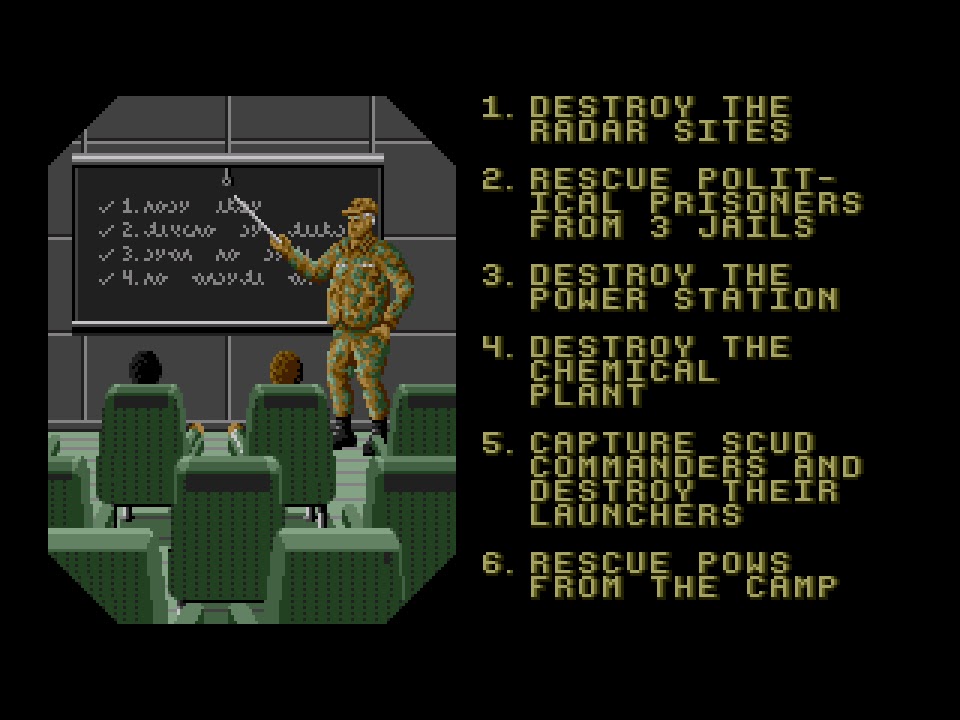
Rather than forming a coalition to send Kilbaba packing, the powers that be decided that all is needed is one man and his chopper.  Desert Strike plays over four 'campaigns' divided into several missions.  The first is called 'Air Superiority'.  Your missions here involve destroying radar sites, power station, airports, command centres, and finally picking up a secret agent.  Although the missions can be played in any order it is recommended playing in the order given as destroying the radars and power station reduces the range and accuracy of enemy anti-aircraft weapons.  The Secret Agent has copies of the Generals plans and his whereabouts is only shown after destroying the command centres and capturing the commander within.

Before you begin the game you must choose your co-pilot.  There are several to choose from, each with their own strengths and weaknesses.  One is marked MIA and can be rescued during the game - he's located next to a downed aircraft on the first level.
Choosing you co-pilot on the Mega Drive [left] and Amiga [right]
I must take issue here with the sprite of your gunship.  Although the game box, manual and in-game stills reference an AH-64 Apache, the main sprite only half resembles one -  the front half.  It looks like they have grafted on the back end of an RAH-66 Comanche with the ducted fan tail rotor and high tailplane.  The Apache has a conventional tail rotor and low tailplane.  I'm guessing this was to simplify drawing the many frames of animation.

The game proper starts with your chopper sat on the back of a frigate and you must head east towards the desert.  You navigate the area by using the map / status screen.  The map shows your objectives as well as the position of ammo crates, fuel, MIAs, missile and gun emplacements.  You can also get a reminder of completed and remaining objectives.  The screen additionally displays remaining fuel, weapons and armour, lives left and the number of MIAs you are carrying.
Status screen on Mega Drive [left] and Amiga [right].
Your gunship is armed with, from least to most powerful, a chain gun with 1,178 rounds of ammunition, 38 Hydra rockets and 8 Hellfire missiles.  The weapons can be fired in the general direction of the target with the accuracy determined by your selected co-pilot.

Ammunition supplies can be replenished by collecting ammo crates that are scattered around the play area.  The finite amount of fuel you carry can be topped up in the same manner.  Fuel and ammo pickups are displayed on the map screen, even those hidden in buildings.

The enemy territory is heavily defended with Rapier surface to air missiles and anti-aircraft guns.  Tiny enemy soldiers carry rifles (they also shoot at MIAs) and portable SAMS. There are also mobile VDAs (armoured vehicles carrying AA guns) roaming the map.  Every hit reduces the armour on your helicopter - you get a buzzer (Mega Drive) or warning speech (Amiga) when it gets too low.  Armour is also depleted if you fly into rock outcrops, high buildings, power lines and other tall structures - the chopper flies at fixed altitude so you can't fly over them.

Armour can be increased by picking up MIAs that are dispersed around the map and taking them to a dropzone. Six MIAs can be wedged into the Apache at one time.  Very rarely armour pickups can be found (usually hidden in buildings).  These pickups do not show up on the map.
Rescuing some MIAs and dropping them off at the LZ for more amour (Amiga)

Once a set of missions has been completed it is back to the frigate for the next level.  Your Apache is limited to three 'lives' which are replenished after each campaign.  You also get a password so there is no need to start from scratch.
Stormin' Norman sets out your objectives for the second campaign (Mega Drive)
And the further you get the tougher the enemies (Mega Drive)

There's a lot to like about Desert Strike whichever version you choose to play.  The handling and momentum feel just right as does the camera which always has the helicopter facing into the screen.  It would be fun as just a straight shooter but the limited fuel, weapons and armour adds some strategy.  An excellent game all round.


Gameplay from the Mega Drive


I had a hard time getting Amiga gameplay to look okay on YouTube but here's my best effort (it looks better in reality)


Monday, 1 May 2017

Defenders of Oasis - Sega Game Gear - 1992


It can safely be said that I'm not a fan of mobile gaming.  I have never been tempted to download a game to my phone and the only portable system I have is a barely used Nintendo DS Lite I won many years ago in a competition.  Until I started Defenders of Oasis I didn't think a mobile system would appear on my blog and I certainly didn't think a Game Gear was capable of running a surprisingly good JRPG.  As soon as the game comes on it starts telling the back story.

Long ago the world was terrorisd by Ahriman, the Wizard of Darkness. Ahriman was finally defeated by a hero called Jamseed and sealed away using three rings given to him by the Wizard of Light. Although stripped of his power, Ahriman sent his servant, Snake King Zahhark to attack the kingdom of Shanadar which was founded by Jamseed.  Jamseed was defeated and the world was once again plunged into an age of darkness. After 1,000 years a new hero called Fallidoon appeared and defeated Zahhark bringing about a new age of peace. When these events were all but forgotten, the evil Empire of Eflaat rose up and once again Shanadar is threatened....

The game begins with you controlling the unnamed prince of Shanadar, a descendant of Jamseed. On this day Shanadar is due to be visited by the princess from the kingdom of Mahamood. A cut scene has the king telling you to escort the princess from the dock back to the castle.

The first thing that struck me was the quality of the graphics. Bearing in mind the original hardware, I was expecting big blocky graphics, but they were well detailed and colourful, even on a large screen. Gameplay is cut from the same cloth as Dragon Quest and practically every other JRPG in between - a top down tiled view with random encounters and turn-based combat.

I took the opportunity to wander around town which was a bit depressing as the townsfolk do not hold a very high opinion of the prince. I visited the weapon and armour stores but couldn't afford anything with my 200 dinar, but bought some herbs, holy herb and snake act from the goods shop. I then headed off to the docks only to find the princess missing. She turned up in the tavern being accosted by some ruffians. 

This introduced combat, which is the usual JRPG turn based fight. Winning the combat gave me some more dinar and enough experience to go up a level, which increased some of my stats. It's than back to the castle for a rest.

During the night Shanadar is attacked by the Empire of Eflaat and the castle put under siege. The King says you should take the Princess and escape to Mahamood. He also gives you a ring.

You are met at the port by the traitorous General Kohle who was offered the kingship for betraying Shanadar. The ensuing battle is unwinnable as Kohle was given a magic sword by the emperor which causes you to faint with one blow.

It's down to the resistance to save your arse and you come to in the their hideout. The leader says you need to get the lamp from the treasury in order to defeat Kohle. It turns out the lamp contains a genie who once served Jamseed – my first party member. 


The Genie is the only member of the party who can use magic. He is also the only member of the party who can't level up. His attributes can be raised by equipping with various items bought or found throughout the game. Hemp, for example, increases his magic points, gilding increases hit points and crystal increases defence. These items are rarely found and are expensive in the shops.

We seek out Kohle and use the spell Varyu to stop him using the magical powers of the sword. He is still a strong enemy but was easily beaten. With Imperial reinforcements on their way we hop on a ship and set sail for Mahamood.

The general plot involves finding all the Rings of Light before the bad guys destroy them and allow Ahriman to regain his full power.  I will note my thoughts below....

  • I pick up my second party member, Saleem, when we stop off at an island to collect some fresh water. Saleem is the captains son. The captain gives us some money to buy water, but when we return to the ship it has been boarded by Ahriman's elite troops. They kill the captain and take the ship and the princess leaving us stranded on the island. It is here the Genie gains the Raag spell which can teleport us between known locations.  This avoids cramming in an overworld map onto the Game Gear cartridge.  It also shows your progress as the destinations grow.

  • The Genie starts with three spells but more are collected by reading inscriptions on walls.  One gripe is the nonsensical names given to the spells which means you have to refer to the manual.  Not ideal when gaming on the go.
Why can't you just call it "Lightning"

  • Our fourth party member is Agmar the thief.  We find him in a prison cell after falling through a trap door in a dungeon.  Fortunately the Genie has the Kshasla spell at this point which can get us through the locked door. 
  • Apart from the normal combat moves each character has a their own special ability.  The Prince can use 'Run' to escape fights and the Genie can cast magic.  Saleem can use 'Dance' in which he attacks all enemies but causes less damage than targeting a single one.  Agmar can use his turn to 'Hide'.  On his next turn he can use 'Assault' to cause more damage to an enemy.
  • There are many useful items that can be found during the course of the adventure.  Most are described in the manual and throughout the game, but there are few that have to experimented with to find their use.  You inventory seems unlimited with the amount of different items you can carry, but you are only able to hold up to 9 items of each type.
  • There is decent music playing constantly during the game. Sound effects are limited to a few bleeps and a couple of undecipherable speech samples.
  • One plot point I didn't like (and I seem to remember something similar happening in Final Fantasy II) is that once you gather all the quest items - rings in this case - one of Ahriman's generals simply takes them off you without you putting up a fight.  He proceeds to burn them, releasing Ahriman.
Little does he know the ashes still have some power...

...and neither does Ahriman.

Despite being a relatively simple JRPG, I really enjoyed Defenders of Oasis.  It's not a game that requires lots of grinding - I did a bit to get better weapons but character stats are limited to 99 points so you can't go on levelling forever.  The economy is also good - once you have the best weapons and armour there are still silks and gilding to buy for the genie at several thousand dinars a pop.  The graphics are well drawn and colourful. I played the game in bite-size chunks (as a mobile game would normally be).  It doesn't have a huge overworld so travelling between towns is accomplished using the Raag spell.  This is good as a lot of JRPGs over stay their welcome by being unnecessarily long with random combats becoming a chore.  The Arabian theme also made a nice change from the usual fantasy settings.

The End....
And finally a JRPG where the ultimate boss has only one form