Thursday, 20 June 2013

Phantasy Star - Sega Master System - 1988


Phantasy Star is the first in a long running and highly regarded series of Japanese RPGs (which also includes several spin-off games and an MMORPG).  It was released in Japan in 1987 and in the US and Europe in 1988.  It was one of the first JRPGs available in the west preceding the English language versions of both Final Fantasy and Dragon Quest/Warrior.  The series was originally a Sega franchise but remakes were released for other companies when Sega opted out of the console business.

Phantasy Star takes place in the Algol solar system which consists of three planets - Palma is a green planet (much like Earth), Dezoris is a world of ice, and Motavia is a desert world.  The planets prospered under the democratic rule of King Lassic.  Later, rumours started of a new religion coming from another galaxy which promised immortality to those who joined. This appealed to King Lassic, but after he joined he turned into a tyrant burdening the populous with massive tax rises, shutting down businesses, limiting travel and placing the towns under martial law. Soon after, evil creatures started stalking the land and Robotcops patrolled the towns hunting down anyone who dared to stand up for the citizens.

I like the varied graphics for the different planets.
The game starts on Palma in the town of Camineet.  The scene is set with Nero being fatally wounded by Robotcops while trying to uncover Lassic's evil plans.  This is witnessed by his sister Alis who vows revenge.  With his dying breath he tells her to seek out Odin who can help her on her quest....

Phantasy Star is a nice blend of fantasy RPG elements (melee weapons, armour, magic) and science fiction (interplanetary travel, laser guns, robots).  The game starts in the town of Camineet with you in charge of Alis.  The town is viewed top down and contains various dwellings, shops, a church (you wouldn't find that in a Nintendo game) and a short dungeon.  There are Robotcops preventing you from accessing the walkway to the Spaceport.

The shops consist of an armoury, a first food (sic) establishment and a second-hand shop.  "First" food shops sell burgers and cola which restore health.  The second-hand shops sell various useful items such as flashlights for use in dark dungeons or a pass to get to the spaceport.  Each armoury sells three types of (often unique) armour and/or weapons.  The dungeon in Camineet contains a chest which holds a small amount of mesetas (the local currency) to get you started.  Dead characters can be resurrected in the church and you are told how many experience points are required to level up.  The other buildings are houses which contain NPCs. The NPCs give stock comments when you speak to them, often giving useful background information and quest hints.  In one house you can rest for free which restores all your magic and health points (otherwise you would need to seek out a hospital for this).


No censorship in Sega games it seems.

Alis starts the game very weak.  I began the game by leaving town to grind out a few levels.  At first she can only survive one fight against the relatively easy insect sworms (sic) or scorpions before having to return to town to heal.  

Combat in Phantasy Star is very simple and not at all satisfying.  The combat screen depicts the type creature you face and the top right corner lists the number of enemies and their hit points.  Basically combat involves choosing the attack or magic option from a menu and that's it.  You can't target which creature you want to attack or do much else.  Defeated creatures drop chests (even ones who have no way of carrying them) containing mesetas and you are awarded set experience points depending on the type and number of enemies.

After gaining a few levels and acquiring a healing spell Alis travelled to nearby Scion where it was hinted that Odin was. There I was told he had headed off to a dungeon and had not returned.  I found the dungeon south of Camineet and discovered Odin had been turned to stone.  Dungeons are viewed in first person and can be quite confusing so need to be mapped.  This one was easy enough as I just kept turning left but others contain 'islands' where this tactic won't work.  Also, you can only see doors when directly facing them - you can walk down a corridor and be completely oblivious to any doors on your left or right.

Clues lead you to your first party member - a talking cat-like creature called Myau who carries medicine to cure Odin.  Your final companion is another female called Noah, who can be found in the bottom of a dungeon on Motavia.  I have listed my thoughts and impressions below....
  • I was impressed by the music and graphics quality in Phantasy Star.  The graphics are much more colourful and detailed than those in the two Final Fantasy games I have played.  The music also sounded richer to me.  I assume this is down to hardware differences rather than programming talent.
  • It has to be said that the text is a bit dodgy in places with some spelling mistakes (sworm, inprisoned), mistranslations (First Food shop), and some unfortunate abbreviations....
 

  • The abbreviations also meant referring to the manual quite a lot to find out what certain weapons, spells and armour were actually called.  For example, the misleadingly named FLY spell takes you back to the church you last visited.
  • As I said above I didn't like the combat.  99% of the time it involved mashing the button until all the enemies were killed and maybe casting the occasional healing spell.  The random encounters became downright irritating when travelling long distances on foot.  However, I did like the variety of weird and wonderful opponents.
 
  • The currency is quite well balanced.  You just about have enough money to buy what you need but there are always some nice-to-have items that seem to stay tantalisingly out of reach, such as the diamond armour at 15,000 mesetas. After I got this it was no longer worth opening chests as trapped ones can cause a lot of damage.
  • I did have to cheat and consult a walkthrough a couple of times.  An NPC asks if you have ever heard of the Hovercraft and only tells you where it is if you answer 'Yes'.  I answered 'No' because I hadn't.  Also information on how to progress the plot gets very vague in places and I was unsure where to go next.
  • Some games can get away with breaking the fourth wall.  Phantasy Star is not one of them.
Select 'NO' and she asks why have you been playing for so long.

In all I enjoyed Phantasy Star.  The plot is good but gets a bit nonsensical in places - there is a cake shop at the bottom of a dungeon; said cakes cost slightly less than a spaceship; how did I even know I needed a spaceship unless the plot forced me to buy one?  Also, in the Final Fantasy games it's easy to work out where to go, why you have to go there and what you have to do when you get there.  In Phantasy Star the NPCs only give vague hints such as "There is a magic sword in a tower on a forgotten island" or "Long ago I saw a giant rock float through the sky".  They make working out what to do next the main challenge in this game.  Other weak aspects are the previously mentioned combat and and lack of character development - apart from HP and MP increasing with each level there are no other stats to speak of.  Overall the good points outweigh the bad and I would have lapped this up back in 1988.  Nowadays, I couldn't spare the time to give it the attention it deserves.

The End (spoilers).....


At the top of Baya Malay tower where Lassic is supposed to reside, an air castle appears.  As hinted in the game feeding the Laerma nut to Myau causes it to sprout wings.  I did try this earlier in the game as he said he wasn't hungry even though he would happily munch on burgers.  Here it works so he can carry us to the castle.....


Unsurprisingly we find Lassic at the bottom of a dungeon.  We kill him.  The End....


Oh no it's not!  Even more unsurprisingly we get the usual JRPG plot twist.  We have to hurry to the governor.  Why?  Because the plot tells us to.  We find the governor is missing and immediately fall down a hole into yet another dungeon....


At the end of this dungeon we find Darkfalz.  After defeating Darkfalz the governor reappears.  I sped through the text here but I think the governor was turned into Darkfalz by Lassic for whatever reason.  Anyhow, the governor announces that Alis has royal blood and asks if she wants to become Queen of the Universe.  Hell, yeah!

I did find the ending left more questions than answers.  What were King Lassic's evil plans?  What was this new religion, where did it come from and why wasn't it mentioned again?  How did Alis and Nero not know they had royal blood?  Why did everyone important live at the bottom of a dungeon?  Will we find out in the sequel?  Probably not.

 
Our hero, heroines and cat thing.

Saturday, 25 May 2013

Gradius II - NES - 1988


After the trials and tribulations of Final Fantasy II it was good to have a bit light relief playing some scrolling shoot 'em ups from my shortlist.  Of the four or five I sampled from F-G,  Gradius II alone made it on the blog.  It was a Japan-only release and came out on the Famicom at the tail end of 1988.

Obviously a sequel to Gradius, it's once again just you and your trusty Vic Viper protecting the planet Gradius from the evil Bacterians.

One of my rare forays into level 3.  It's very reminiscent of level 1 in Gradius.

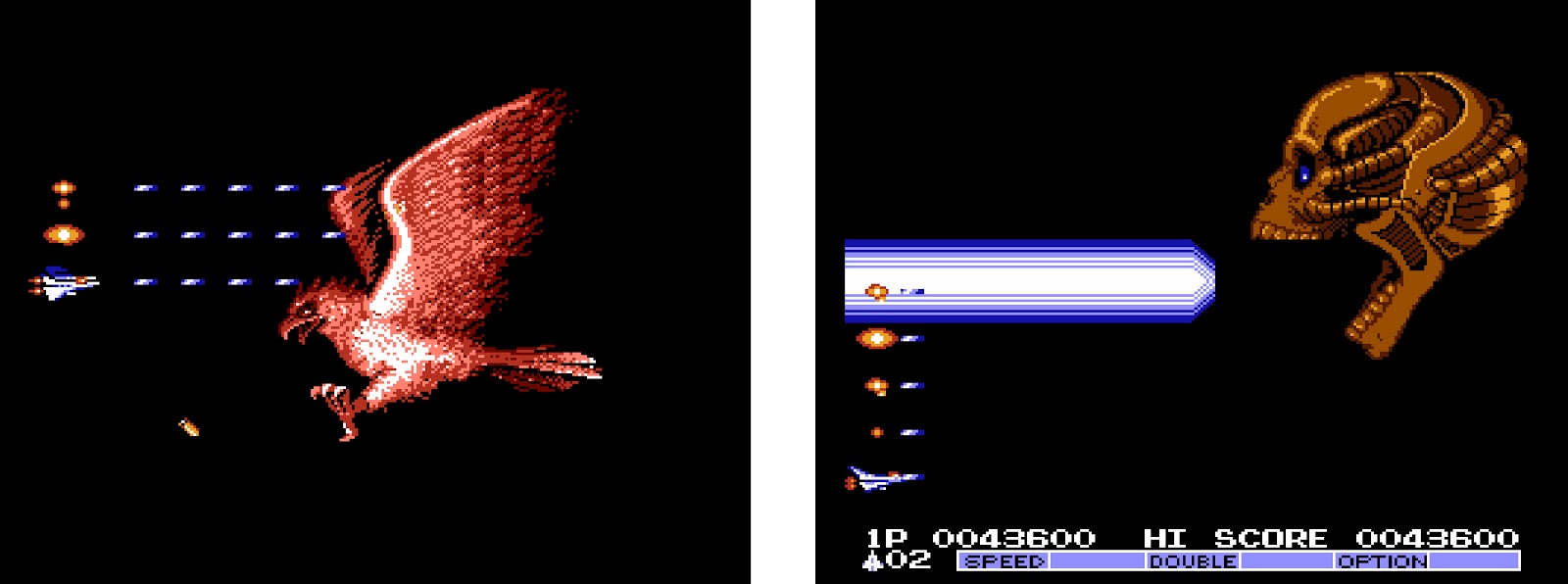
I don't recall playing the arcade version of Gradius II (titled Vulcan Venture in Europe) so I'm not able to see how it compares, but it is a good game in its own right.  Game play is much the same as Gradius so I won't go into any detail here.  The music and sound effects are great for the NES and there is even some speech when selecting a power up.  The graphics are  impressive with some big sprites, but they can flicker quite badly when the action hots up.

Big, bold graphics are the order of the day.

The main difference you'll notice when starting the game is that you now have a choice of power up meters.  The original is there along with three others featuring different weapon configurations.  All four meters contain the 'speed up', 'option' and 'force field' choices.  Additionally, when playing the game you can now have a full compliment of four 'options' rather than the two you were limited to on the NES version of Gradius.  If you select 'option' again when you have all four they start rotating around your ship.

Your choice of power up meters.  I stick with the classic one.

My main criticism of the original game was the harsh difficulty level.  Here at has been turned up several notches and for me it's a struggle just to get past the first stage.  Despite much gnashing of teeth, Gradius II has enough going for it to get onto the blog.  I just need a lot more practice....


The bosses are quite impressive in this game.  I found the first level boss on the left harder to take down than the skull on the second level.


Sunday, 19 May 2013

Final Fantasy II - NES - 1988

A rebel ship carrying a Princess about to captured by an imperial vessel captained by a Dark Knight. Hmmm...
 
Much to my surprise I really enjoyed Final Fantasy so was looking forward to playing Final Fantasy II.  This is Final Fantasy II on the NES which was released only in Japan, not the Final Fantasy II released on the SNES which in reality is Final Fantasy IV.  The original Final Fantasy II later became available in the West with subsequent remakes on newer consoles and smart phones.

Anyhow, Final Fantasy II is set in a different world to the previous game and has a new set of protagonists.  As I can't understand a word of Japanese I installed a translation patch by Neo Demiforce and am utilising the Final Fantasy Origins manual.  

You start the game by naming your party of four friends but don't get to choose their character class.  In Final Fantasy Origins they are already given names which I decided to use.  Firion was adopted as a child by Leon and Maria's parents and grew up as part of their family.  Leon is Firion's adopted brother and best friend.  Maria is Leon's sister.  Finally, Gus is not given a background but the manual says he possesses great strength is able to communicate with small hairy critters (beavers as it turned out).

These svelte individuals are a far cry from the chubby sprites.

The story so far is that the Emporer of Paramekia has summoned fiends from another dimension in bid to take over the world.  A rebel force was formed in the kingdom of Phin but in the ensuing battle the kingdom was lost.  The rebel force retreated to the town of Altea but the four protagonists were left orphaned and homeless.

The games kicks off with a similar looking battle screen to Final Fantasy where your characters are promptly defeated by a band of Dark Knights.  

Your first taste of the game is an unwinnable battle.

The party is found by Princess Hilda who takes three of them to Altea, but Leon has disappeared.  As you are too inexperienced, Princess Hilda won't let you join the rebellion but you are advised to head back towards Phin to search for Leon.

When you speak to NPCs they again give stock answers.  Occasionally key words are highlighted that can be memorised for use in conversations with other characters.  Completing quests changes the dialogue for major NPCs so it is good idea to revisit them. For the majority of quests NPCs are temporarily added to the fourth party slot.


On they way back to Phin random encounters rear their head again.  The battle system looks very similar to the first game but ranged weapons have been introduced and your party can be formed into two ranks.  Only party members in the front rank can successfully attack with melee weapons.  Characters at the rear are protected from physical attacks but can be harmed by ranged weapons and magic.  Combat is turn-based and if a party member targets a monster that is destroyed or flees then that attack is wasted.  I have all my party in the front row - I want them to get hit so they gain HP....

Character development has been completely overhauled and at this early stage I am confused as to which direction to take. Character classes have been done away with and attributes are increased depending on how each character behaves in combat. For example, if a character uses a lot of spells their Intelligence and maximum MP may increase. If they use physical attacks Power may increase.  If they keep taking a beating maximum HP may increase.  Characters can also become adept at using a particular type of weapon and they level up in weapon skills the more they use it.  Not having played this game before I'm unsure of the best way to go.  At the moment my plan is for Maria to focus on using a bow and magic, for Gus to concentrate on the axe he started with (I've since found he can dual wield so added a sword), and for Firion to become a bit of an all-rounder.  The flip side of all this is that attributes can also decrease which looks like developing a well rounded character quite difficult.  Intelligence decreases when Power increases.  Vitality decreases when Intelligence increases.  When Soul increases it depletes your Power.  Sod it, I'll make Firion a fighter too.

The stats screen from early on. Firion is not the sharpest tool in the box to begin with and can't afford to lose much intelligence.

Magic is another area that has been changed.  Each character is now given a pool of mana which depletes when casting a spell. Spells can again be bought in Magic Shops or can be found as treasure and any character is able to learn them.  As with weapon skills,  spells start at level 1 and increase in level the more you use them.  As spells reach higher levels they get more powerful, but use more mana when they are cast.

Back to the story - I found Phin was overrun with imperial forces but discovered Hilda's dying fiancé hidden in the basement of a pub.  He gave me a ring which he said will help me on my journey.  On returning to Altea with the news, I was allowed to join the rebels and then sent on my first mission to find some mithril.  I will not be writing a walk through (I can recommend Shen Nung's hugely entertaining Inconsolable blog for that)  but I will gather my thoughts and experiences below.....
                              
  • Despite the world map looking more open than the original Final Fantasy, you are still herded along the main quest path. Wander too far off the beaten track early on and you will encounter monsters than can take down a character with a single hit.
  • You can save the game as many times as you like outside of towns and dungeons, but you won't regain any mana and health without a shelter.  MP and HP can still be fully replenished by staying at an Inn.
  • In the first dungeon I found a FIRE spell and started encountering slimes that can't be hurt by normal weapons.  Further down I found an EXIT spell and immediately a powerful tortoise-like creature appeared. I lost half my party in the ensuing battle and had to use the spell to escape to the overworld.  Although I had already purchased both these spells, it's little things like this that shows the thought that has gone into the game progression.
  • I really like the story though some of it seems a bit forced in places in order to include all the plot points.  In the Snow Cave it mysteriously wouldn't let me use the EXIT spell to leave.  This was obviously scripted as when I got back to the entrance a boulder started rolling Indiana Jones style down the stairs and Josef, who was already dead, miraculously came back to life before sacrificing himself for the party.
  • Another point regarding the plot is you feel you are fighting the empire all alone.  Apart from the quest characters who temporarily join you, where are the rest of the rebel forces?
When you say 'we'.....                                                               Yeah, just as I thought!

  • Once I was getting used the the game I didn't mind the levelling system too much.  This changed when I entered Dist Cave and started encountering Gigases.  These not so jolly green giants are very resistant to both spells and weapons. I had to spend a lot of time grinding out SLEEP, SAFE and BLINK spells before I was able to defeat them on a regular basis.  Even then it took quite a few EXITs and returns to the nearest inn before I was able to fully explore the dungeon.
Bastards!

  • Another annoyance is that quest items can't be dropped or sold even though you no longer have use for them.  Items picked up early such as the ring and the ice sled have to be lugged around through the entire game taking up valuable space in your inventory.

I can see why the character progression system is divisive but I didn't mind it at first and got used to it quite quickly.  It became tiresome when I had to start prolonging random encounters and keep using the same spells over to level them up.  Thankfully levelling up weapons skills was easier.  In the end I developed Firion as a fighter and Gus as an unarmed ninja, both with useful spells to back up Maria who was the main spellcaster.  Having well developed characters was easier than I initially thought - even though certain stats can decrease, the net effect is an overall increase, although Firion ended the game as a simpleton.  I found the game much harder than Final Fantasy with more full party deaths - getting through the Empire's airship and Dist Cave during the game were particularly tough, as was Jade Passage/Pandemonium at the end.  

I must mention the bestiary here as the developers did away with most of the enemies from the previous game.  The few that have returned have different artwork. Lot's of other developers I can think of would re-use graphics and monsters when doing a sequel. The game world is a different story with a lot of the tiles carried over from the previous game, however the graphics still look good for the NES so I have no complaints there.  Most of the music in Final Fantasy II is quite pleasant and varied too - only the battle screen tune, which returned from the first game, really started to grate.  I found the plot thoroughly enjoyable, though there was a lot of back-tracking to pick up the next quest.  I have to admit that towards the end I was willing the game to be over as it was starting to get repetitive.  Nearly all the quests involve travelling to a dungeon, retrieving the quest item therein, and returning to Altea or Phin to find out where to go next. Random combats were also getting annoying and monotonous.  That said, Final Fantasy II is still a great game and was worth playing.  I'll be interested to see if Square can come up with something fresh for the third and final title on the NES.  Hopefully the quest and levelling system will be given a major overhaul or Final Fantasy III might not appear on this blog.


Other highlights (includes spoilers)....

I don't mind a game that doesn't take itself too seriously....


Getting eaten by a Leviathan was an excuse to add yet another 'dungeon'.  Obviously linear, at least you could only head toward the mouth....


After defeating the Emperor for the first time, celebrations were cut short when a messenger  announced the Dark Knight had taken his place.  As was hinted at earlier in the game, the Dark Knight was Leon.  As it turned out his reign was rather short....


The End.  The final round of combat against the Emporer and the ending scenes.  "Gwaaaahhhh!!" indeed....